
How Much Should We Save for Our Great-Great-Grandchildren?
The Puzzle of Saving for the Unborn

In 1928, the twenty-four-year-old Frank Ramsey (1903–1930) was asked a puzzle by his friend, the economist John Maynard Keynes. If you ran a whole country, how much of its yearly income should you save for the future instead of spending now? Ramsey turned this into a math problem.
Imagine your country as a giant bakery. The oven is capital — the tools, machines, and knowledge used to make things. Each day the oven bakes bread, which is output. You can eat the bread right away — that’s consumption. Or you can put some bread back into the oven to make it bigger, so it bakes even more bread tomorrow. That’s investment (or saving). If you save too little, future generations will have a tiny oven and go hungry. If you save too much, people today suffer. What is the fair balance?
Ramsey believed in Classical Utilitarianism, the idea that society should try to make the sum of everyone’s happiness, across all time, as large as possible. He built a simple model: there is only one good, no new inventions, and each generation is like a single person who cares about all the generations to come. His goal was to find the perfect path of consumption from now until forever.
Should Future Happiness Count Exactly as Much as Today’s?

Ramsey made a bold ethical claim: we should not discount future well-being. Discounting means treating something as less valuable just because it lies further in the future. Many people think a dollar today is worth more than a dollar next year. Ramsey said that is fine for money, but not for happiness. He wrote that discounting future joy is “ethically indefensible and arises merely from the weakness of the imagination.”
So he set up the problem: maximize the infinite, undiscounted sum of well-being over all time. But there was a technical nightmare. If the economy can grow forever, that infinite sum might not settle to a real number — it could blow up to infinity or bounce around unpredictably. That makes it impossible to compare one future plan with another.
Ramsey found a clever fix. He assumed there is an upper limit to how happy anyone can be, which he called Bliss. Then he measured success not by the infinite sum of happiness, but by how small the total gap between actual happiness and Bliss is over time. This re-normalized goal avoided the infinity problem.
Later thinkers discovered a deeper trouble. The economist Tjalling Koopmans (1910–1985) and the philosopher Peter Diamond (born 1940) proved something surprising. If you want an ethical rule for ranking endless streams of well-being, and you insist on two very reasonable features — continuity (small changes in the future shouldn’t flip your judgment wildly) and monotonicity (if one stream gives everyone at least as much and some people more, it must be better) — then you cannot treat every generation perfectly equally. You are forced to discount the future at some positive rate. In other words, equal treatment of all generations clashes with logic itself unless you abandon one of those mild-looking requirements.
Because of this, even Ramsey himself, later in his 1928 paper, studied a version where future happiness is discounted by a constant tiny percentage each year. That version is now the starting point for almost all economic models that weigh present costs against future benefits, including climate change.
The Ramsey Rule: A Formula for Fair Saving

How should a fair-minded planner choose how much to save? Ramsey’s key insight is that you balance two forces. If you spend a little less today and invest the savings, the economy grows and future people can consume more. The planner must stop adjusting consumption when the happiness gained from spending one extra dollar today exactly equals the extra happiness future people will get from that dollar after it has grown.
This balance leads to the famous Ramsey Rule. In symbols, δ + σ × g = FK. Here, δ is the pure time discount rate (how much you devalue future well-being), σ (sigma) is the elasticity of marginal well-being (how sharply the extra happiness from another dollar drops as you get richer — a measure of how much you dislike inequality), g is the growth rate of consumption, and FK is the rate of return on capital (how much extra output you get from saving).
In everyday words: the reward you need to postpone a treat must equal the fruit the treat-seed would bear. The rule tells you how fast consumption should grow, but not the starting level. To find the right starting savings rate, you need an extra condition — the transversality condition — that stops you from saving so much that the value of future capital becomes absurdly large. It weeds out plans that pile up capital forever without ever enjoying it.
In a very simple world where each bit of capital always returns a fixed percentage μ (say, 5% per year), the optimum saving rate falls out neatly:
s* = (μ – δ) / (σ × μ)
The numbers change dramatically depending on your ethical choices of δ and σ.
How Philosophers and Economists Fought Over the Numbers

The debate over climate change brought this arithmetic to life. Three economists used Ramsey-style reasoning with different ethical parameters:
- William Cline (born 1941) set σ = 1.5 and δ = 0 (no pure time discount). His optimum saving rate shot to 67% of national income, with consumption growing at 3.3% per year.
- William Nordhaus (born 1941) chose σ = 1 and δ = 0.03 (3% per year). He got a saving rate of 40% and 2% growth.
- Nicholas Stern (born 1946) selected σ = 1 and a tiny δ = 0.001 (0.1% per year). His math produced a staggering 98% saving rate and 4.9% growth — meaning almost every bit of output should be reinvested, no matter how poor today’s generation is.
These differences are not just number games. In climate policy, Nordhaus recommended moderate emissions cuts; Stern argued for immediate, drastic action, as if the world should pour nearly everything it produces into avoiding future harm. The entire disagreement swings on that tiny parameter δ. A 3% discount rate makes a unit of happiness a century away worth less than 5% of a unit today, so future damage seems far less urgent. A rate of 0.1% treats the well-being of a child born in 2200 almost as equal to ours. The inequality-aversion parameter σ matters too: if you worry a lot about fairness, you might want to save more — unless future people are already going to be richer, in which case maybe you should save less. The fight remains wide open.
Why It Still Matters: Your Piggy Bank and the Planet
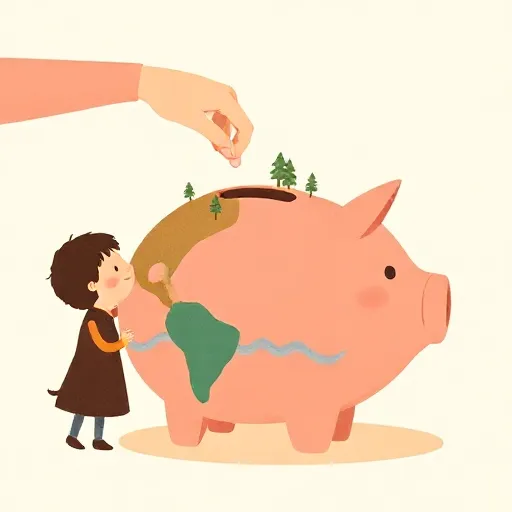
Ramsey’s puzzle is not just for presidents and central bankers. When you decide whether to spend all your allowance or save some for a bigger goal, you are making a trade-off between present you and future you. At the scale of the whole planet, we face the same question: should we burn cheap fossil fuels today, or invest heavily in clean energy so that people in 2100 breathe cleaner air and avoid rising seas? The same equations, the same ethical tensions, and the same arguments appear.
Koopmans showed that no perfectly equal, purely logical recipe is possible. The fight over discount rates forces philosophers, economists, and politicians to be honest about what they really value. Next time you hold a coin and wonder whether to spend or save, remember: you are rehearsing the very same puzzle that might determine the fate of the Earth.
Think about it
- If you could put money in a bank that pays 5% interest forever, would you rather spend ten dollars now or leave it to grow for your great-great-grandchild? What if you knew that child would be much richer than you?
- Suppose a new technology could prevent a disaster 200 years away, but building it would mean everyone alive today has to cut their living standards by half. Should we do it? Who gets to decide?
- Could you design a fair rule for an infinite series of people who do not even exist yet — and prove that your rule is the only right one?