
Are Particles Really Particles? The Strange Quantum Field Puzzle
A Bang in the Tunnel: What Are We Smashing?
Deep under the Swiss-French border, the Large Hadron Collider fires protons at almost the speed of light and smashes them together. Cameras record bright arcs and spirals — the “tracks” of particles. It is easy to picture those protons as tiny solid balls, like billiard cues cracking into each other. But physics has been telling us for decades that this picture is wrong. The best theory we have — quantum field theory (QFT) — says the world is not made of tiny things at all. It is made of invisible fields that stretch through the entire universe. What we call a “particle” is just a ripple in one of those fields.
Why should you care? Because everything in you — every electron, every quark — is a ripple, not a miniature Lego block. And once you start asking what ripples really are, you land in a knotty philosophical puzzle that is still not settled. This article walks you through that puzzle.
From Fields to “Particles”: The Quantum Magic
In classical physics, a field is something that assigns a number or an arrow to every point in space. Think of the temperature in your room: you can measure a temperature value at each spot, and those values make up a temperature field. The electromagnetic field works similarly — it has a strength and direction everywhere.
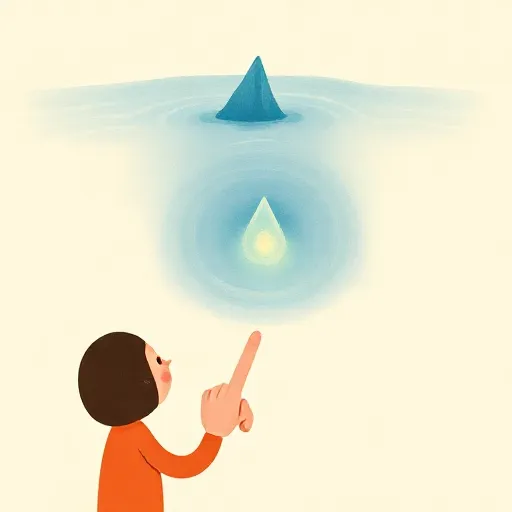
Quantum field theory changes the rules. It turns a classical field into an operator-valued quantum field. Instead of giving you a definite number at each point, the field gives you an operator — a mathematical tool that can create or destroy a ripple of energy. When a ripple appears, we say a particle has been created; when a ripple vanishes, a particle has been destroyed. The operators are called creation and annihilation operators. You can think of them as tiny “ripple-makers” and “ripple-erasers.”
The physicist Paul Dirac (1902–1984) and others built the first successful QFT — quantum electrodynamics — to describe light and electrons. It predicted that the vacuum, completely empty space, is not still. Instead, the field operators constantly hum, making virtual particles pop into and out of existence. That hum is real; scientists have measured its effects. So the “nothingness” between stars is actually a busy symphony of field excitations.
The Vanishing Particles: Why You Can’t Count Them

If particles are just field wiggles, how many are there? You might think you can count them like counting apples. But QFT shows that the number of particles depends on who is looking.
One famous example is the Unruh effect, discovered by physicist William Unruh in 1976. Imagine one observer drifting at a constant speed through empty space, seeing a cold vacuum with zero particles. Another observer accelerates — fires rockets to speed up — and passes through exactly the same patch of space. That accelerating observer will detect a warm bath of particles. The very existence of particles seems to change with the observer’s motion. There is no single “correct” particle count.
A second blow comes from Haag’s theorem. It says that whenever particles interact — when they smash into each other — the mathematics forces us into a description that cannot treat them as countable, independent things. You can still calculate what scattering events look like, but you cannot say “there are exactly three electrons before the collision.” The idea of fixed, countable objects breaks.
Philosophers like Laura Ruetsche and Doreen Fraser have argued that these results show the particle interpretation of QFT is in serious trouble. If something is only sometimes a particle, or its count is not objective, can it really be the fundamental building block of reality?
Nowhere and Everywhere: The Localization Nightmare

There is another core trait we expect from a particle: it should be somewhere. Even if a particle is fuzzy, you should be able to say “it is inside this region and not anywhere else right now.” In 1996, the philosopher David Malament proved a no-go theorem that shatters that hope for relativistic quantum theory.
Malament assumed a few reasonable requirements: the theory must obey Einstein’s special relativity (no faster-than-light signals), and if a particle is in one spot, it can’t simultaneously be in a completely separate spot. He then proved mathematically that if those conditions hold, a particle can never be detected in any bounded region — no matter how large. The predicted probability of finding it anywhere finite is exactly zero. The particle’s existence smears out everywhere at once.
This does not just make particles fuzzy. It means that if you demand particles that are ever confined to a finite volume, you will contradict yourself. Several philosophers, like Gordon Fleming and Jeremy Butterfield, have explored ways to soften Malament’s conclusion with new notions of “unsharp” localization, but the core result remains a heavy weight against the idea of particles.
Faced with these puzzles, many physicists and philosophers prefer a field interpretation: the fundamental stuff is the field itself, which is everywhere by definition, not a collection of tiny objects. The fields are what truly exist; particles are just temporary patterns in them.
Are We Just Music? What It All Means

If particles aren’t the ultimate reality, and fields are the basic stuff, we still face a difficulty: the quantum fields of QFT are operator-valued, not the familiar classical fields with definite strengths everywhere. To get a definite value — for example, to say “the electron field has this strength here” — you need to combine the field with a quantum state, which gives probabilities. So the field itself is not a straightforward physical object like a jelly; it is a kind of mathematical promise of what you might measure.
Because of this, some philosophers have turned to even stranger ontologies. Ontic structural realism says that the most fundamental reality is not objects at all, but structures and symmetries — the mathematical shape of the laws. Others, like Meinard Kuhlmann, propose a trope ontology, where the basic ingredients are individual property-instances (like a specific charge or spin) that bundle together to form what we call an object. In these views, neither particles nor fields are the final word.
Why does any of this matter for you? Because you are made of quarks and electrons, which are excitations of quantum fields. When you touch something, you are not bumping tiny nuggets together; you are bringing two field ripples close. The whole universe is a web of fields humming with excitations — and you are one of its most intricate patterns. The question of what is “really real” is not just for physicists in tunnels; it is the question of what you are. And that question is still wide open.
Think about it
- If an accelerating astronaut sees particles where a stationary friend sees empty space, who is right about what really exists there?
- Can something be a real thing if you can never pin down its location, even a little bit?
- If you are made of vibrating fields, are you more like a water wave or a solid Lego castle — and does that change how you think about yourself?