The Man Who Pretended to Be a Saint to Talk About the Unknowable
A Forgery That Fooled Everyone

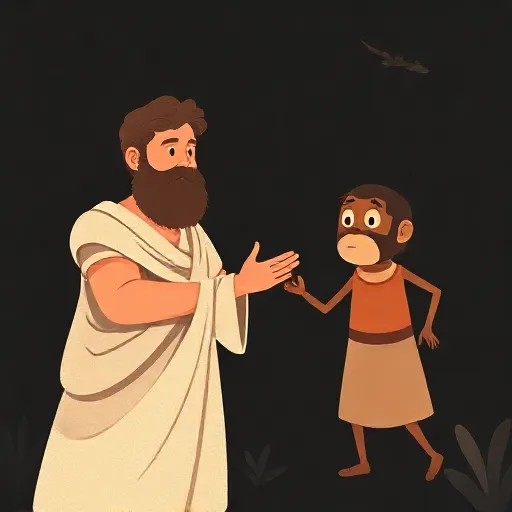
In 1457, an Italian scholar named Lorenzo Valla sat up late, reading a set of ancient writings that everyone believed came from a friend of St. Paul. The author called himself Dionysius the Areopagite, a man mentioned in the Bible who had met Paul in Athens. Valla noticed something strange. The style, the ideas, the words — they all belonged to a much later time. He told the world that the writings were a fake.
Today we call the author Pseudo‑Dionysius (“pseudo” means false). He lived somewhere between 485 and 528 C.E., not in the first century. He probably studied under the great pagan philosopher Proclus (d. 485 C.E.) in Athens and learned both deep Platonism and Christian teaching. By writing as if he were an ancient saint, he gave his ideas an authority that lasted over a thousand years.
For the people of his time, using an older name was not exactly lying. It was a way of saying, “I am passing on a tradition, not inventing something brand new.” Pseudo‑Dionysius wanted to show that Christian wisdom and the best pagan philosophy were not enemies. He hid himself so that his big, unsettling question could take center stage: What can you say about a God who is beyond everything we know?
Why Words Fail God

Pseudo‑Dionysius loved language, but he also thought words break in our mouths when we try to use them for God. He gave two big names to two ways of speaking. Kataphatic theology (from a Greek word for “affirmation”) piles up positive names: God is good, God is life, God is light. But those names can trick you into thinking you have captured God. So apophatic theology (from a word for “negation”) says: God is not good — not in the way a meal or a person is good. God is not even “being” the way anything else exists.
To mark this, Dionysius added the prefix hyper- (Greek for “over”) or pre- to his divine names. God is “over‑good,” “over‑being,” “over‑life.” That little prefix warns you that the word is being stretched past its breaking point.
Dionysius also loved shocking images. He called them dissimilar similarities. The Bible says, “the Lord awoke, like a strong man, powerful but reeling with wine.” If you take it literally, God gets drunk — that’s ridiculous. But the outrageous picture forces you to hunt for a deeper meaning. Dionysius said a worm might be a better symbol for God than “golden” or “bright,” because a worm startles you out of the lazy idea that you already understand.
He also used the image of a mixing bowl, taken from Plato, to talk about how God pours out being into the world. Every symbol, whether from the Bible or from Plato, was like a mirror that needed to be looked through, not looked at.
The Ladder of Light: Angels and Church
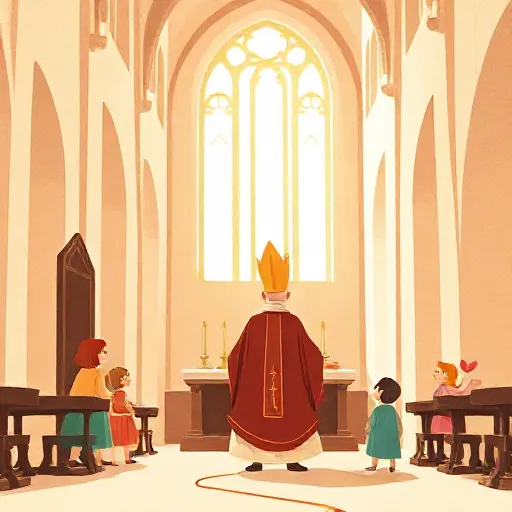
Most of us cannot stare straight at invisible truths. We need help from things we can see and touch. Pseudo‑Dionysius described a great hierarchy of beings that carries divine light downward step by step.
At the top, nine choirs of angels — seraphim, cherubim, thrones, and so on — receive pure knowledge. Below them, the earthly church mirrors that order: bishops (whom he called hierarchs), priests, deacons, monks, and then the regular people. Each rank has a job. Deacons purify newcomers with basic teaching. Priests illuminate the faithful. The hierarch stands at the altar, facing away from the noisy crowd, and brings back sacred objects — bread, wine, incense — that become windows into the divine for everyone else.
Dionysius also used a grand pattern from the Neoplatonists: everything comes from God, flows outward, and is drawn back in. He called it abiding, procession, and return. God stays utterly still, yet overflows with creative love into every creature, and that same love pulls all things home.
For him, the words of the Bible and the actions of the liturgy were not just lessons. They were a kind of theurgy — “god‑work” — where ordinary material things like water, oil, and bread carry hidden divine power. The world becomes a reservoir of signs, and even a shared meal can be a step up the ladder.
The Secret of Silence
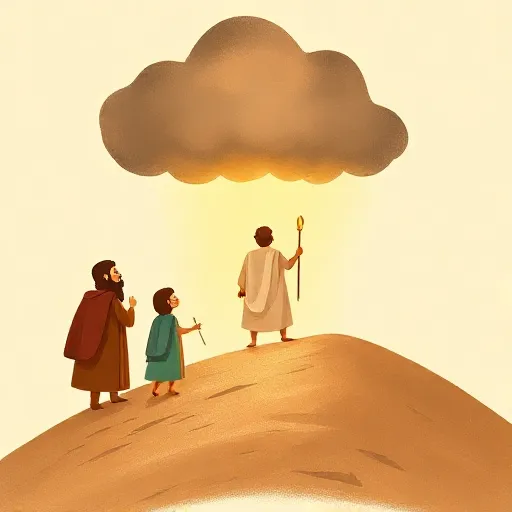
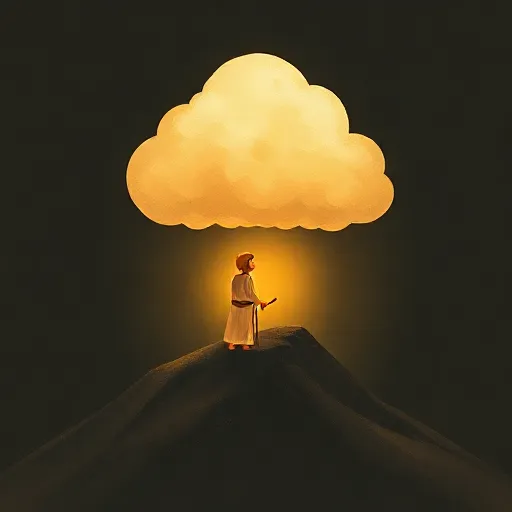
After all the names, after all the luminous images, Pseudo‑Dionysius takes one last, strange step. In his shortest work, On Mystical Theology, he tells the story of Moses climbing Mount Sinai. Moses passes through everything his senses can grasp. He passes through everything his mind can understand. Then, at the very peak, he enters a darkness — not an absence of light you can feel sorry about, but a brilliance so full it blinds every thought.
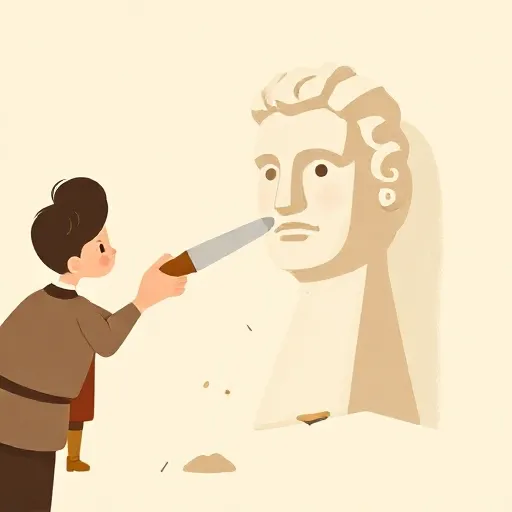
Dionysius calls this unknowing or agnosia. It is not ignorance. It is what happens when you let go of every picture, every word, even the word “God” itself. He compares it to sculpting: a sculptor does not add clay; she chisels away everything that is not the figure. Negative theology chips off each name until only the mystery remains.
The goal, he writes, is a union with the indescribable. He never tells us exactly what that union feels like. He just points to silence. For the first time in history, theology became explicitly mystical, which simply means “hidden.” The deepest knowing, he suggests, is like being inside a quiet so complete that you and the truth are no longer separate.
Why a Fake Apostle Still Matters

Pseudo‑Dionysius was not orthodox in every detail, and his hidden identity made later thinkers nervous. But his ideas took root everywhere. They shaped the architecture of Gothic cathedrals, where light streaming through colored glass was felt as a ladder of divine beauty. They influenced mystics like Meister Eckhart and the author of The Cloud of Unknowing. Even the philosopher Jacques Derrida, working on the limits of language, found a strange partner in this ancient forger.
Why should you care? Because we all run into the edge of words. When you try to describe why a piece of music gives you goosebumps, or tell someone exactly what you love about a friend, language can feel like a bucket with a hole. Pseudo‑Dionysius did not solve that problem — he mapped it. He showed that a community, a ritual, a startling image, or even a shared silence can carry meaning that sentences cannot hold.
So the next time you find yourself speechless in front of something huge — a night sky, a perfect chord, a good‑bye you do not want to say — you are standing in his tradition. He would tell you not to panic. He would tell you that silence, too, is a kind of knowing.
Think about it
- Is it easier to say what something is not than to say what it is? Could you describe your best friend only by listing what they are not?
- If you found out that a book you loved was written by someone pretending to be a different, older person, would that change how you read it? Why or why not?
- When have you understood something better by staying silent than by talking about it?