
Can an Endless Staircase of Numbers Prove Math Is Safe?
A Castle Made of Numbers

In 1900, the mathematician David Hilbert (1862–1943) made a bold promise. He believed that all of mathematics could be built like a fortress — starting from a few simple, clear axioms, the unshakeable truths, and then using pure logic to build up every theorem without fear. Most of all, he wanted to prove that math would never contain a contradiction — a statement that is both true and false at the same time, like a brick that is both a brick and empty air. That guarantee is called consistency.
His plan was a new kind of detective work: treat each proof as an object, a chain of symbols, and study it. He called this proof theory. If you could look at a proof from the outside, like a scientist examining a tool, maybe you could show that no proof could ever end with “0 = 1.” That would mean the whole fortress was safe.
But right away, Hilbert saw a problem. The proofs mathematicians actually use rely on ideal elements — things like infinite sets or the concept of “all numbers” that we never finish writing down. These are powerful, but they feel suspiciously like make‑believe. So Hilbert proposed a two‑part strategy: keep the safe, concrete part of math (like adding up apples) in the finitist corner, and then show that even when you add the risky, infinite‑looking bits, no contradiction can slip in. If that worked, you could use the wildest ideas without fear.
The Boy Who Found a Crack

Just when Hilbert’s program seemed on track, a young Austrian logician named Kurt Gödel (1906–1978) dropped a bombshell in 1931. He showed that in any formal system of math strong enough to talk about adding and multiplying numbers, you could write a sentence that says, in effect, “I am not provable in this system.” If the system proved that sentence true, it would be proving a falsehood — because the sentence itself says it can’t be proved. But if it can’t prove the sentence, then the sentence is actually true. Awkward.
This is the first incompleteness theorem: no consistent system that includes basic arithmetic can capture all truths about numbers. There will always be true statements it cannot prove.
Then came another blow, the second incompleteness theorem. It showed that such a system cannot prove its own consistency. If a system proved “I am consistent,” you could twist that into a proof that the truth‑telling but unprovable sentence is fake, leading to a contradiction. So the system can’t even trust itself on the one thing Hilbert wanted most.
Some mathematicians thought this meant game over. But Hilbert and his students, including a young man named Gerhard Gentzen (1909–1945), saw it differently. The incompleteness theorems said you can’t prove consistency from inside. But maybe you could prove it from a slightly different, “outside” perspective — using tools that the system itself didn’t have. That is where the real adventure began.
The Infinite Staircase
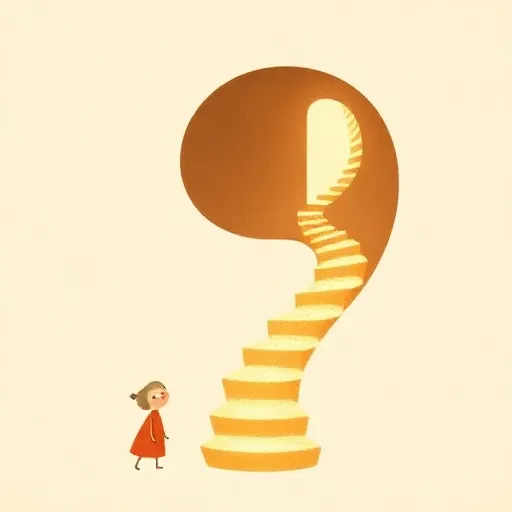
Gentzen’s idea was both simple and strange. Imagine someone claims they have a proof that arithmetic contains a contradiction. Gentzen showed you can take that alleged proof and transform it, step by step, into another proof of contradiction that is “simpler.” And then that one into an even simpler one, and so on. If this process could never go on forever, then the original proof cannot exist — because any chain of simplifications must eventually hit bottom. That bottom would be a proof that uses no cuts at all (no short‑circuit reasoning), and a cut‑free proof of a contradiction is impossible, like trying to build a house without any doors.
But how do you measure “simpler” so that you know the shrinking must stop? Gentzen used a new kind of number: ordinals. Ordinary numbers like 1, 2, 3 count finite things. Ordinals also let you count into the infinite. You can have an ordinal called ω (omega), which is bigger than every ordinary number, but then you can go further: ω+1, ω+2, … and eventually ω+ω = ω·2, and then ω·3, and eventually ω·ω = ω², and then ω³, and on and on. The particular ordinal Gentzen needed is called ε₀ (epsilon nought) — it is the first ordinal that solves the equation ω^α = α, a sort of fixed point of the omega‑powers.
He assigned ordinals to proofs in such a way that every step in his simplification slashed the ordinal. And ordinals have a crucial property: they are well‑founded — you cannot have an infinite sequence of ordinals that keeps getting smaller forever. So if each move makes the ordinal drop, the process must end. Therefore, the original proof of contradiction couldn’t have existed. Arithmetic is consistent.
Why Counting Past Forever Matters

Gentzen didn’t use the infinite in a sneaky way. His reasoning itself was finitist — he used only ordinary, step‑by‑step computations, except for one extra idea: the principle that ε₀ is well‑founded, that there is no infinite descending sequence of ordinals below ε₀. This principle goes beyond what arithmetic can prove about itself, but it feels safe and concrete, almost like a super‑charged version of “if you keep going down a staircase, you’ll reach the ground floor.”
This gave a precise measure of how strong arithmetic really is. The proof‑theoretic ordinal of ordinary arithmetic (called Peano arithmetic or PA) is ε₀. In fact, you can show that any formula about simple number facts (like “there is no largest twin prime”) that PA proves already has a finitist‑friendly truth guaranteed by that ordinal. So if you accept that ε₀ is well‑founded, you can trust all of arithmetic’s findings about concrete numbers. The risky, infinite‑looking parts are “paid for” by that one big ordinal step.
After Gentzen, proof theorists set out to measure stronger theories — the kinds that talk about sets of numbers or even all real numbers. They found ordinals far beyond ε₀, with names like Γ₀, the Bachmann‑Howard ordinal, and even mind‑bending ones like the ordinal of “Π¹₁‑comprehension.” Each time, the ordinal acts like a height marker: climb to that ordinal, and you can see that the theory is consistent. This turned proof theory into a kind of ordinal analysis, a quest to map the landscape of mathematical strength.
What This Means for You
You might never meet an ordinal in your math homework, but proof theory is all around you. When a computer checks a massive proof — like the one for the Four‑Color Theorem — it is using logic engines built on the same ideas Hilbert and Gentzen pioneered. Every time you wonder whether a computer program could have a hidden bug that makes it crash, you are asking a consistency question. Proof theorists design systems that can automatically “normalize” a proof into a clean, cut‑free form, making it easy to spot mistakes.
The search Hilbert started hasn’t ended. We still don’t know the ordinal for all of second‑order arithmetic (the theory that talks about sets of numbers). Some think that discovering it would give us a deep new understanding of infinity. Others use proof‑theoretic tools to mine information from proofs — extracting actual algorithms from arguments that only claimed that something exists. And philosophers still debate: what does it mean to accept an ordinal as “safe”? Where do we draw the line between reliable finitist thinking and bolder forms of reasoning?
Proof theory tells us that even the most abstract ideas can be measured, and that sometimes the key to keeping your feet on the ground is to build a staircase that reaches into the clouds. As Hilbert said, the goal is to describe “the activity of our understanding, to make a protocol of the rules according to which our thinking actually proceeds.” And that is a game that never gets old.
Think about it
- If a computer checked every step of a proof and said it was correct, would you still have any reason to doubt the result? Why or why not?
- Imagine you invent a new kind of number, like an ordinal, that no one has ever used before. How would you convince a friend that this number really exists and isn’t just a game with symbols?
- Gentzen needed an infinite staircase that never goes down forever. Could there be a proof that something is consistent without ever stepping outside the system? Or is that like trying to lift yourself off the ground by pulling your own shoelaces?