Why Is There Evil? Plutarch’s Battle of Good and Evil
A Student’s Question in Athens

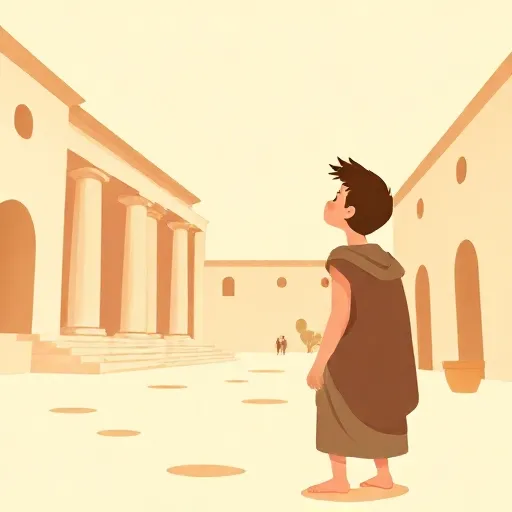
In the year 66 CE, a young man from the small Greek town of Chaeronea stepped off a boat in Athens. His name was Plutarch, and he was about twenty years old. He had come to study with a philosopher named Ammonius, who taught in a school that may have stood near the old Academy of Plato. Plutarch was a bright student, but he could not shake a troubling question: if a good God made the world, why is there so much suffering, chaos, and evil? This question would drive his entire life’s work.
Plutarch (c. 45–after 119 CE) never stopped being a questioner. After his student days he became a citizen of Athens, traveled to Rome and Alexandria, then returned home for good. He served as a priest of Apollo at Delphi, the famous sanctuary where Greeks sought oracles. He wrote more than two hundred works — dialogues, moral essays, and the Lives of famous Greeks and Romans — always defending the philosophy of Plato against the Stoics and Epicureans who he thought had distorted it. But at the heart of everything he wrote was that first, stubborn question about good and evil.
The Universe’s Eternal Wrestling Match

Plutarch’s answer begins with a surprising claim. The world is not the work of a single all‑powerful force. Instead, two principles have always existed side by side. One is God, which Plutarch also calls the One or the Monad — pure goodness, reason, and order. The other is the Indefinite Dyad, a sort of shapeless, restless, and endlessly divisible something that is the source of everything messy, irrational, and bad.
Think of an artist trying to sculpt a beautiful statue out of a lump of clay that keeps squirming and twisting on its own. The artist’s skill and vision represent God; the clay’s wild, stubborn motion is the Indefinite Dyad. Neither created the other — they have been pushing against each other forever. For Plutarch, this explained why the world is a mixture of harmony and conflict instead of a perfectly tidy place. He found hints of this idea in Plato’s Timaeus and in ancient Pythagorean teachings, and he believed it was the only way to rescue God’s goodness without blaming God for earthquakes, diseases, or human cruelty.
The World Soul: A Cosmic Tug‑of‑War

If two principles are always fighting, where exactly does the battle happen? Plutarch answered: inside a world soul. Before the cosmos began, he claimed, there was a mindless, irrational soul that made matter move in chaotic, disordered ways. This pre‑cosmic soul was the “tentacle” of the Indefinite Dyad. Then God acted. Without touching matter directly, God poured his own intelligence into that wild soul, like a calm teacher talking to a panicking crowd. The result was a partly rational world soul that could shape matter into fire, water, earth, and living beings.
But the non‑rational part never disappeared. Even after the world was formed, it kept snapping back — producing accidents, natural disasters, and moral wrongs. Every beautiful sunset and every destructive storm are, in Plutarch’s picture, ripples from the same cosmic tug‑of‑war. He thought this explained evil without making God either weak or cruel: God gives the world its goodness, while the Dyad’s leftover chaos is what makes things go wrong.
Your Inner Daimon and the Battle Within

Plutarch saw the same pattern inside every human being. Just as the world soul is a blend of divine reason and disorderly impulse, our souls are made of two ingredients: a rational intellect and a non‑rational part full of emotions and bodily desires. The intellect, he said, is not just a clever bit of the soul. It is a separate, higher thing — a “portion” of God, which he called our daimōn (a kind of inner guardian spirit). The task of life is to let the intellect rule, smoothing out wild feelings without destroying them entirely.
This is where Plutarch argued fiercely against the Stoics. They taught that true virtue means wiping out emotions completely. Plutarch thought that was a mistake. Emotions, he wrote, are like horses that need a bridle, not a slaughterhouse. You cannot have courage without a dose of fear to steer, or righteous anger without first feeling hurt. Real virtue is a mean between extremes: a state where reason and emotion work together like a well‑tuned lyre. He drew here on Aristotle as well as Plato, but he insisted this training of the soul was the only path to a genuinely good life. And it is possible, he argued, to make progress — nobody needs to be a perfect sage from the start.
How to Think Clearly: Skip the Opinions

If the world is a swirl of appearances and our emotions can trick us, how can we ever know anything for sure? Plutarch recommended a habit that sounds very modern: suspension of judgment (in Greek, epochē). Instead of jumping to a conclusion whenever something seems true, he urged people to pause and check. Our senses often mislead us — a stick looks bent in water, a dream feels real while it lasts — so forming firm opinions too quickly is risky. Suspending judgment, he argued, doesn’t stop you from acting. It just removes the false confidence that you already know the answer.
But Plutarch did not think we are trapped in ignorance. He believed all of us carry built‑in “notions” or Forms from the intelligible realm — the world of true being that lies beyond what we see and touch. When the intellect is calm and the soul is purified of arrogance, we can recollect this knowledge. He saw Socrates as the perfect example: through relentless questioning, Socrates helped others shake off their pretend‑knowledge and start searching together. The goal is not to win an argument, but to let the daimōn — the quiet, reasoning part of you — lead toward what is genuinely real.
Why Plutarch Still Matters

Plutarch’s big picture can feel strange: two eternal powers, a cosmic soul, an inner daimōn. But the questions he wrestled with are very much alive. We still wonder why bad things happen to good people. We still argue about whether it is healthier to control our emotions or let them run free. And we still need to decide when to trust our gut and when to pause and think. Plutarch did not pretend to have the final answer. He wrote his dialogues with voices arguing different sides, sometimes ending a work with a myth rather than a neat conclusion. What he offered was a way of living with those questions patiently and thoughtfully.
The next time you feel pulled between a calm choice and a hot rush of anger or fear, you are standing in Plutarch’s world. And when you decide to hold off on your opinion until you find better reasons — well, you are practicing exactly the kind of careful, honest search that he believed is the heart of philosophy.
Think about it
- If the world contains both order and disorder, can we always tell which is which? Could something that looks bad turn out to be a hidden piece of the good?
- Is it possible to be brave without ever feeling afraid, or does courage require a little fear to be real?
- When a strong feeling tells you “this is right,” how could you tell whether it is your daimōn — your clearest thinking — or just a loud emotion pretending to be wise?