Can Greek Wisdom and the Jewish Bible Go Together? Philo's Answer
A Scholar Caught Between Two Worlds
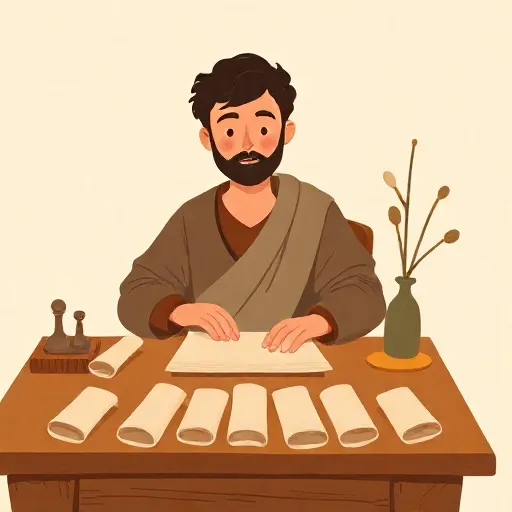
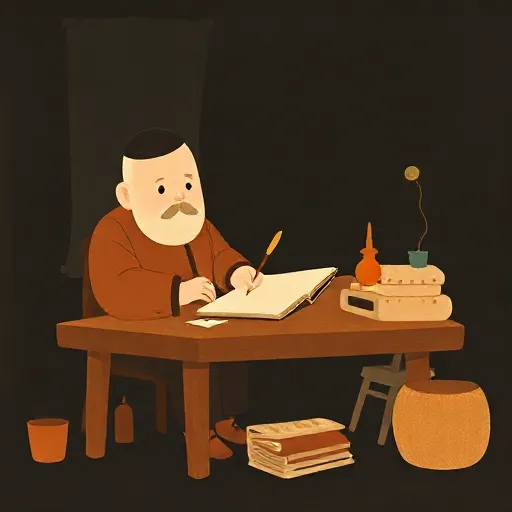
Philo once wrote: “There was a time when I had leisure for philosophy and for the contemplation of the universe and its contents … when my constant companions were divine themes and verities.” But he quickly added that violent envy soon plunged him “into the ocean of civil cares.”
He was not exaggerating. In the year 38 CE, the streets of Alexandria, Egypt, erupted in the first major pogrom against Jewish people. Mobs attacked, a ghetto was imposed, and Philo himself led an embassy to the mad emperor Caligula to beg for peace. The philosopher who longed to study the stars and the soul was dragged into deadly politics.
Philo (lived roughly 20 BCE–50 CE) was a pious Jew and a product of the finest Greek education, or paideia. He wrote in flowing classical Greek, quoted Homer from memory, and knew Plato’s Timaeus inside out. Yet he knew almost no Hebrew; he read the Bible in the Greek translation called the Septuagint, which he believed was exactly as holy as the original. His brother was the richest man in Alexandria, but his own nephew famously abandoned Judaism and later helped the Romans destroy the Jerusalem Temple. That family rift haunted Philo for life.
Standing between a proud Greek elite that despised Jews and an Egyptian population he considered idol‑worshippers, Philo forged a startling project: to show that the Bible did not contradict the best Greek philosophy — it fulfilled it. The question that animated his whole life was whether a faithful Jew could also be a real philosopher. His answer was a careful, daring yes.
The Secret Code of the Bible: Allegory

Philo’s main tool was allegory — reading a text as a code in which people, places, and events stand for deeper, hidden truths. When the book of Genesis says God took a rib from Adam to create Eve, Philo said a literal reading was “most improbable.” Instead, “ribs” were really the powers of Adam’s mind. Eve symbolized sensation, and the whole story taught that the soul can fall when it chooses pleasure over reason.
Philo did not invent allegory. Stoic philosophers used it to explain Homer’s myths, and there were already Jewish exegetes in Alexandria who interpreted the Bible like a philosophical puzzle. But Philo gave the method a new seriousness. He insisted that literal meanings still matter — you can’t ignore the actual commandments just because you enjoy the symbol. “They ought to have given careful attention to both aims,” he wrote, scolding those who tossed the literal away.
When Abraham entertains three mysterious visitors in Genesis, Philo compared the scene to a moment in the Odyssey where gods walk among humans in disguise. The point was not that Homer had stolen from Moses (an idea popular among earlier Jewish thinkers). Rather, Philo was showing that the same divine logic rippled through both traditions — though the Bible alone was the real thing.
Allegory was his “wise architect.” It let him turn every story into a lesson about the soul, virtue, and God. And it allowed him to claim that the founder of Israel was also, in a deep sense, the first true philosopher.
Borrowing, Bending, and Breaking Greek Philosophy
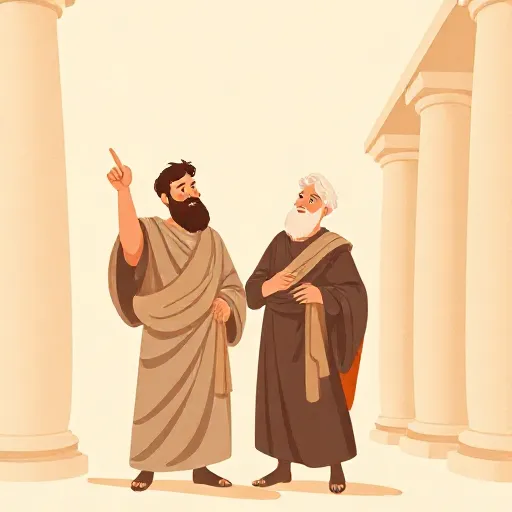
Philo never joined a philosophical school. If you had asked him, “Are you a Platonist or a Stoic?” he would have found the question odd — truth for him was in the Torah, not in human systems. But he used Greek philosophy the way a sculptor uses different chisels.
From the Stoics, he took a vocabulary of reason, law, and the cosmos. He freely used their term logos — the rational order that runs through everything. For a Stoic, logos is God, nature, and human reason all at once, a kind of divine fire inside the world. Philo quietly but firmly turned that inside out. He insisted that God himself is completely beyond the world, so far above us that no concept can capture him. The logos Philo talks about is not God; it is God’s shadow, his instrument, the first and greatest of his powers.
From the Platonists, he absorbed the idea that the physical world is only a copy of a perfect, invisible reality. The structure of his creation story in De opificio mundi echoes Plato’s Timaeus almost paragraph for paragraph. But again, Philo reworked the substance. In Plato, a divine craftsman looks at eternal Ideas and shapes the world from them. For Philo, God creates the Ideas themselves inside his own mind — they are his thoughts. The intelligible cosmos is the place of the Ideas located in the divine logos.
He was also deeply influenced by Skepticism. Philo knew the skeptical “tropes” — systematic arguments that prove human reason can never reach certainty. He used those arguments not to despair of truth but to humble human pride. If even our best education leaves us in the dark about the nature of the soul or the shape of heaven, then maybe we should stop pretending we can figure God out on our own. The skepticism blows away false confidence and makes room for revelation.
Philo rarely named his sources. He preferred the aura of older, venerated thinkers — Pythagoras, Heraclitus — to the Hellenistic philosophers he was actually arguing with every day. The effect was deliberate. He wanted to look like a man of tradition, not a trendy borrower.
God, the Logos, and the Unknowable Light

The God Philo described is so transcendent that we can say more about what he is not than what he is. This is negative theology: God is invisible, ineffable, inconceivable, and incomprehensible. Even Moses, who spoke to God face‑to‑face on Mount Sinai, never saw God’s essence. When Philo calls Moses a “hierophant” initiated into sacred mysteries, he means that the closest a human can get is to be drawn into a darkness where sight fails but presence remains.
But if God is utterly beyond the world, how can he create it, govern it, or care about it? Philo’s answer begins with the concept of dunamis, usually translated as powers. The powers are like the many arms God extends into creation without ever leaving his hiddenness. The two chief powers are the creative power (which Philo linked to the name Theos, God) and the royal or governing power (linked to Kyrios, Lord). In a famous image, he said that God is surrounded by his powers the way a king is surrounded by his bodyguards — they mediate the king’s action while protecting his mystery.
Holding all the powers together is the logos. Philo gave the logos an astonishing number of titles: it is God’s first‑born son, his image, the place of the Ideas, the instrument of creation, the high priest of the cosmos. The logos contains within itself the whole intelligible pattern according to which the sensible world was made.
Crucially, the logos is not a second god. It is the principle that makes it possible for a transcendent deity to touch a material world. That move allowed Philo to speak about God’s activity in the language of Greek metaphysics without ever collapsing the infinite distance between Creator and creature.
The Path to Virtue: Taming the Inner Beast

Philosophy for Philo was not a spectator sport. It was a way of training the soul. He accepted the standard Greek list of four cardinal virtues — prudence, temperance, courage, and justice — but he added specifically Jewish notes. Piety, he said, is the “queen of virtues.” Repentance, which the Stoics classified as a destructive passion, becomes for Philo a holy and healing turn of the heart.
He described the inner life as a battlefield. Like the Stoics, he named four main passions (pathē): desire, fear, sadness, and pleasure. But he quietly altered the Stoic scheme. Alongside the three “good passions” of joy, caution, and will, he added hope and repentance — two attitudes that only make sense if the future and the past are real, and if a personal God is guiding them.
Can a person ever become free of passion? Philo thought the goal was worth aiming for, but he was more realistic than the Stoics. He knew that even Abraham — the model of faith — was not expected to feel nothing when his wife Sarah died. Abraham avoided both hysterical grief and cold indifference; he chose metriopatheia, the moderate middle way. Philo was not demanding that humans become stone. He was asking them to stop letting their feelings steer the ship.
The deepest transformation Philo imagined was omoiōsis — becoming like God as far as a mortal can. The Stoics had an ideal called oikeiōsis, a natural kinship that draws every living thing toward its proper life. Philo took that word and gave it a sharp vertical twist. You are not born at home in nature; you have to emigrate out of your selfish instincts and into a life aligned with God. The patriarchs Abraham, Isaac, and Jacob each show a different path: Abraham migrated from idol‑worship to the knowledge of God, Isaac was a soul naturally at peace, and Jacob wrestled with his own desires.
Philo’s ethics, then, is one long journey from the noisy port of the body to the quiet harbor of divine reason. He never claimed the body was evil outright — God had created it beautiful — but he called it a “burden” and, in one blunt passage, ponēron fusei, bad by nature, because it pulls the soul downward. The trick was not to hate the body but to stop confusing its needs with your true self.
Why Philo Still Matters

Philo’s work was largely ignored by his fellow Jews. It was the early Christians who treasured him, copied his scrolls, and sometimes even mistook him for one of their own. His ideas about the logos as God’s firstborn son would echo for centuries in debates about the Trinity. His method of allegory became the default way to read Scripture in Alexandria for generations.
But his deepest legacy is simpler. He bequeathed a working model of how a person can hold two powerful commitments — the critical, questioning habits of philosophy and the absolute loyalty of a religious believer — without letting either destroy the other. He didn’t smooth over the tensions. He lived inside them.
Next time you find yourself asking whether your science textbook and your family’s faith can be friends, or whether you have to choose between thinking and believing, you are stepping into the same ocean of civil cares Philo complained about. He would tell you that the effort to bring those worlds together is itself a kind of prayer.
Think about it
- If a religious story seems scientifically impossible, does reading it as a symbol take away its power — or make it more real?
- Can you have a personal relationship with a God who is completely unknowable, or is that a contradiction?
- Philo believed the highest life was one of quiet study, yet he risked his safety for his community. Which do you think matters more: thinking well or acting well — and can a person do only one?