How Do You Know You’re Not a Brain in a Vat?
The Brain in the Vat and the Veil of Perception

In 1641, René Descartes (1596–1650) sat in a warm room and asked an ice-cold question: could everything I see be a dream? He imagined an all-powerful demon feeding him perfect illusions — a sky, a chair, the pages of his own notebook — none of it real.
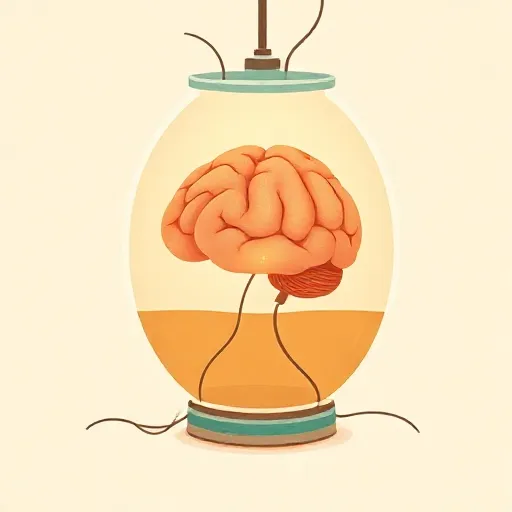
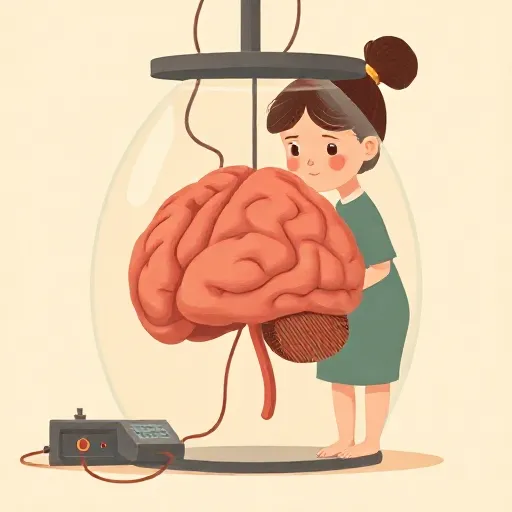
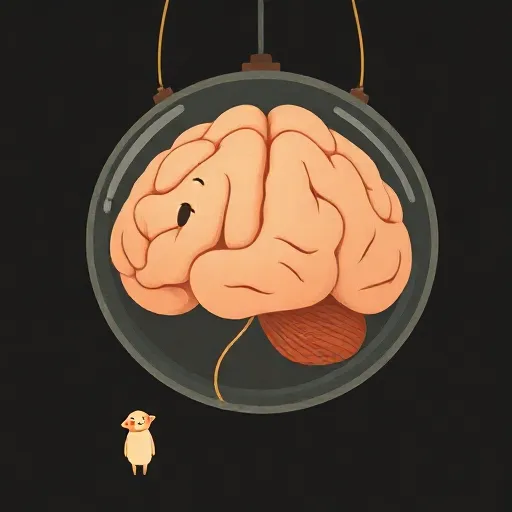
Modern philosophers give that demon a new name: the brain in a vat. Their thought experiment asks you to picture a bare brain floating in a jar of chemicals. Scientists have hooked it to a supercomputer that sends it exactly the same electrical signals your own brain gets now. To that brain, the world feels exactly the same. A sunset glows orange. A dog barks. Yet there is no sun, no dog — just electrical hum.
Both stories point to the same unsettling idea. You never touch the world directly. Your senses feed you perceptual appearances — images, sounds, smells — that your brain turns into beliefs about tables, trees, and other people. If those appearances can be faked perfectly, how do you know they aren’t? That large, troubling gap between you and reality is what philosophers call the veil of perception. And it leads straight to a skeptical steamroller: maybe none of your beliefs about the outside world are justified.
The Argument That Knocks Down Your Certainty

The skeptic’s reasoning can be laid out like a chain of three dominoes. If they all fall, your everyday confidence crashes with them.
First is the Indirectness Principle: nothing is directly present to your mind except perceptual appearances. You never hug a friend; you only experience the hugging-feeling, which might be a trick.
From this, many thinkers draw a second claim, the Metaevidential Principle: you are not justified in believing what your senses tell you unless you have a good reason to think your appearances are truthful. After all, if the only road to town is known to be full of mirages, you need a reason to trust what you “see” ahead.
Now the skeptic brings in the third piece, the No-Good-Reason Claim. Can you check whether your senses are reliable without using your senses? If you try to look for evidence — say, by reading a neuroscience textbook — you already assume your eyes and ears tell the truth. That makes the argument go in a circle. The skeptic says the circle is vicious: you cannot get a non-cheating reason. Therefore, you have no good reason to trust your appearances.
So the chain falls. Premise 1 (indirectness), plus Premise 2 (you need a reason), plus Premise 3 (you have none) leads relentlessly to Premise 4: you are not justified in your perceptual beliefs. If knowledge requires justification, you don’t know there’s a real world, either. This is the Problem of the External World — a puzzle about whether your mind can ever reach past its own front porch.
Metaphysical Solutions: Closing the Gap

One way to fight back is to attack the first domino. If the Indirectness Principle is wrong, the skeptic’s challenge might never get off the ground.
Direct realists like Thomas Reid (1710–1796) insisted that physical things — rocks, cats, your own desk — really are directly present to the mind, just as thoughts are. You don’t need a curtain of appearances between you and a tree; the tree itself is what you see, not some inner movie. This fits everyday common sense: you feel that you see the tree, not a picture of it.
A very different way to close the gap is idealism. George Berkeley (1685–1753) agreed that only mental things are directly in front of the mind, but he denied that tables and mountains are physical stuff outside the mind. For Berkeley, a table is a collection of sensations and ideas. There is no extra, hidden table behind the sensations. So the gap between appearance and reality disappears — but only because Berkeley redefines reality as mental.
Both strategies reject the Indirectness Principle, but the skeptic isn’t out of bullets yet. Even if you remove the first domino, the Metaevidential Principle still stands: do you still need a good reason to trust your experiences? Berkeley, for instance, would say dreaming and waking are different bundles of ideas, but to know which bundle you are in, you’d need evidence — and the skeptics’ circle appears again. Metaphysics alone, sober philosophers now admit, can’t fully solve an epistemological puzzle.
Epistemological Solutions: Do You Really Need a Bigger Argument?

If the veil-of-perception story feels right, maybe we should look directly at the epistemic dominoes. A family of views called modest foundationalism says the Metaevidential Principle is too harsh. The idea is simple: you are prima facie justified in believing what your senses seem to tell you, right away, without any background check.
James Pryor (b. 1968) and Michael Huemer (b. 1969) develop this in a view often called seemings internalism. If you have a perceptual experience as of a red apple, that experience itself gives you a good enough reason — a prima facie reason — to believe there’s a red apple in front of you. You don’t need to first prove your eyes are working or that you aren’t a brain in a vat. The experience is your evidence, and it counts until a stronger reason knocks it down (say, a friend tells you they’re wearing apple-shaped glasses that tint the world red).
This view spares you from having to solve the skeptic’s circle. But critic worry: is just seeming enough? What if you suddenly sprouted a brand-new sixth sense you’ve never had before? If you got an electroreceptive “buzz” that felt as if there were a fish behind you, the seemings rule would say you’re justified — but would you really be? And if wishful thinking makes your dad look angry when he isn’t, does the angry-looking experience still give you a real reason to believe he’s angry? The debate rages on.
Other thinkers go in a completely different direction. Process reliabilists like Alvin Goldman (b. 1938) reject the whole idea that you must hold some inner evidence. Instead, a belief is justified if it is produced by a reliable mental process — a process that usually leads to truth. If your vision system is generally accurate (and in normal conditions it is), your vision-based beliefs are justified, even if you are totally unaware of the reliability and have no “good reason” of the sort the skeptic demanded. You don’t even need conscious experiences at all: a zombie or a blindsight patient who forms accurate visual beliefs without any “what-it’s-like” feel could, on this view, still be justified. Many philosophers find that either totally liberating or faintly absurd.
The World in Your Head: Why It Still Matters

You probably don’t wake up worried that you are a brain in a vat. But the problem of the external world follows you anyway. Whenever you wonder whether a friend’s smile is real, or double-check a text because you half-suspect autocorrect fooled you, you’re doing a tiny piece of this philosophy. You ask: am I interpreting appearances correctly? Is there a second opinion I can check that doesn’t rely on the same possibly-misleading source?
Philosophers still disagree where the skeptic’s argument really breaks. Some insist on a world-involving solution: in the good case, when you see a real dog, the seeing itself puts you in contact with the world, and no hallucinator shares that same entitlement. Others think our best theories of knowledge must work even for perfectly deceived victims.
None of these answers resolves every doubt, and that is why the problem is so alive. The next time you feel sun on your face, you can smile at the sheer oddity that some of the smartest people in history have spent their lives arguing about whether that warmth is proof of anything at all — and whether you need proof to trust it.
Think about it
- If a scientist built a machine that made you feel, hear, and see a delicious pizza that wasn’t there, would you be silly to believe the pizza was real — or would your experience still make it reasonable?
- Imagine a friend who absolutely refuses to trust any of her senses until she gets a non-sensory proof that they work. Could she ever get started? What might you say to her?
- When virtual reality gets so good you can’t tell it from waking life, should courts treat “I thought I saw the crime happen” as strong evidence? Why or why not?