Is Believing in God the Smartest Bet You Can Make?
The Gambler Who Bet on Forever
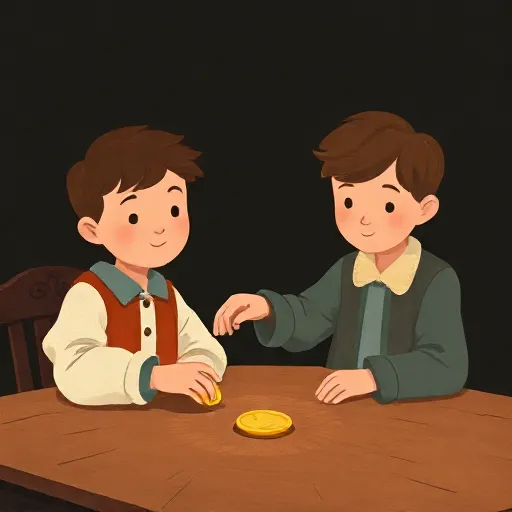
Paris, 1654. A gentleman in a velvet doublet leans over a gaming table, watching a coin spin. He is not just betting on heads or tails. He is thinking about the biggest gamble anyone could take: whether or not to believe in God. His name is Blaise Pascal (1623–1662), a mathematician, inventor, and one of the sharpest minds of his time. He had already helped invent the first mechanical calculator and laid the foundations of probability theory. Now he was turning his attention to a question that had troubled him deeply: if you can’t prove that God exists, should you still believe?
Pascal’s answer was unlike any that came before. He did not try to prove God’s existence with logic or evidence. Instead, he argued that believing in God is simply the smartest bet you can make. He treated religious belief as a decision problem, like choosing which side of a bet to take. He asked: what do you stand to gain, and what do you stand to lose?
This was a radical move. Before Pascal, thinkers like Anselm and Thomas Aquinas tried to demonstrate that God must exist. Pascal swept those proofs aside. He wrote, “We do not know if He is …” So, he said, we must wager. And he set out to show that the rational choice is to wager that God exists. This became known as Pascal’s Wager, one of the most famous arguments in the history of philosophy. It draws on what we now call decision theory — the study of how to make choices when the outcomes are uncertain.
A Decision Without Evidence: Superdominance
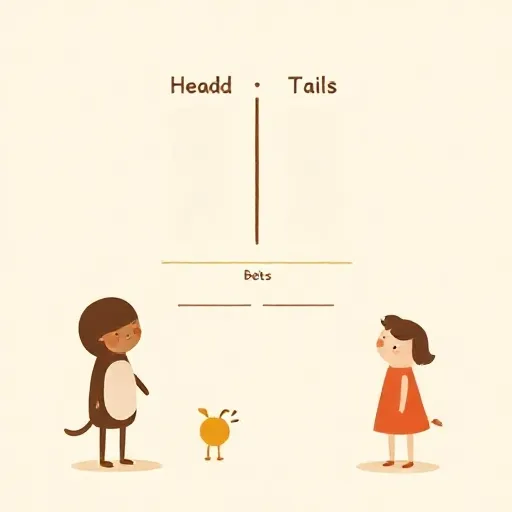
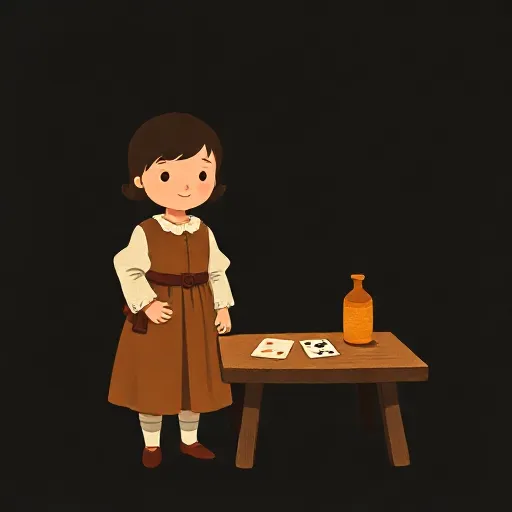
To understand Pascal’s first version of the wager, imagine a simple game. I flip a coin. You know nothing about the coin — it could be fair, two-headed, two-tailed, or weighted. You can bet on heads or tails. If you bet correctly, you win one dollar. But I offer a deal: if you bet on heads, I’ll throw in an extra dollar, no matter what. So if the coin lands heads, you get $2; if it lands tails, you get $1. If you bet on tails, you get $1 for tails and $0 for heads.
Now, look at the worst that can happen for each bet. Betting on heads, the worst outcome is $1 (if tails). Betting on tails, the worst outcome is $0 (if heads). The best possible for betting on heads ($2) is better than the best for betting on tails ($1). In every possible state of the world, betting on heads pays at least as much as betting on tails, and in one state it pays more. This is called superdominance: one option is never worse and, in at least one possible case, strictly better. Rationality, Pascal would say, requires you to choose the superdominant option. You don’t need to assign probabilities to heads or tails at all — the structure of the payoffs makes the choice clear.
Pascal applied this reasoning to belief in God. He set up a decision table:
- If God exists: wagering for God leads to infinite happiness; wagering against God leads to misery.
- If God does not exist: wagering for God leaves things as they are (the status quo); wagering against God also leaves things as they are.
So wagering for God superdominates wagering against God: the worst outcome for wagering for God is no worse than the best outcome for wagering against God, and in the case where God exists, wagering for God is much, much better. Therefore, Pascal concluded, you should wager for God.
But there’s a catch. For superdominance to work, you must think that God’s existence is at least possible — that is, you can’t be absolutely certain God doesn’t exist. If you assign probability zero to God’s existence, then you might treat that row of the table as not counting. Pascal anticipated this and later made sure to address it. But first, he tried a different angle, using probabilities.
When the Reward Is Infinite: Pascal’s Real Wager

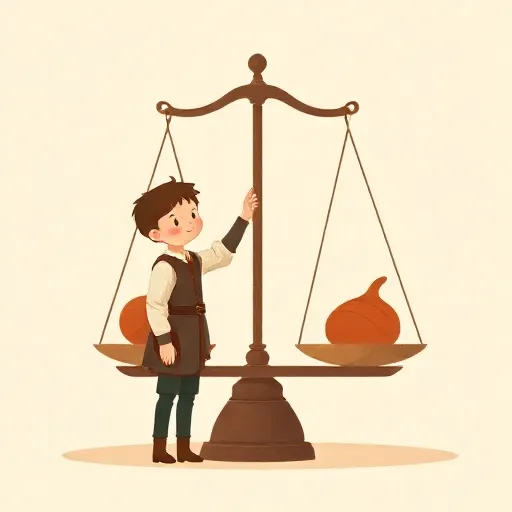
Pascal then shifted gears. Suppose you assign a probability to God’s existence — maybe 1/2, or maybe much smaller. What should you do? Here he appealed to expected utility, a core idea in decision theory. The expected utility of an action is calculated by multiplying the payoff in each possible state by the probability of that state, and then adding them up. A rational agent, according to this view, chooses the action with the highest expected utility.
Pascal imagined a game where you stake your life. If God exists, the reward for wagering for God is “an eternity of life and happiness” — infinite utility. Let’s write that as ∞. If God does not exist, the outcome is finite, some ordinary earthly life. Wagering against God yields finite outcomes either way.
Now, whatever positive, finite probability p you assign to God’s existence, the expected utility of wagering for God is: ∞ × p + (finite) × (1 – p) = ∞. That’s because any positive number times infinity is still infinity.
On the other hand, the expected utility of wagering against God is finite. So the expected utility of wagering for God is infinite, while the alternative is finite. Therefore, rationality demands that you wager for God.
This is the core of Pascal’s Wager. It doesn’t require you to be certain God exists, or even that it’s likely. It only requires that you think it’s possible — that you give it some nonzero chance. As Pascal put it, “our proposition is of infinite force.” Even if the odds against God were enormous, the infinite reward swamps any finite cost.
But Which God? And Other Problems
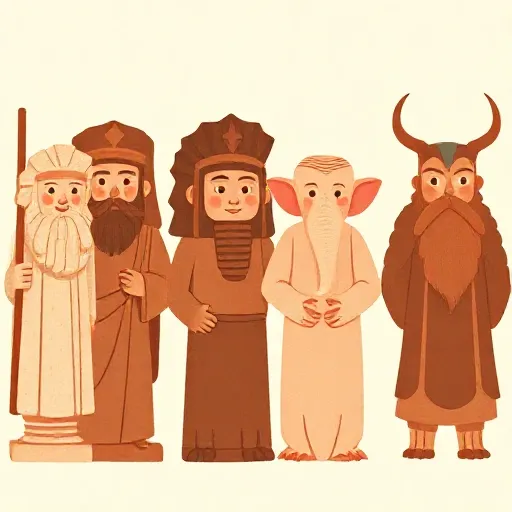
Almost immediately, critics spotted cracks in Pascal’s argument. One of the most famous objections is the many Gods objection. Pascal assumed a particular Christian God. But why not some other deity? An angry god might punish those who worship the wrong one, or reward only those who follow a different religion. As Diderot (1746) puts the point: “An Imam could reason just as well this way”. If reason alone cannot decide which god exists, then you face a multitude of possible bets, each promising infinite reward for different actions. How do you choose?
Some defenders of Pascal reply that not all gods are equally probable. They argue that a perfect, all-good God is simpler or more plausible than a chaotic or cruel deity. Others say Pascal was addressing people in 17th-century Paris, where the live options were Catholicism and atheism. But the problem doesn’t easily go away.
Another objection attacks the very idea of infinite utility. Can a finite human mind even experience infinite happiness? Some philosophers say infinity is a mathematical ideal, not something you can actually receive. If the reward is only very large but finite, then a high enough cost or a tiny enough probability might make it irrational to bet.
Then there’s the problem of zero probability. A strict atheist might assign probability 0 to God’s existence — not just “very small,” but exactly zero. If God is logically impossible, like a square circle, then any probability above zero is mistaken. In that case, the infinite reward times zero is zero (under standard arithmetic), and the wager loses its force. Pascal’s argument only works if you leave the door open even a crack.
A subtler challenge comes from mixed strategies. What if instead of betting outright on God, you flip a coin? If heads, you wager for God; if tails, you wager against God. Since there’s a positive probability you’ll end up wagering for God, your expected utility is infinite as well. In fact, almost any action you take — having a sandwich, going for a walk — carries some chance that you’ll eventually wager for God. So everything seems to have infinite expected utility, and decision theory cannot recommend one action over another. This leads to what some call Pascal’s Revenge: even if you think Pascal’s whole setup is very unlikely, as long as you give it some tiny chance, you might still face a paralyzing tie between all your options.
Moral Wagers and the Heart

Even if Pascal’s wager were logically airtight, some argued that it’s morally wrong to bet on God. The 18th-century writer Voltaire thought the whole idea cheapened religion, making it sound like a casino. Others worried that believing in God just for the payoff corrupts your character. The philosopher William James later pointed out that a God worthy of the name might not reward someone who believes purely out of self-interest. Pascal himself was aware of this: his imaginary conversation partner says, “I am so made that I cannot believe.” How can you force yourself to believe something you don’t find convincing?
Pascal’s answer was surprising. He didn’t say you should immediately force yourself to believe. Instead, he gave practical advice: act like a believer, take part in religious rituals, and surround yourself with believing people. By going through the motions, he thought, your heart and mind would follow. He believed that by acting as a believer, you would eventually become one. Critics today might question the psychology of belief — can you really choose what you believe? But Pascal saw wagering for God as a lifelong practice, not a single moment of decision.
The Final Twist: Winning Even Without God

In the last part of the Wager, Pascal added an unexpected twist. He claimed that wagering for God makes your life better right now, even if God doesn’t exist. He wrote that the believer will be “faithful, humble, grateful, generous, a sincere friend, truthful.” By contrast, the non-believer risks missing out on these virtues. So the decision table now looks like this:
- God exists: wager for God = infinite happiness; wager against God = misery.
- God does not exist: wager for God = gain in earthly life; wager against God = ordinary earthly life.
Now wagering for God is not just superdominant; it is what some call superduperdominant: the worst outcome for wagering for God (a good earthly life) is strictly better than the best outcome for wagering against God (a merely ordinary life). You don’t need probabilities at all — the choice is obvious. Pascal believed that a life lived in pursuit of God was simply better, here and now.
Why It Still Matters
Pascal’s Wager is more than a historical curiosity. It forces us to ask: when you can’t be sure about the biggest questions, how should you decide what to do? The wager opened up deep discussions about pragmatic reasons for belief — reasons that aren’t about evidence, but about the benefits of holding a belief. It also pushed philosophers to think harder about infinity, probability, and decision-making in the face of enormous stakes.
Today, echoes of Pascal’s reasoning appear in surprising places. When governments invest huge amounts to prevent catastrophic climate change, they’re using a kind of Pascalian logic: even if the chance of worst-case scenarios is small, the possible damage is so vast that it’s rational to act. When you decide to look both ways before crossing the street even though you’re almost sure no car is coming, you’re acting on a tiny probability of infinite negative value — your life. Pascal’s Wager is not just about God; it’s about how we handle uncertainty in any high-stakes decision.
And it leaves you with a personal question: if you were sitting at that gaming table in 17th-century Paris, what would you bet?
Think about it
- If a scientist proved that a certain action would give you a tiny chance of winning a trillion dollars, but cost you a dollar, would you take the bet? Would you feel differently if the reward were “eternal happiness”?
- Can a person choose to believe something just because it would be useful to believe it, even if they have no evidence? Why or why not?
- If a friend told you they follow a religion because Pascal’s Wager convinced them, would you respect that choice? What if they followed a completely different religion for the same reason?