Is It Smart to Bet on God? Blaise Pascal’s Wager
A Scientist Climbs a Mountain
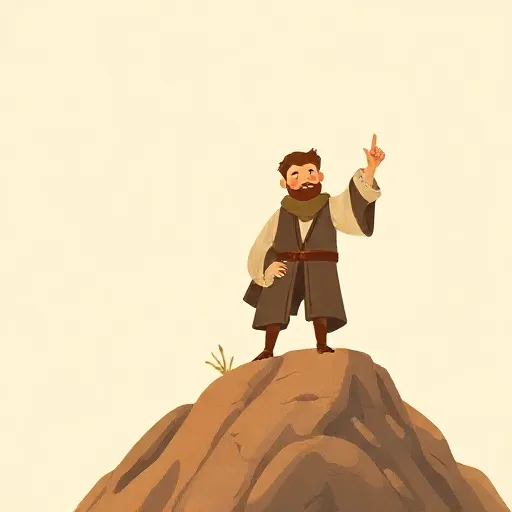
In 1648 a strange experiment climbed a mountain in central France. Blaise Pascal (1623–1662) was too ill to travel, so he sent his brother‑in‑law, Florin Périer, to the summit of the Puy de Dôme with a long glass tube filled with mercury. At the top, the mercury stood lower in the tube than it did at the bottom. When the team returned and compared the readings with a second tube left at the base, they matched exactly: the mercury’s height shrank as the altitude rose. Pascal drew a bold conclusion. The air has weight, and what looks like empty space at the top of the tube really is a vacuum — a region with nothing in it.
Pascal was already famous for building a calculating machine and probing the mathematics of gambling. He trusted observation and reason to unlock nature’s secrets. But within a few years, he would declare that the most important truths cannot be reached by experiments or proofs. A single night shattered his confidence in unaided reason.
The Night That Split His Life in Two

On 23 November 1654 Pascal had an experience he later described as a fiery religious vision. He wrote a short note called the Mémorial and sewed it into the lining of his coat, where it stayed until his death. From that night onward, he abandoned his scientific projects and poured his energy into defending a severe kind of Christianity known as Jansenism, inspired by the theology of Saint Augustine.
Why turn so sharply against reason? Pascal came to believe that human nature is broken by the Fall — the moment when Adam’s first sin corrupted all of humanity. Our minds are clouded by concupiscence, a disorderly hunger that pulls us away from God. Because of that damage, logical arguments can never climb up to heaven. Real religious faith, he insisted, is not a conclusion you reach with your brain. It is a pure gift from God, a kind of supernatural grace given freely to some people, not something you earn by being smart or good.
If that is true, then every philosophical proof of God’s existence is useless. Pascal dismissed them bluntly: he wrote that metaphysical proofs “have little value.” For natural facts, our eyes and our reasoning are the right tools. For supernatural matters, only faith works. That separation left him with a crackling question: if reason cannot lead a person to God, how can a believer reply to a doubter who honestly asks, “Why should I believe?”
The Wager: Betting on the Impossible

Pascal’s daring reply is the famous wager. He never published it as a polished argument — we find it scribbled in his notebook, the Pensées — but it has become one of the most hotly debated ideas in the philosophy of religion. The wager does not try to prove that God exists. Instead, it borrows the logic of gambling, which Pascal knew well from his work on probability with mathematician Pierre Fermat.
Imagine you must decide whether to live as if the Christian God is real. You cannot stay neutral; even trying not to decide is a decision. Now consider the possible outcomes. If you bet that God exists and you are right, you gain eternal happiness — an infinite reward. If you are wrong, you lose some earthly pleasures and a bit of pride, but that is only a finite loss. If you bet against God and you are wrong, you lose everything forever. From a gambler’s point of view, the expected payoff for believing is infinite, while the payoff for not believing is at best nothing, at worst eternal misery.
Pascal never said this calculation creates faith — in his theology, only God can give that. What the wager shows, he argued, is that a person who already has faith is not being irrational. Choosing belief is like accepting a bet where the prize massively outweighs the cost.
But critics spot an immediate snag: the same reasoning works for any religion that promises an infinite reward and threatens an infinite punishment. If you wager on the wrong one, you might still lose everything. Pascal, deeply convinced that Roman Catholicism was the one true church, did not think that was a serious risk. Others, however, see a spiral of endless bets with no way out.
The Trap of Being Free
If faith is a gift and God’s grace is efficacious — meaning it always achieves its goal — a troubling puzzle surfaces: do we really choose to believe, or does God choose for us? Pascal’s answer was shaped by Augustine. Left to ourselves after the Fall, we always follow our strongest desires, and those desires almost never point toward God. When God gives someone efficacious grace, He plants a desire so powerful that the person freely and infallibly turns toward the good.
Pascal explained that the will can always resist grace, but when God wishes to move someone, that person desires the good so intensely that they choose it without being forced. The choice is still free, he thought, because it flows from what the person most wants at that moment — it is simply that God made that desire sudden and overwhelming.
Many philosophers then and now ask what “free” can mean in such a picture. If God decides in advance who gets this irresistible grace and who does not, salvation looks like predestination — God choosing before we are born who is saved and who is not. Pascal accepted that tough conclusion, while insisting that those who are not saved cannot blame God; they suffer justly for a nature inherited from Adam. He never pretended it felt comfortable. He called it a mystery we simply accept if given faith.
The Thinking Reed and You

Pascal’s later notes are packed with images of human fragility. In one fragment he compares a human being to a “thinking reed.” The whole universe could crush a person, but a reed that knows it is crushed is greater than the universe that crushes it. Dignity, Pascal claimed, comes from thought, not from power.
These reflections strike a chord far beyond 17th‑century France. In your own life you often make decisions without proof — which friendships to invest in, whether to trust someone, what to devote your time to. Those are modest wagers compared with eternity, but they share the same shape: you weigh possible gains against possible losses, using head and heart together.
Pascal’s larger warning is about the limits of pure reason. A man who helped invent the modern idea of experimental science spent his final years arguing that life’s most important questions cannot be settled in a laboratory. He was not anti‑science; he was convinced that observation and logic work for the natural world. But for questions about meaning, purpose, and the divine, he thought we must wade into uncertainty with a different part of ourselves. Whether that seems wise or a bit too much like wishful thinking is something philosophers still argue about today.
Think about it
- If you had no way to prove whether a belief is true, but believing it made you happier and kinder, would that make the belief reasonable?
- Pascal’s wager only works if you think the reward of the right religion is infinite. Should you consider all possible gods when placing your bet?
- Is there a difference between choosing to act as if something is true and genuinely believing it? Can you decide to believe something the way you decide to raise your hand?