Where Do 'I' End and 'the World' Begin?
The Moment Before ‘I’ and ‘It’

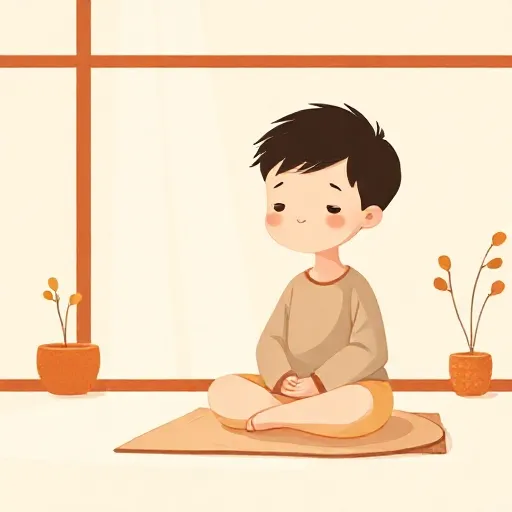
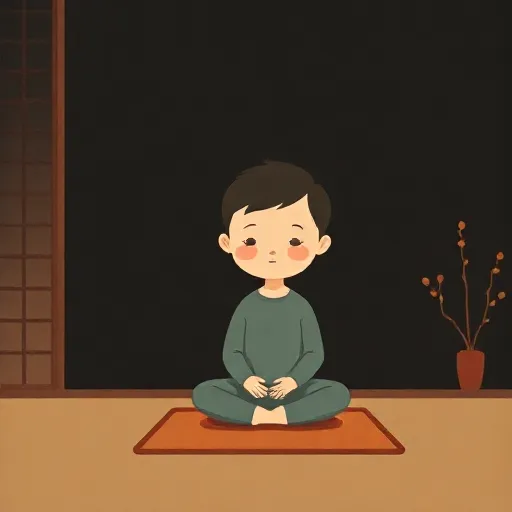
On a tatami mat in a Kyoto temple, a man sits perfectly still. He is not thinking about yesterday or planning for later. He is just seeing, hearing, feeling — but without an “I” inside his head observing it all. The man is Nishida Kitaro (1870–1945), and that raw state where you and the world are not yet split apart is what he called pure experience.
Nishida believed that pure experience is not something strange that only monks reach. It is the hidden foundation of every moment of your life. Right now, you see these words, hear a background sound, feel your weight on a chair. Before you label any of it — “I am reading,” “that’s a bird chirping” — the seeing and hearing simply happen. That is pure experience. For Nishida, that undivided flow is the most real thing, and everything else — thoughts, objects, even your sense of being a separate person — grows out of it.
He first wrote about this in 1911 in a book called An Inquiry into the Good. His claim was radical. Most philosophers in his day assumed the world is made of two separate realms: a mind inside you and physical objects outside you. Knowing something meant the mind’s ideas matched the objects. But Nishida said that whole picture is a later construction. The original reality is unitary. A running horse is not first a horse and then a mind noticing it; the pure experience of “running horse” is given all at once. Even thinking and judging are just activities that happen — they are forms of pure experience as long as you are absorbed in them. The moment you stop to think “I am thinking,” you have stepped back and split things up. Nishida wanted to trace how that split happens, and how we can find our way back to the wholeness.
The Mirror That Sees Itself
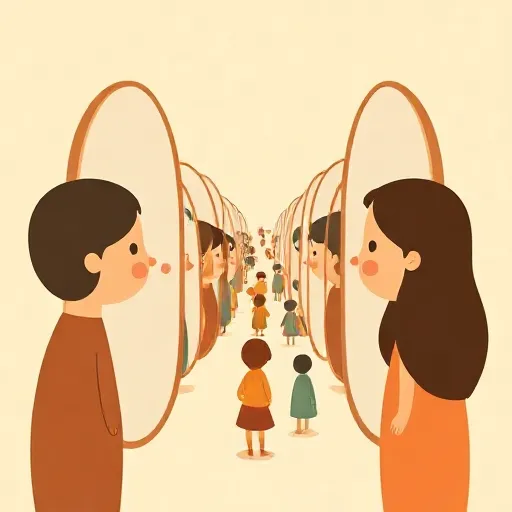
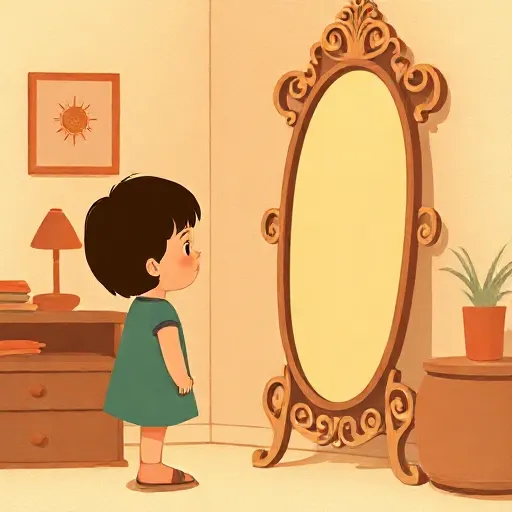
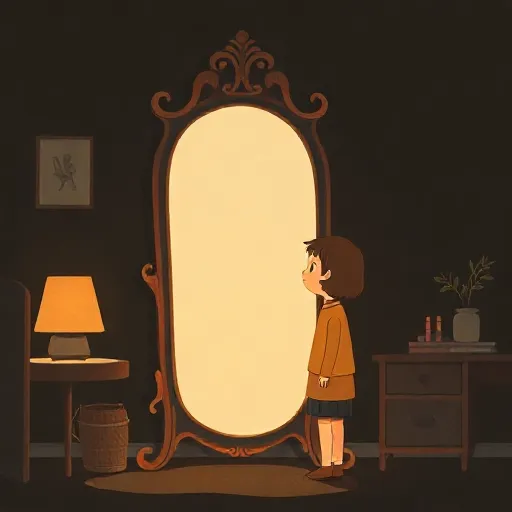
If pure experience is a seamless whole, where does your sense of “I” come from? Nishida’s answer involves self-awareness (he used the Japanese word jikaku). Imagine a mirror. Normally, a mirror shows you an object. But what does the mirror show when there is nothing in front of it? It reflects itself — its own surface, its own act of reflecting. Nishida thought consciousness works the same way. Consciousness is not a box you look out through; it is a self-reflecting activity. It knows itself not by turning into a second consciousness that watches the first, but because reflecting is its very nature.
This self-awareness is the prototype of all knowledge. In that inner mirroring, there is no gap between knower and known. When you feel a warm breeze, in the instant before you say “I feel warmth,” the feeling and the awareness are one. Nishida said that this unified moment is the seed from which our everyday “I” and “world” sprout. He also liked to call it “seeing without a seer, hearing without a hearer.”
But Nishida soon ran into a problem. If self-awareness is so basic, where does it happen? It cannot be inside a physical brain, because brains are objects for a consciousness. It cannot be a ghostly soul either, because that would still be another “thing.” Nishida concluded that consciousness is more like a place — a field where all things appear. He adopted the Japanese word basho.
The Container That Contains Everything (Even Itself?)
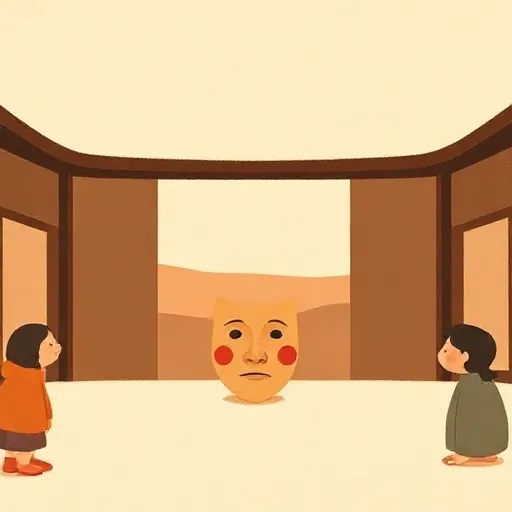
Take any judgment, like “That leaf is red.” The leaf is a subject, the redness is a predicate. In Nishida’s logic, a predicate is a kind of universal that contains the subject. “Red” is wider than “this leaf,” because many things can be red. The sentence is true only within some larger context — a judging mind. That mind is itself a basho, a place that “wraps” the judgment. But what wraps the mind? Nishida built a hierarchy of ever-more-inclusive places. The natural world we study in science is one place. The field of self-aware consciousness that reflects on nature is a deeper place. And the creative realm where we pursue truth, beauty, and goodness is deeper still.
At the bottom — or rather, the widest horizon — he placed absolute nothingness. This is not emptiness in the sense of “nothing there.” It is not the opposite of being. It is the ultimate basho that makes any distinction — between being and non-being, self and world, subject and object — possible in the first place. Nishida called it “the form of the formless.” It cannot be described as a thing, yet every thing appears within it.
His idea echoes Buddhist notions of emptiness. Just as a stage makes a play possible without being part of the story, absolute nothingness is the open space where reality unfolds. Nishida also compared it to the idea of a field in physics — something not made of matter that nevertheless shapes and contains everything.
The Dancing World: You Make It, and It Makes You
For years, Nishida focused on the deep structure of experience. Then, in the 1930s, critics — including his own students — said he had forgotten something huge: history. Real people act in a real world that changes over time. We are born into families, cultures, and events we did not choose. Nishida listened, and he expanded his philosophy to include the historical world.
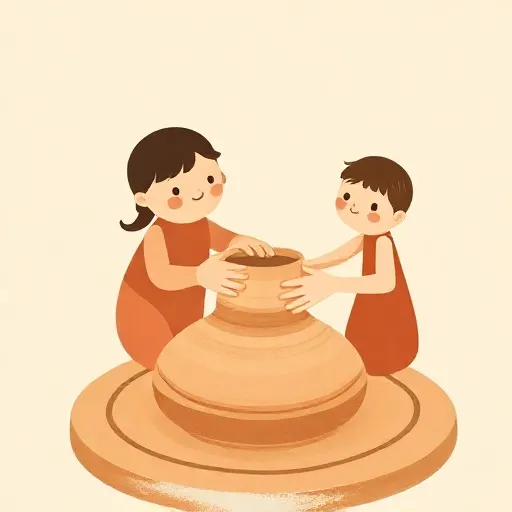
He realized that the world is not a static container but a dynamic process. It forms itself through the actions of embodied individuals — and those individuals are formed by the world in return. He called this a dialectic: “from the created to the creating.” To explain how we participate in this ongoing creation, he coined the term enactive intuition (kōi-teki chokkan). Usually we think of intuition as a passive seeing, and action as something we do. Nishida said the two are really one. A sculptor doesn’t first see a perfect shape in her mind and then mechanically copy it; she discovers the shape through the act of carving, and each chip of stone changes her next move. Her body and the stone are in a dance where seeing, touching, and making cannot be separated. That is enactive intuition.
This mutual formation happens between people, too. Nishida argued that your sense of being a unique “I” arises only in relation to a “you.” I know I am a talker because I meet someone who listens. And I also carry an “absolute other” inside — a strange depth that I can never fully grasp, which keeps my identity from becoming a closed box. In his later years, he described this as a “self-identity of contradictories”: you are yourself precisely by including what you are not.
What Nishida Tells Us About Connection

In his last essay, finished just two months before his death in 1945, Nishida turned to the biggest boundary of all — death. He wrote that dying is not simply an event at the end of life; it is present in every moment as the possibility of our own limits. Facing that finiteness, he said, makes you truly an individual. But it also puts you in touch with something absolute. For Nishida, that absolute — which he sometimes called God — is not a person-like being outside the world. It is an encompassing nothingness that “lives” by pouring itself into finite things, while always remaining more than any of them. The closer you draw to it, the more distinct you become, not less. He called this an inverse correlation: the finite self and the absolute grow closer only by becoming more different.
Why does any of this matter today? Nishida’s whole journey aimed at a world where no one — no person, no culture, no nation — is a sealed-off island. He thought that true global culture would come about when each nation became aware of itself by becoming aware of others, like two selves in a genuine “I–You” encounter. His critics disagree about how well he lived up to that vision during wartime Japan, but the vision itself remains powerful.
His ideas have rippled into unexpected places. The physicist Yukawa Hideki, who won a Nobel Prize, used Nishida’s logic of place to rethink what elementary particles are. Architects, ecologists, and psychologists have all found inspiration in his picture of a world where things are interconnected without losing their uniqueness. At its heart, his philosophy asks you to consider: what if the deepest truth is not a thing, but a kind of open, creative nothingness that you and I are already part of?
Think about it
- Have you ever been so absorbed in a game, a story, or a sport that you forgot you were a separate “you” watching it happen? Do you think that kind of moment shows something truer than your everyday feeling of being an “I”?
- If the world shapes you and you shape the world, like a potter and clay, where do you think the strongest influence goes — from you to the world, or from the world to you? Try to think of an example.
- Nishida believed that recognizing your own limits — even the fact that you will someday die — can make you more truly yourself, not less. Does that idea feel scary or freeing to you? Why?