Can Science Tell Us What's Right and Wrong?
Is Goodness Something You Can Measure?

Twelve-year-old Maya helps her elderly neighbor carry groceries up the stairs. As the neighbor smiles and thanks her, Maya feels a quiet warmth. She thinks, “That was the right thing to do.” But then she wonders: Is that “rightness” something out there in the world, like gravity or electricity? Could a scientist ever measure it, the way you measure the temperature of a room? These questions lie at the heart of a big idea in philosophy called moral naturalism.
Moral naturalism is the view that moral facts — facts about what is right, wrong, good, or bad — are stance-independent natural facts. “Stance-independent” means they don’t depend on what people happen to think or feel. If kindness is good, it’s good regardless of anyone’s opinions, just like the Earth orbits the sun regardless of what anyone believes. Moral naturalists combine this with another belief: moral realism, the idea that such stance-independent moral facts really exist. Then they add one more claim: these moral facts are natural — they belong to the same world that science studies, a world of atoms, organisms, pleasure, pain, and social cooperation.
A moral naturalist would say that Maya’s kindness is genuinely good, and that “goodness” is a real feature of the situation, one that could, at least in principle, be investigated by science. This isn’t the only way to see morality. Some people think moral facts are supernatural, like commands from a god. Others think moral facts are their own special kind of thing, neither natural nor supernatural — a view called non-naturalism. And still others think there are no stance-independent moral facts at all. What makes moral naturalism so interesting is that it tries to keep morality real while also keeping it firmly inside the natural universe.
But saying that moral facts are “natural” raises a tricky question: What counts as natural? Most philosophers answer: the kinds of things that scientific methods can tell us about. That includes physical things like electrons, but also complex things like health. A person’s health isn’t something you can see directly — you have to look for signs like heart rate or blood tests. Moral naturalists think goodness or wrongness might be like that: real natural properties that we detect through their effects.
The Supervenience Puzzle: No Moral Change Without a Natural Change
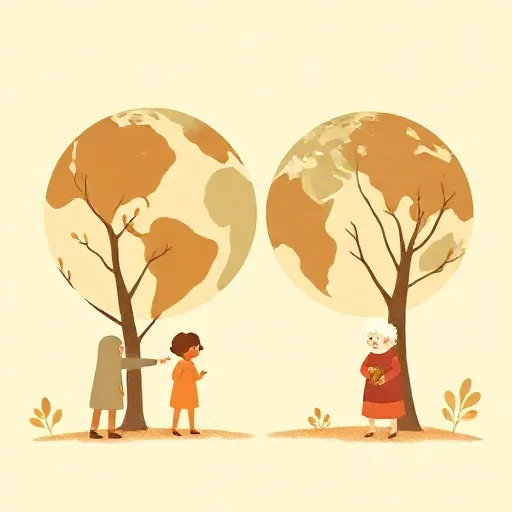
Imagine two possible worlds that are exactly alike in every physical detail: the same atoms, the same brain states, the same actions. Could it be that in one world Maya’s act is good and in the other it is bad? Most philosophers — naturalists and many non-naturalists alike — say no. This idea is called supervenience: moral facts cannot differ without some natural difference. If you want a moral change, you must have some natural change underneath.
Supervenience gives moral naturalists a powerful argument. One version, called the Direct Argument, goes like this. Consider every possible natural situation where an action counts as wrong. Take all those natural features and bundle them into one giant “or” property: the property of having natural feature N₁ or N₂ or … all the way to Nₙ. Since each N is natural, this big disjunction is natural too. And it turns out that an action is wrong exactly when it has that disjunctive natural property. So, the argument claims, wrongness actually is that natural property. The same could be said for any moral property.
Critics push back. Is a giant disjunction of properties really a genuine natural property? And does sharing a necessary connection make two properties identical? Think of the properties being triangular and being trilateral. Anything with three angles also has three sides, and vice versa — but some philosophers say they’re still different properties. So the Direct Argument remains controversial.
Another argument asks: why does supervenience hold in the first place? Naturalists have an easy explanation: if moral facts just are natural facts, then of course no moral change can happen without a natural change. Non-naturalists need a different story, and some say supervenience itself is not a genuine requirement. For a naturalist, though, supervenience feels like a clue that morality is part of the natural order.
The Open Question: Why Pleasure Isn’t Obviously Goodness

A hundred years ago, the philosopher G. E. Moore (1873–1958) launched a famous attack on moral naturalism with his Open Question Argument. Moore looked at theories that said “good” means just the same as some natural description, like “pleasurable.” He asked: take anything you like that is pleasurable — a slice of cake, a funny joke. Now ask yourself: “It’s pleasurable, but is it good?” Moore said this question always feels open. It makes sense to wonder, even doubt. That shows, he argued, that goodness can’t possibly mean “pleasurable” — otherwise the question would feel closed, like asking “He’s a bachelor, but is he unmarried?”
Moore’s argument really targets a specific version of naturalism: the idea that moral terms can be defined using purely descriptive language. That view is sometimes called analytic naturalism or descriptivism. But as later philosophers pointed out, naturalists don’t have to say that “good” means the same as any descriptive phrase. They can say instead that goodness is a natural property, not by definition, but as a matter of synthetic fact — discovered empirically, the way we discovered that water is H₂O. Or they can say that moral terms simply refer to natural properties without being equivalent to any neat description. This is called one-term naturalism: there is only one term, a moral one, that refers to the moral property, and it doesn’t reduce to any non-moral vocabulary.
Even so, some philosophers feel Moore was onto something deeper. The Normativity Objection says that moral facts have a special “to-be-done” quality that plain natural facts lack. Natural facts just describe what is the case; moral facts seem to tell you what you ought to do. Can a fact about atoms or pleasure ever have that kind of authority? Some naturalists reply that normativity itself can be explained naturally — for example, by analyzing all normative concepts in terms of reasons, and then giving a natural account of reasons. But the worry persists: if you try to reduce morality to nature, you might lose the thing that makes morality matter.
The Cornell Realists: Goodness as a Hidden Natural Property

In the 1980s, a group of philosophers connected to Cornell University — Richard Boyd (b. 1942), David Brink (b. 1958), Nicholas Sturgeon (b. 1942), and Peter Railton (b. 1950) — developed a view called Cornell realism. They offered a bold analogy: moral goodness is like health. You can’t directly see healthiness; there’s no single “healthy” look. But health is a real natural property, made of the proper functioning of an organism. We know someone is healthy by observing signs — rosy cheeks, energy — that are caused by or tend to cause health. Cornell realists say goodness works the same way. Goodness is a complex natural property with a causal profile: things like honesty and kindness tend to produce it; human flourishing tends to result from it. We can investigate goodness indirectly by noticing these patterns.
This view relies on a theory of language called causal regulation semantics. In science, words like “water” refer to whatever stuff causally regulates our use of the term — in our world, H₂O. Cornell realists claim that moral terms like “good” refer to whatever natural property causally regulates our moral judgments. So goodness is a homeostatic cluster property, a higher-level natural property that can be realized in many different physical arrangements, just as health can be realized in very different bodies.
But the Moral Twin Earth objection challenges this. Imagine a planet just like ours, except the term “right” there is causally regulated by a different natural property — say, whatever maximizes apple pie production rather than human well-being. If causal regulation semantics is true, then “right” on that planet means something different. Yet our intuition is that we simply disagree with those people about what is right, we don’t think their word means something else. This suggests moral terms don’t work like “water.” If so, the Cornell realist’s bridge between moral language and natural properties looks shaky.
Jackson’s Recipe: Solving Morality with Ramsey Sentences
Frank Jackson (b. 1943) offered a different naturalist path: analytic functionalism. He thinks we can analyze our moral concepts by gathering all the platitudes we accept about goodness, rightness, virtue, and so on. Then we replace every moral term with a variable — G, R, V, etc. — producing a huge description of a network of functional roles. This is called a Ramsey sentence. Finally, we investigate empirically what natural properties, if any, satisfy that whole network. Whatever satisfies it just is goodness, rightness, and the rest.
Jackson admits we don’t yet have a finished, mature folk morality. Our platitudes will be refined over time through discussion and reflection. But he believes that someday a coherent set of moral beliefs will emerge, and the natural facts that fit will be the moral facts. This avoids Moore’s Open Question, because whether “pleasure is good” ends up in our mature theory isn’t something we can know in advance — so the question always feels open.
Critics worry that this rests on an optimistic hope of future agreement. What if moral disagreement never ends? Then Jackson’s method might lead to relativism, where “right” means different things for different communities, or to the idea that there are no moral facts at all. Others argue that the mature folk morality might not be “natural” in the way Jackson wishes — the process of refinement might smuggle in non-natural assumptions. Still, Jackson’s view illustrates a serious attempt to locate morality inside the natural world using the same tools that work for other philosophical puzzles.
Why It Matters: Can Science Help Us Live Better?

Back to Maya, carrying groceries. If moral naturalism is true, her warm feeling of having done the right thing is a response to a real, natural property — something as much a part of the world as her neighbor’s grateful smile. That means in principle we could study moral facts the way we study health or ecosystems. It might become possible to gather evidence, run experiments, and improve our moral knowledge through careful investigation.
But if the objections stick — if moral facts have a “to-be-done” quality that can’t be captured by any natural feature, or if we have no reliable way to identify which natural facts are the moral ones — then we might need something else. We might need to accept that moral truths are known by intuition, or that morality is a human construction, or that there are no objective moral facts at all.
Moral naturalism doesn’t hand us easy answers. It doesn’t tell Maya that helping is good. But it offers a picture in which her goodness is real, woven into the same world that gives us stars, cells, and friendship. The argument over whether that picture makes sense is still very much alive. If you’ve ever felt sure that something was wrong, and also marveled at what science can explain, you’re already standing at the edge of this centuries-long conversation.
Think about it
- If a scientist invented a “goodness meter” that scanned people’s brains and gave a number for how morally good an action is, would you trust it? Why or why not?
- Could two people in complete agreement about all the natural facts still have a deep moral disagreement? What would that mean for moral naturalism?
- Imagine we discover alien life whose biology is entirely different from ours, but they have a concept almost identical to our idea of “justice.” Does that make justice more like a natural property, or less?