Can You Really Know Right from Wrong?
The Pond and the Argument

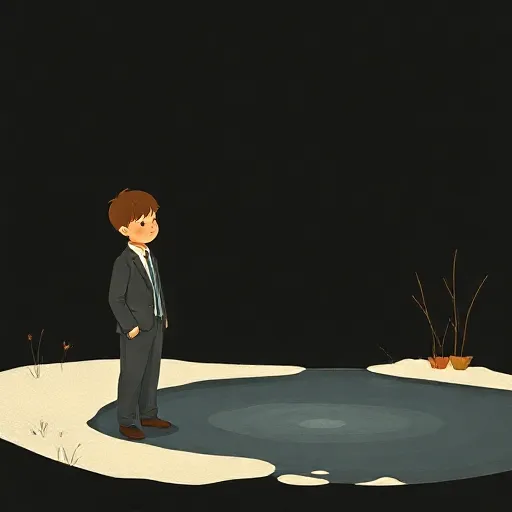
Imagine you see a small child drowning in a shallow pond. You are wearing your favorite suit — the one you saved up for — and you know that if you wade in, the suit will be ruined. Still, you know immediately that you should save the child. Almost everybody, no matter where they come from, agrees on that. The philosopher Peter Singer (born 1946) made this case famous to show that some moral truths feel obvious.
But not all moral questions are that easy. For hundreds of years, people have argued about whether capital punishment is ever right, or whether helping a sick person to die can be morally okay. Even when they agree on the plain facts — for example, that a punishment does not scare off other criminals — they still disagree. This has led some thinkers to wonder: if we argue this much about morals, can we really know what is right? Maybe moral “truths” are just strong feelings, not something we can prove like “2 + 2 = 4.”
One way to respond is to point out that some core moral values appear in every culture studied. Psychologists have found that people everywhere care about avoiding harm, playing fair, being loyal to family and community, and respecting responsible authority. So while we disagree about how to apply these values — like when loyalty to your group clashes with treating outsiders fairly — the basic building blocks are universal. That suggests moral knowledge might not be impossible; it might just be hard to untangle.
A more radical proposal is moral relativism: the idea that moral truths are relative to your culture. A relativist would say that if one culture believes women must cover their faces in public, and another culture does not, each is simply stating what is right in their own society. Neither is wrong. But the philosopher G. E. Moore (1873–1958) spotted a problem. If two people from different cultures argue about whether a practice is wrong, and each is only making a claim about their own culture, they are really talking about different things. They are not disagreeing. Yet it certainly feels like they are clashing. So relativism might explain away disagreement at the cost of making real argument impossible. That leaves the big question standing: can we have moral knowledge at all, or is every moral claim just an expression of attitude?
Can Feelings Be Knowledge?
Morality does not just sit quietly in your head. When you judge that bullying is wrong, you normally feel some urge to stop it or at least not to join in. That tight link between moral judgment and motivation was a problem for the Scottish philosopher David Hume (1711–1776). Hume argued this way:
- If moral knowledge is possible, then moral judgments must be beliefs — mental states that can be true or false, like “the Earth is round.”
- Moral judgments, all by themselves, give you some motivation to act. (This view is called internalism.)
- A belief alone, without a desire attached, never moves you to act. (Imagine believing there is ice cream in the freezer. That belief by itself won’t make you walk to the kitchen unless you desire ice cream.)
Conclusion: moral judgments cannot be mere beliefs. So moral knowledge — true justified belief — is impossible.
Is that argument airtight? Many philosophers have pushed back. One move is to reject premise 3 and say that some beliefs really can motivate by themselves. When you see a toddler drowning, the belief that not helping would be wrong seems to create an instant desire to help, not the other way around. Critics reply that this makes moral beliefs into a weird hybrid — half belief, half desire — that does not fit neatly into our usual picture of the mind.
Another path is to reject premise 2 (internalism) and adopt externalism: the idea that moral judgments do not necessarily motivate. A person might say, “I know this is wrong, but I don’t care,” and still be making a genuine moral judgment. The connection between the judgment and the motivation is supplied by outside factors, like whether the person was raised to be kind. Internalists counter that such a person is only mouthing the words, not really judging.
A more promising idea is a hybrid view. It says moral judgments normally combine belief and motivation, but these two sides can come apart in unusual cases. For instance, a woman passed over for a promotion might feel deep resentment, sensing she has been treated unfairly, even though she initially believes the choice was fair. Later, that persistent feeling might lead her to form a new belief — that she really was wronged. If this picture is right, then moral judgments can sometimes be true beliefs and sometimes just emotional signals. That would allow moral knowledge to exist without breaking Hume’s rules.
The “Open-Question” Trick
Even if moral judgments can be beliefs, what kind of fact could make them true? Imagine somebody says: “Being morally good just means maximizing pleasure and minimizing pain.” G. E. Moore thought definitions like that always fail. He used a famous test: take any natural property — pleasure, for example — and ask, “This action produces pleasure, but is it good?” Moore noticed the question still feels open, not silly. If “good” and “pleasurable” meant exactly the same thing, asking it would be like asking, “This is a bachelor, but is he unmarried?” Moore called the mistake of identifying a moral property with a natural property the naturalistic fallacy. Moral truths, he thought, must be non‑natural and known through a special moral intuition.
Moore’s argument pushed many thinkers toward moral naturalism, the view that moral facts are natural facts, even if the identity is not obvious. After all, water turned out to be H₂O, but for centuries nobody knew that. The fact that you can sensibly ask “Is this water, though?” while holding a glass of H₂O did not prove water wasn’t H₂O. In the same way, a moral property like “wrongness” might turn out to be a complex natural property — for example, the property of violating a norm that, if widely accepted, would best help a society meet its needs for peace and cooperation. If so, moral facts are out there in the world, open to study, just like biological or economic facts. The challenge that remains is whether we can really reason from ordinary experience to moral conclusions without already sneaking in a moral assumption — but many philosophers think the back-and-forth of comparing cases and testing explanations can do the job.
Did Evolution Trick Us?

Charles Darwin (1809–1882) proposed that human morality grew out of social instincts shaped by natural selection. Groups that cooperated, shared, and cared for one another did better than groups that did not, so helpful and fair‑minded tendencies spread. That raises an unsettling possibility: maybe our moral “beliefs” are just survival tools, not glimpses of truth. If evolution hard‑wired us to feel that certain acts are wrong simply because that feeling helped our ancestors survive, then feeling so does not mean we know anything real.
This sort of evolutionary debunking tries to undercut moral knowledge. But moral naturalists have a reply. If moral facts are natural facts — facts about what genuinely helps or harms conscious beings — then evolution could have tuned our moral emotions to track those facts, much as our taste buds track the nutritional value of food. A deep‑seated aversion to cruelty for fun would not be an illusion; it would be an accurate response to the real badness of pointless suffering. So evolution and moral knowledge need not be enemies. The debate continues, but the idea that our evolved moral sense could be a window onto a natural moral reality is taken seriously by many philosophers today.
Why It Matters: Slaves, Suffrage, and Progress
If moral knowledge is impossible, then we have no rational way to say that one society’s practices are better than another’s. Yet history gives us examples that look a lot like moral learning. In the early 1800s, many people in Britain and America believed slavery was acceptable. But through decades of public debate — where formerly enslaved people spoke, where economic arguments were tested, and where Christian ideals of equality were pressed to their logical conclusion — the moral consensus shifted. By 1834, Britain had abolished slavery in most of its empire. Later, similar long debates led to recognizing women’s right to vote and to better treatment of animals.
These changes did not happen because a single person had a flash of intuition. They happened because diverse groups of people kept challenging each other’s reasons, exposing biases, and demanding consistency. In that messy, social process, moral knowledge seemed to grow — not perfectly, not all at once, but piece by piece. So perhaps moral knowledge is less like a private possession and more like a group project. Figuring out what is right takes talking, listening, and being willing to change your mind when the evidence and arguments point elsewhere. That is why the abstract question “Can we know right from wrong?” matters when you find yourself arguing about fairness in the lunchroom, or trying to decide whether to break a promise that felt easy to make.
Think about it
- If two people from different cultures disagree strongly about whether it is wrong to eat meat, does that mean there is no real answer to the question? Why might someone say yes — and why might someone say no?
- If our moral feelings were shaped by evolution to help our ancestors survive, does that make them less trustworthy than if they came from a special built‑in moral sense?
- Can you imagine a completely new moral truth that nobody has ever thought of before — like a scientific discovery? What would it look like for a whole society to learn that something they always thought was okay is actually wrong?