
What Do You Know? Montaigne and the Art of Doubting Yourself
A Boy Who Spoke Latin and a Tower Full of Questions

Imagine growing up where everyone around you spoke only Latin. That was the childhood of Michel de Montaigne (1533–1592). His father, a French nobleman who had fought in Italy, wanted his son to absorb the best of ancient Roman culture. So he hired a German tutor and ordered the whole household to speak Latin to the boy. By age six, Montaigne was reading Virgil and Ovid on his own, long before he ever set foot in a classroom.
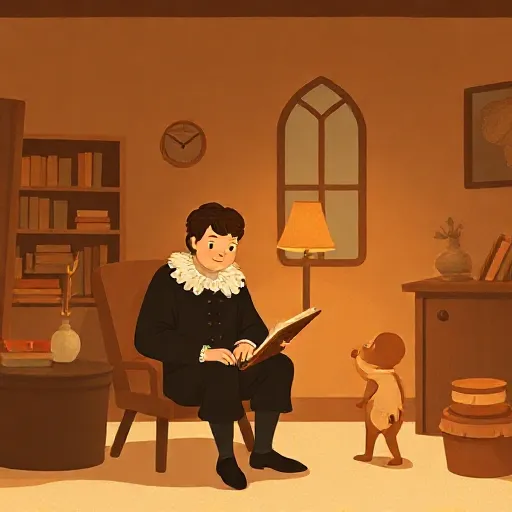
Later, after a brief career in law and deep grief over the death of his closest friend, Montaigne did something unusual. At only thirty-seven, he retired from public life and locked himself away in a round tower on his family estate. The room was a library filled with books. What made it special were the words carved into the wooden ceiling beams. Among them were two mottos in Greek and French: one meaning I suspend judgment and the other asking Que sais-je? — “What do I know?” Those questions became the engine of his entire life’s work.
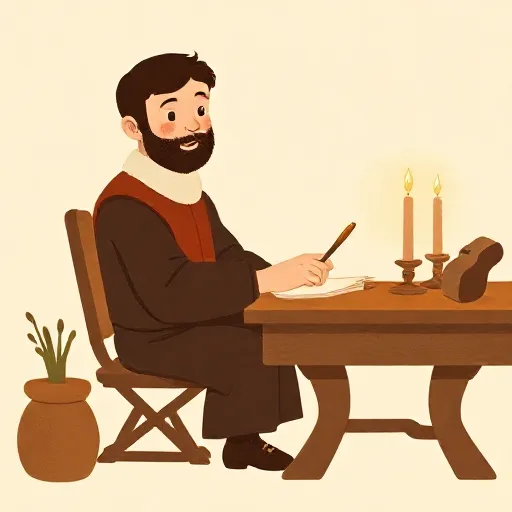
Montaigne started writing not to become famous, but to chase away sadness. He wrote short, informal pieces about whatever came into his head: fear, friendship, the way a horse stumbles, the taste of a radish. He called them essays, a word that meant “attempts” or “trials.” He wasn’t trying to build a grand system of philosophy. He was trying to think clearly, one topic at a time, by testing his own judgment.
What Is an Essay? Trying Ideas on for Size

The word “essay” was Montaigne’s own invention for a new kind of writing. Before him, philosophy usually meant writing long, orderly treatises that proved one big truth. Montaigne flipped that idea. An essay was a trial or a test run — like trying on a pair of shoes to see if they fit. You start with a question, not an answer. You chase the thought wherever it leads, even if you change your mind halfway through.
His book the Essays (first published in 1580) jumps from “Idleness” to “Liars” to “Thumbs” with no obvious plan. He even welcomed the messiness. One chapter might argue that our choices are shaped by chance, the next might blame custom. Montaigne added to his essays over decades, but rarely deleted. The result is a mind in motion, arguing with itself, circling back, always rethinking.
This was his big idea: judgment — your power to size up a situation and decide for yourself — matters more than hoarding facts. He hated pedantism, the habit of stuffing your head with book learning just to sound smart while never thinking for yourself. A good education, he insisted, should exercise judgment, not memory. A pupil should not just repeat the teacher’s words; she should weigh them, push back, and form her own view. Philosophy, for Montaigne, wasn’t a dusty subject for universities. It was a way of living. He wrote, “I love life and cultivate it as God has been pleased to grant it to us,” and insisted that philosophy should be “always gay and joyful.”
“What Do I Know?” Montaigne’s Sceptical Side

Around 1576, Montaigne had a medal struck with his age, the Greek word for “I abstain,” and his now-famous French question: “What do I know?” Something had shifted. He had been reading an ancient Greek thinker named Sextus Empiricus, a sceptic who argued that for every argument in favor of something, you can find an equally strong argument against it. For a while, Montaigne’s doubt felt sharp and unsettling — some scholars call it his “sceptical crisis.”
But Montaigne’s scepticism was not a permanent gloom. Instead, he used doubt as a tool. He saw that human reason often tricks us into thinking we know things for certain — about God, about the soul, about what is just. His essays practice a habit of pulling back: “perhaps,” “to some extent,” “they say,” “I think.” He deliberately softened his claims, never letting himself get too attached to any one opinion.
On one ceiling beam he carved the phrase iudicio alternante — “by alternating judgment.” He didn’t want to smash arguments; he wanted to load both sides of a scale and see which tipped. This method let him shift perspectives without ever locking himself into a final answer. Instead of the radical doubt that says everything is equally uncertain, he leaned toward probabilism: some opinions look more reasonable than others, so you follow the more probable one, but lightly, always ready to reconsider.
This does not mean Montaigne believed nothing. He still got up in the morning, ate breakfast, and served as mayor of Bordeaux. He trusted his senses and common life. What he doubted was our ability to turn our opinions into absolute Truth with a capital T. By holding ideas lightly, he found he could explore them more freely. He could argue like a Stoic one day and an Epicurean the next, taking each viewpoint seriously without becoming its prisoner. The goal was not to win debates, but to keep thinking, like a man always on the lookout for fresh paths, as he said of Socrates.
Are Your Customs Just Accidents? Montaigne and Relativism

Montaigne was a voracious reader of travel books and histories from the New World. He learned that in some societies people ate their dead relatives as a mark of respect, while in others they buried them. He found places where it was a son’s duty to kill his aging father, and others where children cared for parents tenderly. These stories convinced him that custom — the habits and rules we absorb from the crowd around us — is an invisible tyrant.
Custom, he wrote, acts like “Circe’s drink,” the magic potion in Homer’s Odyssey that turned men into pigs. It makes us believe that the way we do things is the only natural way, blinding us to other possibilities. So when we call something “barbaric” or “unnatural,” we are usually just saying it’s not our custom.
Yet Montaigne did not slide into total relativism, the view that all customs are equally good and there’s no way to judge. He still believed our judgment could compare. In one famous passage, he looked at cannibals who ate their dead enemies and then pointed at the religious civil wars tearing France apart. “I think there is more barbarity in eating a man alive than in eating him dead,” he wrote, “and in tearing by tortures a body still full of feeling….” By lining up different practices side by side, he showed we can still spot degrees of cruelty. Reason and nature are not completely empty words; they offer rough scales, even if we can never nail down a single universal rule.
Even in politics Montaigne applied this cautious balancing act. He thought changing laws too quickly usually causes more harm than sticking with old ones — but a sharp judgment, he believed, could still decide when change is truly needed. The important lesson was humility. “We are all huddled and concentrated in ourselves, and our vision is reduced to the length of our nose,” he warned. Traveling — or even just reading about other ways of life — could stretch that nose a little longer.
Why It Still Matters: Thinking for Yourself in a Noisy World

Remember Montaigne in his tower, carving “What do I know?” into a beam. He didn’t carve it because he had given up. He carved it because he wanted to stay awake. Today, we are constantly pushed to pick sides, to “like” or “cancel,” to defend our group’s ideas without pausing. Montaigne offers a different path.
He teaches that it’s okay — even smart — to say “maybe,” “I’m not sure,” or “I hadn’t thought of it that way.” That is not weakness; it is the very skill he called free judgment. You don’t have to abandon all beliefs. But you can treat them as essays: first drafts, always open to revision. You can ask yourself whether you believe something because it’s true, or just because your family, your friends, or your phone screen taught you it was true.
Centuries later, the philosopher René Descartes followed Montaigne’s advice by leaving his books behind and traveling to learn from experience. Montaigne’s method — reading widely, comparing customs, trying out opinions without marrying them — is a recipe for intellectual courage. It helps you spot “Circe’s drink” when your own culture is serving it. It makes you less threatening to people who disagree, because you remember how often you have been wrong yourself.
Far from making him miserable, this restless questioning filled Montaigne with what he called a “modest but effective pleasure.” The philosopher Friedrich Nietzsche later said that reading him “increased the joy on earth.” So the next time a loud opinion pushes at you, you might ask yourself that simple, tower-carved question: What do I know? You might find that the answer — “less than I thought” — is exactly where real thinking begins.
Think about it
- If you had grown up in a completely different culture, what might you believe about right and wrong that would seem crazy to your friends now?
- Montaigne thought we should often use “perhaps” and “it seems to me” instead of “definitely.” Why is it sometimes uncomfortable to admit you might be wrong?
- Suppose you could never be completely certain of anything — would that make you feel anxious or free? Why?