
If It’s True in All Possible Worlds, Why Do We Need a Lab to Find It?
A Gold Ring and an Unbreakable Fact
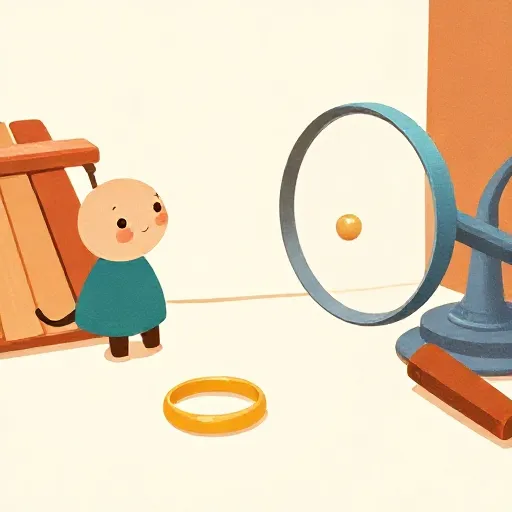
You are holding a gold ring. It is heavy, smooth, and warm. If you could travel to another universe where trees are purple and rivers flow uphill, would this ring still be gold? Most people say yes. Being gold isn’t about colour or weight; it’s about having 79 protons in each atom. A substance with 78 protons would be platinum, and one with 80 would be mercury. The statement Gold has atomic number 79 is necessary—it is true in every possible world, no matter how different that world is.
Philosophers describe a possible world as a complete way things could have been. A truth is necessary if it holds in all possible worlds, possible if it holds in at least some, and contingent if it holds in some but not all.
But here is the puzzle. You cannot sit in a dark room, shut your eyes, and figure out that gold has 79 protons. You need to run experiments, build a lab, and measure. That means the truth is a posteriori—something you can only know through experience. A truth you could reach by pure reasoning, without checking the world, would be a priori. So we have a necessary truth that is not a priori. Philosophers call this a necessary a posteriori truth.
The Zipper Inventor Who Didn’t Have to Invent

Now try a different trick. Suppose you decide to give a name to the actual inventor of the zipper. You do not know who this person is, but you know someone invented it. Call that person Julius. Now you announce:
If Julius exists, then Julius invented the zipper.
Do you need to do any research to know this? It seems not. You defined Julius that way. You can be certain just by understanding the definition. That makes the claim a priori.
But is it necessary? Could Julius have been a baker instead? Sure. The actual person who invented the zipper—say, Whitcomb Judson—might have chosen a completely different life. In some possible worlds, that very same person never invents anything. So the statement is true because of how we fixed the name, but it could have been false. It is a contingent a priori truth. This example comes from the philosopher Gareth Evans (1946–1980).
Kripke’s Big Shake-Up
For a long time, many philosophers thought that the a priori truths and the necessary truths were exactly the same set. If you could know something without looking, it had to be true in every possible world; if something was necessary, you could know it by reason alone. It was a neat, elegant picture.
Then Saul Kripke (1940–2022) and Hilary Putnam (1926–2016) shook that picture. Kripke noticed that ordinary names like “gold,” “water,” and “Mark Twain” work like rigid hooks. A rigid designator picks out the very same thing in every possible world. “Mark Twain” always refers to Samuel Clemens, even in worlds where he never writes a book. Likewise, “gold” always points to the element with atomic number 79, no matter what it looks like elsewhere.
Descriptions, by contrast, can be floppy. The phrase “the clear drinkable liquid in rivers” might pick out H₂O on Earth but a completely different substance (call it XYZ) on another planet. That description is non-rigid.
Now consider the sentence Water is H₂O. Because “water” is rigid, the sentence is necessary—in every possible world, water is H₂O. But we cannot know that by pure reasoning. We have to go out and test the clear liquid. So it is a necessary a posteriori truth. Similarly, Mark Twain is Samuel Clemens is necessary (both names rigidly pick out the same person), yet you might need historical evidence to learn it.
Kripke’s examples created a puzzle: how can necessity and a prioricity come apart?
Two Necessities or Two Meanings?
Philosophers split into two camps to solve the puzzle.
Some, the dualists, say there really are two different kinds of necessity. Metaphysical necessity is about the world itself: a truth is metaphysically necessary when it holds in every way the world genuinely could have been. Epistemic necessity is about what our reasoning can rule out: a truth is epistemically necessary when no amount of pure thinking could allow it to be false. Kit Fine (born 1946) suggests that metaphysical necessity flows from the very natures of things—being H₂O is part of what it is to be water, so water must be H₂O in all metaphysically possible worlds. But before we do chemistry, we cannot rule out a world where the watery stuff has a different atomic number, so such a world is still epistemically possible. Thus the set of epistemically possible worlds is larger.
Other philosophers, the monists, argue we do not need two kinds of necessity. There is only one space of possible worlds: the metaphysically possible ones. The appearance of a split comes from the fact that a single sentence can express two different propositions, depending on how we ask the question “Is this sentence true in world w?”
David Chalmers (born 1966) and Frank Jackson (born 1943) built a tool called two-dimensional semantics. Imagine a world where the clear drinkable liquid is XYZ. Now ask: if that world were actual—if that was the real world—would “Water is H₂O” be true? No, because the liquid there isn’t H₂O. That gives us the sentence’s primary intension, which tracks what we can know a priori; its primary intension is contingent. But ask a different question: given that in the actual world water is H₂O, if that XYZ-world had been the case, would water be H₂O there? Yes—because “water” rigidly refers to H₂O, so in any counterfactual scenario, water is H₂O. That gives us the secondary intension, which is necessary.
So one sentence has two intensions: a contingent primary one (tied to epistemic possibility) and a necessary secondary one (tied to metaphysical necessity). The monist says this explains all the Kripkean data without inventing two distinct modal realms.
Both camps have lively replies. Dualists worry that monism buys metaphysical simplicity by making the theory of meaning more complicated. Monists reply that two-dimensional semantics can be motivated independently and that postulating two kinds of necessity is extravagant. The debate remains open.
Why It Matters When You Argue About “What If”

Every day you dip into these ideas without realising it. When you say, “If I had practised, I would have won,” you are considering a possible world where you practised, and you expect that world is close enough to be relevant. That is a bit of metaphysical modal thinking. When you insist, “The thief must be the butler; the footprints prove it,” you use epistemic necessity—given what you know, no other possibility is left open.
The puzzle of the necessary a posteriori teaches us that imagination is not a perfect guide to reality. You can picture a shiny yellow metal that behaves exactly like gold but has 78 protons, yet that metal would not be gold. So picturing a situation does not guarantee it is genuinely possible. Likewise, the contingent a priori reminds us that some things you can know without looking might still have been false—they rest on how you set up your words, not on the deep structure of the universe.
Philosophers continue to argue about the architecture of possibility because it shapes how we understand science, knowledge, and even ordinary talk. Next time you wonder whether something had to be true, or whether you can know it from your armchair, you are walking right into the middle of this centuries-old conversation.
Think about it
- Imagine you discover a distant planet where the clear liquid in rivers looks, tastes, and flows exactly like water but is made of a chemical called XYZ. Would you call it water? Why might some philosophers say no, even if it quenches thirst the same way?
- You find a strange shiny rock in the backyard and decide to name the metal inside it “Zorblax.” You declare, “If Zorblax exists, it has whatever property made me call it Zorblax.” Do you know that statement for sure without testing anything? If you later learn the metal is plain iron, were you wrong?
- Think of a time you were absolutely sure something had to be true because you could not imagine it being false—like “my friend would never lie.” Could it still turn out to be false, even if your imagination couldn’t picture it? How does this connect to the difference between what is imaginable and what is possible?