
Could the Universe Have Turned Out Differently?
The Fork in the Road
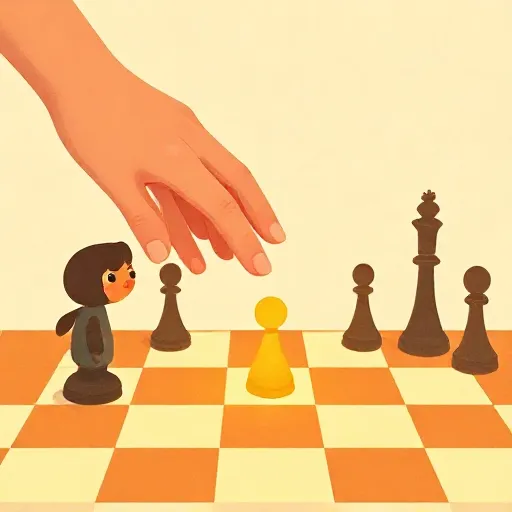
You are walking home from school and come to a fork in the road. You can turn left and stop at the library, or turn right and grab a slice of pizza. You choose the pizza. But could you have chosen the library instead? Most people would say “yes, I could have decided differently.” Yet the more you think about it, the stranger the question becomes. If everything in the universe follows rules, including your brain, was the pizza choice necessary from the start? And if it was necessary, what does “could have” even mean?
These questions tangle us up because we use words like “must,” “could,” and “cannot” all the time without stopping to define them. A whole branch of thinking called modal logic tries to clean up this mess. Modal logic is the study of reasoning that involves the words necessarily and possibly. It gives us a precise way to handle the words that stretch our thinking beyond just what is true right now.
The Box and the Diamond
Philosophers like to replace wiggly words with clear symbols. In modal logic, the box symbol (\Box) stands for “it is necessary that…” and the diamond symbol (\Diamond) stands for “it is possible that…”. So if (A) is the sentence “the sun is hot,” then (\Box A) means “it is necessary that the sun is hot,” and (\Diamond A) means “it is possible that the sun is hot.” Already you can see that some sentences feel like they must be true in a deep way, while others are just lucky accidents.
The American philosopher Clarence Irving Lewis (1883–1964) was one of the founders of modern modal logic in the early 20th century. He was bothered by a problem in ordinary logic. In plain logic, a false statement can imply anything. For example, from “the moon is made of cheese” you can logically conclude “the moon is made of cheese or I am a giraffe.” Lewis wanted a stronger kind of “if…then” that reflected real reasoning, where the connection between the two ideas really matters. He invented something called strict implication, which uses the box to say that “if A then B” is not just true by accident — it must be true in a strong, necessary way. His work launched a whole family of systems.
Building a Logic: From K to S5
The simplest modal system that logicians agree on is called K, named after Saul Kripke (1940–2022), another giant in the field. K starts with all the ordinary rules of logic and then adds two simple principles. First, if something is a logical theorem, then it is necessary (the Necessitation Rule). Second, if it is necessary that “if A then B,” and it is necessary that A, then it is necessary that B (the Distribution Axiom). These feel obvious — like saying “if a truth is airtight, it’s airtight.”
But K is a bit too weak to capture what we really mean by necessity. Think about this: if something is necessary, then it should actually be the case. You cannot say “it must rain” and then watch the sun shine. So many logicians add an axiom called M: (\Box A \rightarrow A) (if necessarily A, then A). The system that adds M to K is sometimes called T. It says nothing necessary could be false.
Now things get juicier. If something is necessary, is it necessarily necessary? At first you might say yes — a truth that cannot be false seems like it couldn’t possibly be uncertain. The axiom called 4 ( (\Box A \rightarrow \Box \Box A) ) captures that thought. A system with M plus 4 is called S4. In S4, piling up boxes doesn’t change anything; “necessarily necessarily A” is just a long-winded way of saying “necessarily A.”
Then there is an even stronger axiom, 5: (\Diamond A \rightarrow \Box \Diamond A). This one says that if something is possible, then it is necessarily possible. That creates a system called S5, where any string of boxes and diamonds collapses to the last modal operator in the chain. In S5, “it is possible that it is necessary that A” is the same as “it is necessary that A.” S5 is the most famous candidate for a logic of “absolute” necessity — a necessity that doesn’t depend on our particular knowledge or position.
Possible Worlds: A Map of What Could Be

When you start throwing around words like “necessary,” you quickly need to ask: necessary according to what? In ordinary life, we don’t think “I must eat” is necessary in the same way that “2+2=4” is necessary. To sort this out, philosophers invented possible worlds semantics.
Imagine all the ways the universe could be — every alternative history, every different physics, every choice you didn’t make. Each one is a possible world. In the actual world, you ate pizza; in another possible world, you ate nothing; in yet another, pizza was never invented. Now we give a crisp definition: (\Box A) is true in a given world if and only if (A) is true in all possible worlds that are accessible from the starting world. The accessibility relation is just a rule that tells you which worlds count as possible given where you are.
This is where the different axiom systems start to line up beautifully with different pictures of reality. If you think every world must be accessible to itself — that is, whatever is the case in a world is possible relative to that world — you get axiom M. If accessibility is transitive (whenever world (w) sees world (v) and (v) sees (u), then (w) sees (u)), you get axiom 4. If accessibility is symmetric and transitive in a certain strong way (technically Euclidean), you get S5.
This machinery lets us ask: is the actual world the only world accessible to itself? Or is the web of possibility wide open, with every world seeing every other world? The answer you choose changes which arguments count as valid. For example, in S5, everything that is possibly necessary is simply necessary — which would mean the universe is rather stiff. In weaker systems, there is more breathing room.
Beyond Necessity: Other Kinds of “Must”
Once you start playing with boxes and diamonds, it turns out the same pattern of thinking applies to many words besides “necessary.” Philosophy calls this whole family modal logics. Deontic logic replaces the box with (O) for “it is obligatory that” and the diamond with (P) for “it is permitted that.” Here the axiom M ((\Box A \rightarrow A)) would be a disaster: just because you ought to clean your room doesn’t mean you actually do. So deontic logicians use a milder axiom called (D): if something is obligatory, it is at least permitted. That way you can’t be trapped having to do something you’re not allowed to do.
Temporal logic uses operators like (G) for “it will always be the case that” and (H) for “it always was the case that.” This logic can talk about time the way we talk about possibility. Epistemic logic uses (K) for “knows that,” helping us model what different people can know in a conversation or a game. The template is the same, but the interpretation of the box changes.
Why Does Any of This Matter?
You might think this is just a dusty game with symbols. But modal logic is the invisible grammar behind some of the biggest arguments you’ll ever have. When you argue about whether a friend could have acted differently, you are doing modal reasoning. When you imagine counterfactuals — “if the bus hadn’t been late, I would have caught the train” — you are using the same structure that C.I. Lewis was trying to tame. When computer scientists build programs that must avoid crashes or games where players must consider what moves are possible, they lean on modal logic.
More deeply, modal logic gives you a way to be precise about freedom. If S5 were the correct logic of necessity, your entire future might already be determined in a strong sense — every possibility that seems open to you now would already be sealed into a necessary web. But if a weaker system like T or S4 better matches reality, the future might stay genuinely open in some way. You don’t need to decide the answer today. But you now have the language to even ask the question clearly — and that is a superpower.
Think about it
- If a supercomputer could predict every choice a person will ever make, would it still make sense to say that person “could have chosen otherwise”?
- Imagine a world where nothing is obligatory — everything is merely permitted. Would anything be wrong with that world?
- Is there a difference between something being logically impossible (like a square circle) and something being physically impossible (like flying by flapping your arms)? How would you draw that line?