The Friar Who Said God Is Both Everything and Nothing
The friar who talked too much

Cologne, September 1326. A frail Dominican friar, Meister Eckhart (around 66 years old), stands before a panel of church judges. They have collected 74 sentences from his sermons and books, and they want to know if he is a heretic — someone who teaches false and dangerous ideas about God. The room smells of stone and wax, and the charges are serious. Yet Eckhart does not panic. He draws a careful distinction: making an intellectual mistake is not the same as wanting to believe something wrong. Heresy, he says, is about the will, not the intellect. Even if he has said something untrue, he is no heretic because he never meant to reject the faith.
This clever defence bought him time. Eckhart would eventually travel to the pope’s court in Avignon to appeal. By then, the question was not whether Eckhart himself was a heretic, but whether the propositions — the exact sentences — were heretical. A commission of theologians trimmed the list to 28 sentences and declared them “heretical as the words sound.” But Eckhart died in 1328, before the pope could issue a final decision. A year later, Pope John XXII published a bull (an official letter) that condemned all 28 propositions, adding that some might simply have been misunderstood. Nowhere was Meister Eckhart ever officially named a heretic. Yet the church worried that “simple people” who heard his sermons might be led astray.
So who was this friar whose words caused such alarm? Eckhart was a star of the Dominican order, a master of the University of Paris — an honor only the great Thomas Aquinas had previously received. He ran dozens of monasteries, taught in Paris and Cologne, and preached in German to nuns and laypeople. His ideas blended Christian faith with a deep love for Aristotle and Islamic and Jewish philosophers like Avicenna and Maimonides. He was, you might say, a Lesemeister (master of learning) and a Lebemeister (master of living) rolled into one. But what exactly did he say that was so unsettling?
God: a boiling fullness and an empty nothing

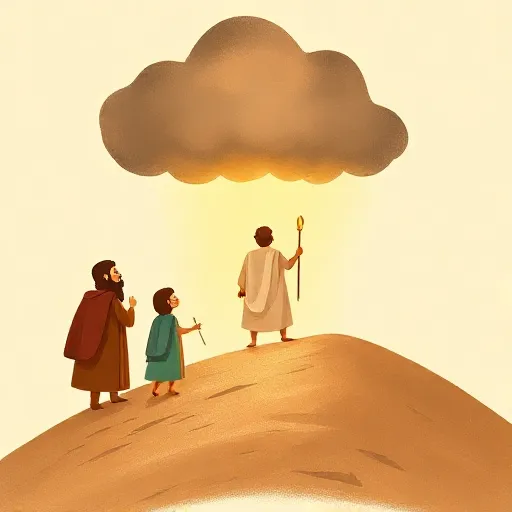
Eckhart loved to speak about God in two very different ways. Sometimes he described God as a boiling fullness — an overflowing ocean of being that cannot help pouring itself out. He borrowed the Latin word bullitio (a boiling) to describe the inner life of God: the Father, Son, and Holy Spirit eternally bubbling and glowing within the Godhead. Then there is ebullitio — a boiling over. This is God’s free act of creating the universe, like a pot so full that it spills over and gives being to everything. In this picture, God is pure existence, and creatures are like rays of light that borrow all their brightness from the sun.
But Eckhart also turned that picture upside down. In one of his most startling statements, he said that God does not exist because he understands. Intellect comes before being. To see why, think about your own mind. What is the intellect, all by itself, without any thoughts? It is not a thing — it has no colour, no shape, no place. It is like an empty space that can take in the form of whatever it knows. Eckhart argued that the divine mind is an even purer emptiness: a no-thing-ness that is not limited by any single description. In his German sermons he called God a “desert,” an “abyss,” a “wilderness,” or simply “the divine nothing.” This is not a gloomy nothingness, but a richness so full that no word fits it. God, he wrote, is neither this nor that.
How can God be both a boiling plenitude and a silent emptiness? Eckhart’s answer lies in a tool he used whenever he spoke about God: the little phrase insofar as (in Latin, in quantum). When you consider a caterpillar insofar as it is an insect, it has six legs; when you consider it insofar as it is a crawling animal, you might count more. No single description captures everything. Likewise, when we speak of God insofar as God is the overflowing source of all being, we call God pure being. When we speak of God insofar as God transcends every name and form, we call God a nothing. Eckhart thought both were true, as long as you remember that no human word ever pins God down.
The spark in your soul

Eckhart’s most daring idea was not just about God. It was about you. He taught that the deepest part of the human soul — what he called the ground (grunt) — is not created and does not come and go with time. It is, in a mysterious way, already one with the Godhead. He spoke of it as a “little castle” or a “spark” (vünkelin) that no creature can touch. This spark is not your ordinary reasoning or your feelings. It is the soul taken insofar as it is pure intellect — a bare, receptive nothing that can receive God the way a virgin receives a seed.
That image was more than poetry. Eckhart described the Christian life as a birth of the Word in the soul. Just as the Father eternally speaks the Son (the divine Word) within the Trinity, so the soul, when it is emptied of all images and attachments, becomes a place where the Word can be born again — not just once long ago, but right now, in the ground of the self. He said that “God cannot refrain” from flowing into a soul that has been cleared of distractions, “just as when the air is clear and pure the sun has to burst forth.”
But how do you clear the soul? You cannot just grab a mop. Eckhart warned that you cannot catch God by using special techniques like prayer, fasting, or ecstatic experiences. “Whoever seeks God in a special way,” he wrote, “gets the way and misses God.” The problem is that we are full of attachments — we cling to our own plans, our good deeds, even our ideas about God. True spiritual poverty, for Eckhart, meant letting go of the feeling that anything belongs to you, including your own acts. That is how the soul becomes a “virgin wife”: receptive enough to conceive the Word, but also “fruitful” enough to bring that Word to life through ordinary action.
Learning to let go

This path is full of paradoxes. Eckhart said we must “transcend the virtues” — go beyond rules and habits — yet at the same time he insisted that this is advice only for people who have already made the virtues so natural that goodness flows from them effortlessly. He loved the words abgescheidenheit (detachment) and gelȃzenheit (letting-go-ness). These are not flashy virtues like courage. They are quiet, negative habits of not gripping things too tightly. They help you stop being a separate, anxious self and start acting from the ground where your will and God’s will are one.
One of his most famous sermons flipped a well-known Bible story on its head. In the Gospel of Luke, Martha bustles around serving guests while her sister Mary sits at Jesus’ feet, listening. For centuries, preachers had praised Mary as the model of contemplation. But Eckhart thought Martha was the real master. Martha, he said, was so grounded in her essence that her busy chores did not distract her at all. Mary, still a beginner, was sitting “a little more for her own happiness than for spiritual profit.” Martha had reached the point of acting without a why — she simply did what was needed, freely, because God was acting through her. The goal, Eckhart said, is not to run away from the world but to be “with things and not in them.”
So the central spiritual question for Eckhart was not “What should I do?” but “From where do I act?” If you act from the uncreated ground, your activity is God’s activity, and you need no further reward. Even heaven itself, he wrote, is not something to aim for. The highest life is to live “without a why” (ȃne warumbe), simply because that is what God does.
Why Eckhart’s puzzles still matter

Eckhart’s ideas were not only a spiritual challenge; they were a philosophical shock. He pushed the logic of Christian theology to a breaking point, and later thinkers kept picking up the pieces. In the 1800s, German idealists like Hegel called him “the father of modern speculation.” In the twentieth century, the philosopher Martin Heidegger took Eckhart’s word Gelassenheit and used it for his own brand of thinking. Others have compared Eckhart’s paradoxes to Buddhist teachings about emptiness or to the Sufi idea of fanā’ (annihilation of the self).
But you do not need to be a scholar to feel the tug of his questions. If your deepest self is already one with something boundless, what are you really afraid of losing? If you stop chasing happiness and start acting “without a why,” would your life feel richer or just impossible? Eckhart does not give easy answers. He invites you to sit with the tension between being and nothing, speech and silence, activity and rest. In the end, he thought the very best we can do is to be still: “The very best and noblest attainment in this life is to be silent and let God work and speak within.”
That may sound impossible. But maybe that is the point.
Think about it
- If your deepest self is already one with something infinite, does it make sense to worry about making mistakes or being judged by others? Why or why not?
- Could you live an entire ordinary day — chores, homework, conversations — without doing any of it “for a reason”? What might that feel like?
- Eckhart said the best way to speak about God is to say what God is not. Can you describe the most important thing in your life only by saying what it is not?