If Math Is Only in Our Heads, Why Can It Predict Eclipses?
The Black Hole That Needed a River of Numbers
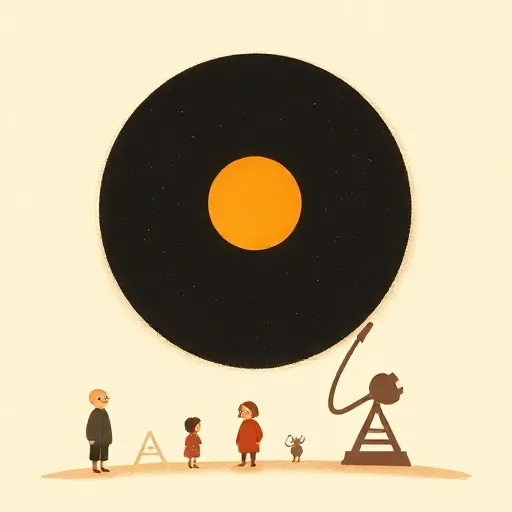
In April 2019, the world saw the first-ever photograph of a black hole. The fuzzy orange ring, captured by the Event Horizon Telescope, was not seen through an ordinary lens. It was reconstructed by feeding more data than you can imagine into equations — equations full of imaginary numbers, tensors, and sets so large they go beyond anything physical. The math was not a side helper; it was the engine that turned radio whispers into a picture of something 55 million light-years away.
This is common in science. When physicists talk about quarks, they rely on group theory. When evolutionary biologists model how species change, they use probability and differential equations. It seems our best stories about how the world works simply cannot be told without mathematics. But here is the puzzle: if a scientific theory needs numbers, sets, or functions to do its job, does that mean those mathematical things actually exist, the way that black holes and quarks do? Or are they just a convenient language — like the notes a musician reads, which are not the music itself?
That question is the heart of a famous argument in philosophy called the indispensability argument. It was shaped most powerfully by two thinkers: Willard Van Orman Quine (1908–2000) and Hilary Putnam (1926–2016). Their claim was bold: if mathematics is truly indispensable to our best scientific theories, then we have the same reason to believe in numbers and sets as we do to believe in electrons and galaxies.
”You Can’t Live Without Them”: The Argument in Plain Steps
The indispensability argument can be broken into two main ideas:
- We should believe in the things our best scientific theories cannot do without.
- Mathematics is something our best scientific theories cannot do without.
So, they conclude, we should believe in mathematical entities. Philosophers call the first premise a commitment to ontological commitment — a fancy way of saying what you are willing to count as part of reality. The conclusion is a form of platonism (named after the ancient Greek philosopher Plato), which says that mathematical objects are real, even though you can’t touch them. The opposite view is nominalism, which says numbers and sets are just useful fictions or names for patterns, not parts of the furniture of the world.
Why accept the first premise? Quine and Putnam gave two supporting ideas. The first is naturalism: the view that science, not pure reasoning or mystical insight, is our best guide to what exists. If you want to know whether quarks are real, you look at physics, not old myths. The second idea is confirmational holism: when a scientific theory gets confirmed by evidence, the whole theory — including its mathematical backbone — gets some of that support. It is like baking a cake; if the cake tastes amazing, you don’t just praise the flour and ignore the sugar. The success of the whole recipe gives credit to every ingredient that was necessary.
So holism supplies the “all” — believe in everything indispensable — and naturalism supplies the “only” — trust science to tell you what’s real. Together they defend that critical first step.
The Scientist Who Said “Not So Fast”

Not everyone agrees that mathematics is truly indispensable. The philosopher Hartry Field (born 1946) argued that we could, in principle, rewrite scientific theories without ever mentioning numbers. His idea was that mathematics is not a truth-telling part of our best theories — it’s a brilliant shortcut.
Field compared it to using a map. A map can get you across a city without describing every single stone in the pavement. The map works because it conserves the real geographical facts — nothing false is added, and nothing true is lost. But you don’t need to believe the map’s colored lines are real objects; they are tools. Similarly, Field thought mathematical theories are conservative: when you add them to a purely nominalist (number-free) science, no nominalist consequences appear that weren’t already there. Math just makes calculations faster and statements shorter.
To show this wasn’t just talk, Field tried to rewrite a big chunk of Newtonian physics using only points and regions, without quantifying over numbers at all. The result was monstrously long, but it was a proof of concept. If even one serious physical theory could be rid of numbers, maybe all of science could be, too. If Field was right, the second premise of the indispensability argument — that math is indispensable — would be false. Math would be handy, not necessary.
When Scientists Use Math They Don’t Believe In

Philosopher Penelope Maddy (born 1950) took a different line of attack. She noticed that in real scientific practice, people don’t treat all parts of a theory as equally believable. If naturalism tells us to respect how scientists actually work, then holism might be wrong — and the first premise would crumble.
Maddy pointed out that scientists constantly use false mathematical assumptions as helpful fictions. In the analysis of water waves, for instance, physicists often assume the water is infinitely deep. This makes the equations cleaner, and near the surface the predictions still match reality. But nobody — not even the most passionate platonist — thinks an infinite ocean exists. The math is treated as an idealization, not as a truth. Similarly, in fluid dynamics, matter is modeled as continuous even though we know it’s made of atoms.
What, then, of the math that is indispensable? If scientists themselves don’t believe everything in their well-confirmed theories, why should we swallow the whole thing? Maddy suggested the mathematical bits might be more like the “infinite deep water” assumption — part of the engine, not a picture of the world. For her, naturalism (following science) sides with the scientists who don’t believe all mathematical posits, rather than with holism, which would force them to.
Are Numbers Tested Like a New Medicine?

Elliott Sober (born 1948) offered a related worry about confirmation. In science, you test a hypothesis by comparing it with rivals. If you want to know whether a new medicine works, you don’t just give it to sick people and see if they recover; you compare the group that got the drug with a group that got a placebo. Evidence speaks for one idea only when it speaks against another.
Sober noticed that all scientific theories share the same basic mathematical backbone. There is no mathematics-free competitor in physics or biology that we can pit against the math-filled versions. Without such a contest, the success of our scientific theories never puts mathematics specifically to the test. A weather forecast that uses calculus might be accurate, but you can’t conclude from that accuracy that the number 3 exists, because you never checked whether a forecast without numbers would do worse. So the empirical support that flows to a theory’s physical claims does not automatically splash onto its mathematical toolkit.
This does not directly refute the first premise, but it weakens the holist idea that math gets an equal share of confirmation. If math isn’t being confirmed by the evidence in the same way, it is harder to justify treating it as part of reality simply because it appears in a successful theory.
Prime Cicadas and the Power of Explanation

After these attacks on holism, the debate took a fascinating turn. Maybe the real test isn’t whether mathematics is generally indispensable, but whether it plays a special role: explanation. Many contemporary philosophers now hold that you should believe in the parts of a theory that are genuinely doing the explaining, not just the parts that happen to be present.
This brings us to a quirky insect from North America: the periodical cicada. Some broods of these cicadas live underground for exactly 13 years before emerging; others wait 17 years. Those are prime numbers — numbers that can only be divided by one and themselves. Biologists have proposed that prime-numbered life cycles give cicadas a huge evolutionary advantage. With such a cycle, they almost never sync up with predators or competitors whose life cycles have shorter periods. It’s like showing up to a party only when you’re sure nobody else will be there.
The philosopher Alan Baker (writing in the early 2000s) argued that this is a case where mathematics itself does the explaining. The reason the cicadas survive better isn’t just a biological list of facts — it is a fact about prime numbers: that they have no non-trivial factors. If that’s right, then numbers are not just a convenient shorthand; they are part of the story about why the living world looks the way it does.
This “explanatory indispensability” shifts the fight. Even if Field could eliminate numbers from a physical theory, the cicada case suggests that getting rid of numbers would make the explanation worse — it would leave out the very thing that makes the pattern understandable. Many philosophers now debate whether such cases really show what Baker hopes, or whether the numbers are just dressing for the biological facts. The question is alive and well.
Why This Fight Matters for Your Math Homework

You may be wondering whether all this matters beyond dusty philosophy departments. It does. When you solve a physics problem that correctly predicts the swing of a pendulum or the path of a planet, you are relying on numbers and functions. If platonism is true, you are staring at the abstract skeleton of reality — mathematics is something you discover, like a hidden continent. If the critics are right, you are using a brilliant human invention, a language that helps us talk about patterns without making the language itself part of the universe.
The indispensability argument matters because it forces you to ask: what makes something real? Is it enough that a thing appears in the best story science tells, or must it also pull its weight by explaining the world in a way that cannot be replaced? For now, there is no settled answer. Quine’s original vision has cracked and been rebuilt, but the debate has never been sharper. The next time you calculate a planetary orbit or graph a line of best fit, remember — you are holding a piece of a philosophical storm that has been raging for decades.
Think about it
- If you could do all of science using only shapes and points, never once mentioning the number 2, would you still believe the number 2 exists? Why or why not?
- In a video game, your character has “health points” that are not real, yet they still affect what happens. Are the numbers in a scientist’s theory any different from those health points?
- Imagine we discover that mathematics was invented by humans by accident. Would that make the fact that 7 is a prime number any less certain than it is today?