
What If Two Plus Two Equaled Five—and It Was Fine?
A Picture That Can’t Be Built
You stare at the print. It shows a grand building with columns that twist upward in a way no real building could. At first glance everything looks normal, but the more you look the wronger it gets. The pillars connect a top balcony to a bottom courtyard as if two different realities were stitched together. M. C. Escher drew many such impossible scenes, and holding one in your hands feels like holding a contradiction you can see.
In everyday life, a contradiction is two claims that cannot both be true — like “it is raining” and “it is not raining” at exactly the same spot and moment. Classical logic has a strict rule about contradictions. From a single contradiction, every statement you can think of becomes provable. This rule is called explosion (the Latin phrase is ex contradictione quodlibet). If “it’s raining” and “it’s not raining” were both accepted, explosion would let you “prove” that the Moon is made of cheese. That’s why mathematicians treat contradictions like dangerous cracks in a building: one crack, and the whole structure collapses into nonsense.
But what if a contradiction didn’t have to explode everything? What if your picture of the impossible building wasn’t just an optical prank, but a real mathematical object that could be described with its own kind of logic? That question gave birth to inconsistent mathematics.
The Set That Ate Itself

Around 1900, the mathematician and philosopher Bertrand Russell (1872–1970) noticed a terrifying problem. He and Gottlob Frege (1848–1925) had dreamed of building all of mathematics from one simple idea: for any clear property, there is a set containing exactly the things with that property. That idea is called naive comprehension. The set of all red objects, the set of all even numbers — all fine. But Russell asked: what about a set of all sets that are not members of themselves? Does that set belong to itself?
If it does, then by its own rule it must not be a member. If it does not, then it qualifies and must belong. Both answers lead straight to a contradiction — the Russell set is and is not a member of itself. Think of a barber in a village who shaves all and only those who don’t shave themselves. Who shaves the barber? If he shaves himself, he shouldn’t; if he doesn’t, he must. The paradox showed that naive set theory, under ordinary logic, explodes into triviality.
The standard repair was Zermelo‑Fraenkel set theory (ZF) — a careful list of rules that prohibits naughty sets like Russell’s. But some logicians, among them Richard Routley, Graham Priest (born 1948) and the Australian logician Ross Brady (20th–21st century), chose a different path. They kept the simple comprehension principle and changed the logic instead. They threw out explosion, and with it a related rule called disjunctive syllogism (from “A or B” and “not A” you can deduce B). The new logics are called paraconsistent logics — they allow contradictions to exist without making every statement true. Brady later built an inconsistent naive set theory where the Russell set genuinely both belongs and does not belong to itself, yet mathematics doesn’t dissolve. Suddenly the old dream of logicism, the idea that all of mathematics reduces to logic, looked alive again — no longer killed by Russell’s contradiction.
When 2 = 0 (and It’s Okay)

If you can keep a set contradiction, could you keep an arithmetic contradiction too? The American logician Robert K. Meyer (1931–2009) thought so. Around 1976 he built an inconsistent arithmetic by taking the ordinary integers and “collapsing” them so that numbers that differ by 2 are treated as the same. In a three‑valued paraconsistent logic, both “0 = 2” and “0 ≠ 2” become true. Yet addition and multiplication still deliver the results you expect. The contradiction doesn’t infect your sums.
Meyer used this to revive a famous project. David Hilbert (1862–1943) wanted to prove that mathematics is free of contradictions using only simple, safe steps — his Hilbert Program. That hope was thought to be ruined by Kurt Gödel’s incompleteness theorems, which showed that a mathematical system cannot prove its own consistency. But inside Meyer’s inconsistent arithmetic, you can prove something almost as good: whatever contradictions might lurk in the system, they can never mess up your numerical calculations. In that sense, Hilbert’s goal of showing mathematics is trouble‑free turns out to be reachable if you let go of explosion.
Graham Priest and others later developed richer inconsistent arithmetics where even a truth predicate lives comfortably. The Liar paradox — “This sentence is false” — becomes both true and false, a true contradiction. Priest calls this dialetheism, the view that some contradictions are not mistakes but truths about the world. So inconsistent mathematics isnʼt just a clever trick; it might describe the real logical furniture of our language.
Math That Draws Impossible Things
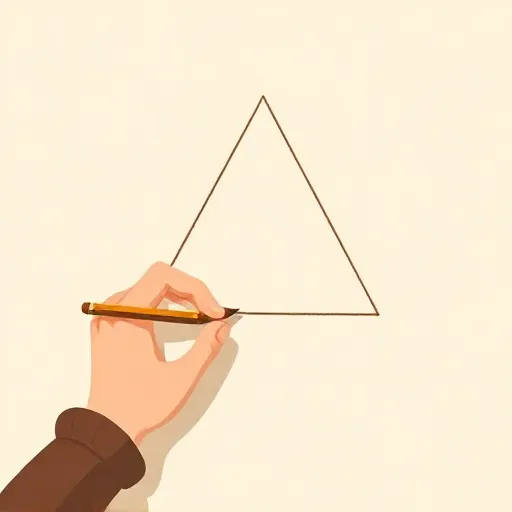
Escher’s impossible pictures make your brain stumble. You see two edges meeting and yet not meeting. Classical geometry treats them as illusions — a cheat of perspective. But the philosopher Chris Mortensen (20th–21st century) argued that no consistent theory can capture the feel of genuinely seeing an impossible object. Only an inconsistent geometry, where a boundary both separates and doesnʼt separate two regions, matches that experience.
In fact, inconsistent mathematics has become a natural language for describing the cutting‑and‑pasting that mathematicians do in topology — where identifying two edges of a space can be described by saying the two edges are and are not identical after gluing. Closed‑set logic, a sibling of the open‑set logic used in intuitionistic mathematics, naturally handles contradictions at boundaries: on the overlapping border, a point is both inside and outside the space. So impossible figures, like the Reutersvärd–Penrose triangle, don’t belong to fairy tales; they are genuine mathematical structures that arise when you reason with boundaries.
Even the old calculus trick of shrinking an error down to zero can be modeled with contradictory thinking, sometimes by splitting a problem into separate consistent “chunks” and moving conclusions between them — a method Brown and Priest call Chunk and Permeate. The point is that contradictions, when carefully fenced in, are not monsters but tools.
A Universe of Mathematicians

If inconsistent mathematics works, then the old picture of one true mathematics cracks open. You can do geometry where parallel lines never meet, and geometry where they always do. You can do set theory with ZF’s strict fences, and set theory where the Russell set lives openly. None needs to be the “real” one; each is a consistent or paraconsistent world of its own. This is mathematical pluralism — the idea that mathematics is a collection of structures, not a single building with one perfect blueprint.
Pluralism matters because it changes the question “Is this true?” into “What can we discover here?” Just as a novelist can write an impossible house and make it feel real, a mathematician can explore a contradictory set theory and find new theorems about infinite sizes, or show that the Axiom of Choice follows from a paraconsistent framework. The subject of mathematics becomes the study of theories themselves, with contradictions welcomed as interesting neighbours rather than signs of disease. Next time you puzzle over a logic board game whose rules seem to clash, you might smile: maybe you are holding a miniature inconsistent system, waiting to be mapped.
Think about it
- If someone drew a picture of a square circle, could a mathematician describe it with a special logic, or is it just nonsense?
- Can you imagine a real‑life situation where something seems both true and false at the same time? How would you decide how to act?
- If you designed your own mathematical universe and let yourself keep one contradiction (like 1 = 0), what other rules would you have to change so your arithmetic still made predictions you could trust?