
Are Words Invisible Hands That Reach Into Someone’s Mind?
“It’s Raining” — Words as Tools of Thought
It is a grey afternoon, and the first big drops splatter against the classroom window. Somebody murmurs, “It’s raining.” Instantly, hands reach for backpacks, jackets get zipped, and plans change. But how did three little sounds — just vibrations in the air — flip a switch in all those brains? That is the puzzle that grabbed Anton Marty, a philosophy professor in Prague in the late 1800s.
Marty was not interested in how words changed over centuries or how babies learn to babble. He wanted to understand language right now, in the moment somebody speaks and somebody else understands. He had learned from his teacher Franz Brentano that every act of the mind is intentional — your thought is always about something, like an arrow that cannot fly without a target. If you picture a dragon, your mind points to a dragon, even though no dragon exists outside your head. Marty took that idea and asked: what happens when the arrow you shoot is a word? His answer was surprising. Speaking is not just flapping your tongue. It is an attempt to reach into another person’s mind and plant a thought, a judgment, or a feeling there.
That means language is not a dusty museum of labels. It is purposeful action. Marty called it the purposeful manifestation of inner life — a way of showing the invisible contents of your consciousness and getting someone else to share them. All the puzzles about meaning, truth, and even right and wrong, he thought, start from that simple, electric moment of one mind aiming at another.
The Three Kinds of Meaningful Speech
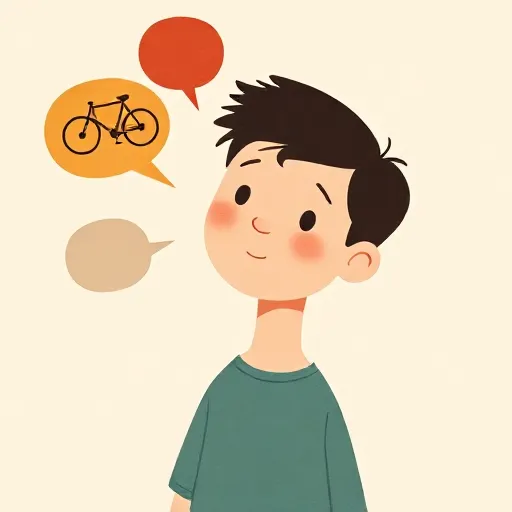
Marty’s big idea was that the words you use are built to match the three basic moves your mind can make. His teacher Brentano had sorted all conscious acts into three families: presentations (just having an image or idea in mind), judgments (accepting something as real or rejecting it), and phenomena of love and hate (all the shades of wanting, liking, disliking, or valuing). Marty lined up language with those three boxes and gave each one a job.
First come names, or what Marty called presentational suggestives. If you say “a blue whale” or “my grumpy cat,” you are trying to summon a specific picture in the listener’s mind. The word works like an invitation: imagine this, right now.
Next are statements, such as “The cat is on the sofa.” Here you are not just pointing at an image; you are asking the hearer to accept that state of affairs as true. For Marty, every statement boils down to either an acceptance or a rejection — a mental “yes, that exists” or “no, that does not exist.” Even a plain sentence like “It is raining” really means something like “I judge that the event of raining is happening, and you should judge the same way.” The statement is a communicator of judgment.
The third family is emotives, or interest‑demanding expressions. “Help!”, “I wish you were here,” or “Don’t you dare!” all belong here. When you use an emotive, your aim is not just to make someone think of something or judge it true, but to stir a feeling or a will-act that matches your own. You are trying to make the other person care the way you care.
Notice how each kind of speech has a purpose that goes beyond the words themselves. The meaning is not just a definition in a dictionary. It is the intended mental effect on a listener. That is why Marty said you cannot really understand a sentence unless you know what the speaker is trying to do inside your head.
The Hidden Bridge: Why Metaphors Work
If every word is an arrow aimed at a thought, how does the arrow actually hit the target? Marty noticed that many expressions come with a silent helper: a little presentation that acts as a bridge between the sound and the meaning. He borrowed a term from earlier thinkers and called it inner linguistic form.
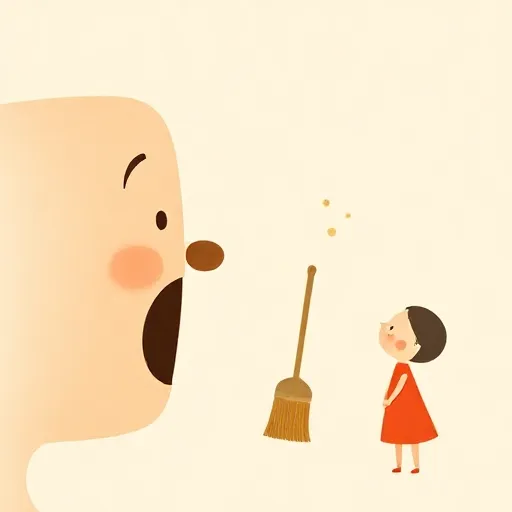
Take the phrase “to sweep an opinion aside.” Nobody literally pushes a thought with a broom. But when you hear those words, a quick image flashes — the swish of bristles brushing something off a table — and that image makes the real meaning feel obvious. The inner form is not the meaning itself. It is the mental shortcut, the flash of metaphor or association, that carries you from the noise to the idea. Marty pointed out that other expressions, like “to give a hand” or “a warm welcome,” work the same way. They pack a tiny picture that helps your mind grab the sense almost instantly.
He also noticed that grammar builds its own inner bridges. As you hear the first part of a sentence — “If the train is late…” — your mind already starts to expect a certain kind of completion, like “then we’ll miss the start of the film.” That expectation is another kind of inner form, what Marty called a constructive inner form, scaffolding your understanding before the sentence is even finished.
Why does this matter? Because Marty thought many philosophers and linguists got confused and mixed up the bridge with the destination. They treated the mental image as if it were the meaning itself. Once you see that the image is only a helper, you can separate the tool from the thought it delivers. And that insight, Marty believed, unlocks a much clearer picture of how language actually works.
Did Language Start with a Grunt or a Plan?

If speaking is purposeful, where did the purpose come from in the first place? In the 19th century a fierce debate raged about the origin of language. One side, which Marty called nativism, claimed that language grew out of instinctive cries and reflexes — babies make sounds, those sounds get attached to objects by association, and very slowly, without anyone meaning to, language emerges. The other side, empiricism, denied any inborn link between sound and thought. It said language is entirely learned, a collection of habits.
Marty rejected both. He argued that from the very beginning, language was a tool made on purpose. Early humans, he said, felt a basic need to cooperate and to let others know what was going on in their heads. They did not sit down and invent a whole grammar book in one afternoon. But each small step — choosing a sound to signal danger, using a gesture to invite someone to look — was driven by a conscious, goal‑directed mind, not by blind reflex. In his view, even the simplest cry was already an act of intentional communication: one person aiming to produce a specific mental act in another.
This was a bold claim. It meant that language was not an accident that happened to humans; it was something humans did. Marty believed that if you forget the purposeful nature of speaking, you cannot explain why a sentence like “The fire is hot” makes sense in a way that a random string of sounds does not. Words are not echoes of the body; they are messengers of the mind.
Your Words, Your Mind: Why It Still Matters

Marty’s picture of language may sound like philosophy from a dusty library, but it touches everything you do when you talk, text, or even think. Notice what happens when a friend tells you a joke. They are not only describing a situation; they are aiming to produce a pleased, surprised state in your mind. When somebody says “I believe you,” they are not just reporting a fact about themselves; they are trying to get you to accept that your words were judged to be true. Even a tiny phrase like “I’m okay” is rarely a simple label. Often it is an emotive in disguise, meant to stop you from asking more questions.
Understanding speech as purposeful action gives you a special kind of superpower. You begin to see that words are always doing work — shaping how you judge, what you care about, and how you picture the world. That is why Marty’s ideas echo into the 21st century. Later thinkers who studied how we perform actions with words — promising, apologising, persuading — walked a path that Marty helped clear. His insistence that meaning is never just a floating dictionary entry, but something that lives in the exchange between two minds, is a reminder that every time you open your mouth, you are planting a tiny seed in someone else’s consciousness.
On that rainy afternoon in the classroom, “It’s raining” was never just a sound. It was a judgment, a warning, and a shared reality, all packed into two words. According to Marty, that is what language always is: the invisible hand of one mind reaching out to another.
Think about it
- If you whisper “I’m scared” to a friend and they hear the words but do not feel scared themselves, did your sentence do its job? What would Marty say?
- A robot can say “I’m happy” with a perfect human voice. If Marty is right that speaking is a purposeful attempt to share inner life, can the robot ever really mean those words?
- Think of a time you used a metaphor, like “my brain is fried.” What mental picture flickered inside you — and did that picture confuse or sharpen what you were trying to say?