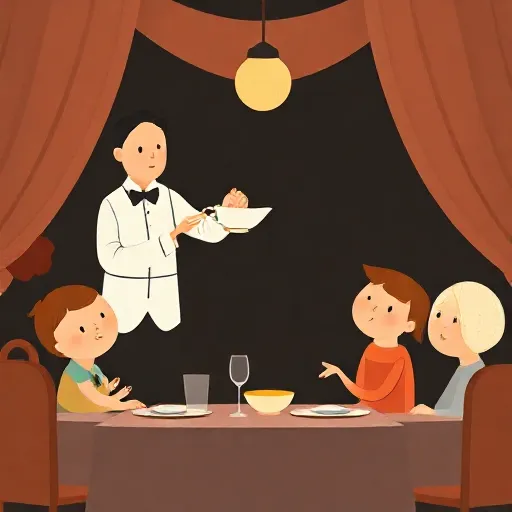

How Does a Waiter Know Without Asking?
How Information Rules Out Possibilities

You are at a café with a friend. You order a soda and an espresso. When the waiter arrives, he asks, “Who gets the soda?” You say it’s yours. Without another word, he hands your friend the espresso. He didn’t need to ask. How did he know? Because you gave him one tiny piece of information, and that let him cross out the only other possibility. Before you answered, two worlds were possible in his mind: one where you had the soda and your friend had the espresso, and another where it was the opposite. Your answer eliminated the second world. Only one remained.
This idea — that information is what lets you rule out possible worlds — was first spelled out in 1952 by philosopher Yehoshua Bar-Hillel and logician Rudolf Carnap. They called it the inverse relationship principle: the more a statement rules out, the more information it carries. A statement that leaves many possible worlds standing is weak and carries little information. A statement that narrows things down to just a few worlds is powerful and informative.
Think of “the soda is for me” as pointing to a set of possible worlds — those where you really are the soda-drinker. That set is its information range. If a statement is true in most possible worlds, its range is wide, it’s very likely true, and it’s not very informative. If it’s true in only a tiny slice of worlds, the range is narrow, it’s surprising, and it’s packed with information. So there’s a built-in trade-off: the safer and more obvious a claim, the less information you get from it.
This way of thinking captures something deep. But it also leads to a weird puzzle. What about a statement that is false in every possible world — a contradiction, like “it’s raining and it’s not raining”? It rules out all worlds, so by the measure, it would be maximally informative (a score of 1.0). Yet you can’t learn anything from it. Bar-Hillel and Carnap noticed this puzzle but didn’t try to solve it. They just said their theory wasn’t designed to handle that kind of case.
The Big Puzzle: Can a Lie Carry More Information Than the Truth?

The inverse relationship principle says that the less likely a statement is, the more information it holds. A logical truth like “either it will rain or it won’t” is always true — it holds in every possible world. Its information range is the whole space, so it carries zero information. A contradiction, on the other hand, is never true. It’s as unlikely as anything can be, so its information score is 1 — the maximum. This is the Bar-Hillel-Carnap Semantic Paradox. If a friend tells you, “I’m bringing a cake made of solid gold that’s also not made of solid gold,” the statement is impossible, and yet by the numbers it’s a burst of pure information. That feels wrong.
Some philosophers, like Luciano Floridi, have argued that real information must be true. He calls this strongly semantic information. By that rule, a lie or a contradiction simply carries zero information — no matter how many possible worlds it would wipe out. Others think the problem is deeper, and we need a whole new way to measure informativeness that doesn’t just count worlds but cares about whether a statement connects to reality at all.
This puzzle shows that deciding what counts as information depends on more than just probabilities. It also depends on whether we care about truth, workability, or something else entirely. The waiter’s answer works because it’s true. But imagine you lied and said the soda was yours when it wasn’t. The waiter would still cross out a possible world — the wrong one — and your friend would end up with the wrong drink. Information, it seems, has to get something right about the world, or it leads you in circles.
Information Points to Something Else: The Correlation View

Another major approach says that information is never just about ruling out possibilities. Information is always about something else. A dot moving on a radar screen doesn’t just narrow some abstract set of worlds; it tells you that a real plane is moving north. The connection exists because there is a lawful relationship — a constraint — between one type of situation and another. This is the information as correlation view, developed by Fred Dretske and later by Jon Barwise and John Perry with their situation theory.
In this view, the world is made of concrete chunks called situations, like a radar screen at a particular moment or a flying plane at a particular altitude. Situations support little informational units called infons. The simplest infon is something like “the dot is moving upward” or “the plane is moving north.” An infon by itself is not a claim about the whole world; it’s more like a note about a local situation. Information flows when a constraint links two types of infons: whenever a situation supports the first kind, a connected situation supports the second kind. In the radar case, the constraint is “if a radar dot moves upward, the linked plane moves north.”
This means information always rides on a structure of relationships. If the radar is broken and the constraint fails, then the dot moving upward no longer carries information about the plane — it carries nothing, or perhaps misinformation. So the correlation view naturally explains why we need the background system to work properly. It also captures the idea of aboutness: information is always about something beyond itself. Dretske even proposed an Xerox principle: information can be copied from one situation to another without loss, as long as the chain of constraints holds solid, just like a photocopier preserves a document.
Information Is All About How You Encode It: The Code View

So far, the views have treated information as something already “out there,” waiting to be measured or traced. But there’s a third stance: information doesn’t just sit in the world; it gets encoded, stored, and processed. This is the information as code approach. Imagine you buy a flat-packed table from IKEA. In one sense, you have a table — all the pieces are in the box. In another sense, you absolutely don’t have a table until you assemble it. The same goes for reasoning. You might have all the premises of an argument in your head, but you don’t have the conclusion until you do the mental work of putting them together.
This idea gave rise to a whole family of logics called substructural logics. Ordinary logic lets you do things like ignore extra information, reuse the same piece of information endlessly, or change the order of steps without care. Substructural logics are pickier. They track exactly which pieces of information you used (by rejecting the rule called Weakening), how many times you used them (by rejecting Contraction), and in what order (by rejecting Commutation). Some even keep track of how pieces are grouped together (by rejecting Association). The weaker the logic, the more it behaves like a real thinking process where you can’t just magically reshuffle facts.
The mathematician Joachim Lambek created some of the earliest systems of this kind in the 1950s to model the grammar of languages. Later, philosophers and computer scientists realized these same systems describe the step-by-step flow of information in a mind or a machine. This is sometimes called categorial information theory. It matters because it shows that the way you encode and combine information changes what you can learn. A contradiction you haven’t yet noticed might sit harmlessly in your knowledge base; it only becomes a problem when you process it and see the clash. So even “false” information has a kind of life inside an encoding system.
Why This Matters When You Text a Friend

These three big pictures of information — as a range of possibilities, as a network of correlations, as an encoded structure — aren’t just dusty philosophy. They’re alive every time you use a phone, hear a rumor, or solve a puzzle. When you see a friend’s status change to “online” and you infer they’re probably free to chat, you’re using the correlation view: the app links a signal to a real state of affairs. When you narrow down who sent you an anonymous note by thinking about word choices, you’re ruling out possible worlds — that’s the range view. When you type a password that’s encrypted and can only be unlocked with a key, you’re in the code view: nothing about the string of letters by itself tells you the message; the encoding and processing are what make it information.
Philosophers haven’t settled which view is the “right” one. In fact, many now think that a full picture of information will have to weave together all three. And that matters for building better search engines, smarter AI, and clearer communication. Information isn’t just one thing; it’s a dance of narrowing, pointing, and organizing.
Think about it
- If your friend tells you, “I’ll either come to your party or I won’t,” that statement rules out zero possible worlds — so it gives no information by the range measure. But if they tell you a riddle whose answer turns out to be a contradiction, like “I’m coming and not coming,” does that give you any useful information? Why or why not?
- A secret note is encrypted so that it looks like gibberish without a key. Using the “code” view of information, is the encrypted text already information, or does it only become information once someone can decode it? What if no one ever can?
- Think of a rumor you heard at school. How would each of the three views — range, correlation, code — explain what makes that rumor informative? Which view makes the most sense to you in that case?