
Can Two Things Be in the Exact Same Spot at Once?
The Ghost in the Wall

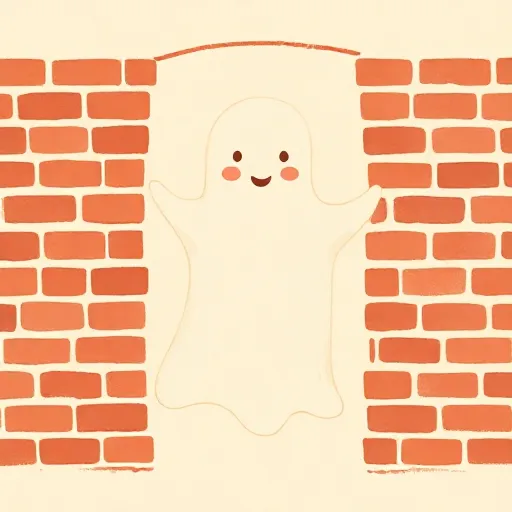
Close your eyes and imagine a ghost floating through a solid brick wall. The ghost passes right through, but the wall stays whole. Could that really happen? Your first answer is probably “no,” because real things can’t share the same exact spot — your desk and your iPad can’t both fill the same bit of space. But why not? And what if there are weirder cases: something with no parts at all that still stretches across a whole room, or a person who is in two places at once?
To get at these puzzles, philosophers ask two big questions. First, what does it really mean for a thing to be exactly located somewhere? Second, how do an object’s parts relate to the parts of its location? The answers lead to surprising debates about ghosts, time travel, and the tiny building blocks of the universe.
The Perfect Match: Mereological Harmony

Imagine you build a Lego castle. The castle has parts — turrets, bricks, little flags. You can say that each brick is a proper part of the castle (a part that is not the whole thing). The castle itself is exactly located in the spot it fills on the floor: it has the same shape and size as that region, and stands in the same spatial relations to other things.
Now look closely. Each brick also has an exact location, and that brick‑location is a subregion of the castle’s location. The tower’s location is part of the whole location. This perfect mirroring has a name: Mereological Harmony (mereology is the study of parts and wholes). More precisely, if the castle is complex (has proper parts), its location has matching subregions. If a brick is simple (has no proper parts), its location should also be simple, like a point. Most of us assume that this harmony holds for everything, everywhere, necessarily.
But what if it doesn’t? Philosophers have imagined cases where the mirror cracks — where objects and their locations fail to match. Four famous cracks are interpenetration, extended simples, unextended complexes, and multilocation. Each one threatens the idea that parts and locations always line up.
When Things Overlap Without Sharing: Interpenetration
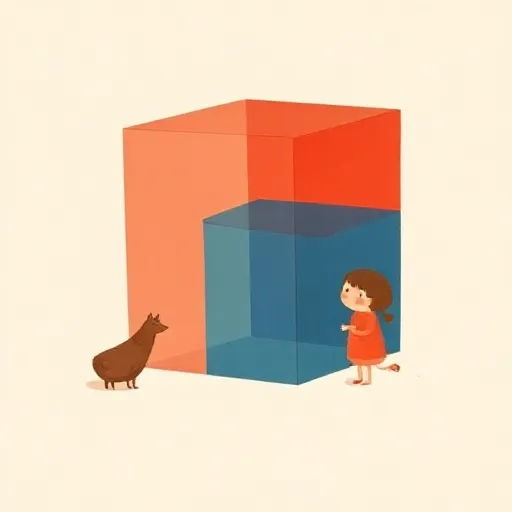
Interpenetration happens when two things have overlapping exact locations, but don’t overlap as objects — they don’t share any parts. The ghost and the wall are an example. If interpenetration is possible, then Mereological Harmony is in trouble, because the locations overlap but the objects don’t.
Could it be real? One argument comes from universals. A universal is a property that many different things can share, like being charged or being red. Some philosophers, called immanent realists, say that a universal is fully present in each thing that has it. So the universal electron charge is completely in your left earbud and also completely in your right earbud — two distinct objects. If universals have exact locations at all, then the charge‑universal and the mass‑universal of a single electron would both be exactly at the same spot, yet they are distinct and don’t share parts (they are simple, different universals). That’s interpenetration.
Other arguments appeal to your imagination. You can conceive of two pieces of matter passing through each other, like light beams crossing. And some physicists point to bosons — particles that, unlike ordinary matter, can bunch up in the same quantum state. Some philosophers take that as evidence that interpenetration is actually happening in the subatomic world.
On the other side, many philosophers insist that No Interpenetration is a necessary truth: if two things’ locations overlap, the things themselves must share a part. They might grant that ghosts or universals could be special, but material objects like bricks and bodies cannot pass through each other without sharing parts. The debate isn’t settled; it forces us to ask whether the rules for locations change depending on what kind of thing you are.
A Simple Thing That Takes Up Space: Extended Simples

A simple is an object with no proper parts. A point‑sized particle, like a tiny dot, could be simple. But could a simple be extended — bigger than a point, with shape and size, yet not built out of any smaller pieces? If so, we have an extended simple, and Mereological Harmony breaks: a simple object sits in a complex location (a region with subregions), violating the rule that simple things occupy simple spots.
Some thinkers appeal to string theory in physics. According to the physicist Brian Greene, strings are “atoms” in the original sense — uncuttable. Even though a string has length and can wiggle, it isn’t made of any smaller things; the question “what are strings made of?” has no content. If Greene is right, strings are extended simples.
But a famous puzzle stands in the way. Suppose an extended simple, shaped like a hammer, is white at the handle and gray at the head. How can one simple thing have two different colors at once? It can’t have a white part and a gray part, because it has no proper parts. One solution says the simple has a special kind of property, a distributional property, like being‑half‑white‑and‑half‑gray, that isn’t built out of parts’ properties. Others say we should rethink how color attaches to places, maybe by saying the simple “instantiates‑here white” and “instantiates‑there gray,” much like how we talk about time travel and change. The problem mirrors the classic puzzle of how one person can change over time yet stay the same person — so the same solutions get borrowed.
Not everyone is convinced. Some philosophers maintain that extended simples are impossible, precisely because of this color‑variation problem. The argument continues, with each side drawing different lines in the sand about what properties really are.
In Two Places at Once: Multilocation

Multilocation means having more than one exact location. Imagine a time traveler who visits last Tuesday three times: on her original trip, then again during a “redo,” and once more by accident. At a single instant on Tuesday, the traveler is present three times over — one person, three non‑overlapping spots. That violates the rule that nothing has more than one exact location, so Mereological Harmony (which assumes exactly one location per object) would fail.
Immanent universals provide another argument. If the universal redness is wholly present in every red thing, then redness is exactly located at a vase in Italy and at a fire truck in Canada — two locations that don’t overlap. That’s multilocation.
But some powerful objections have been raised. Consider a scenario from philosophers Effingham and Robson: a time‑traveling brick, Brick₁, goes back repeatedly so that at one time there seem to be 100 bricks. A bricklayer arranges those into a wall, Wall. It seems Brick₁ is a proper part of Wall, and Brick₂ (which is actually still Brick₁ on a different trip) is a proper part of Wall, and so on. According to the standard rules of parthood, if one thing is a proper part of another, there must be a remainder — a part of the whole that does not overlap the first part. But in the wall, every part overlaps every brick, because all 100 bricks are the very same brick! So multilocation seems to conflict with the minimal logic of parts.
Friends of multilocation have a clever reply: maybe parthood isn’t a simple two‑place relation (“x is part of y”). Instead, it might be a four‑place relation: “x at location r is a part of y at location s.” Then Brick₁ at spot A is a proper part of Wall at the whole wall’s region, and Brick₁ at spot B is a different part‑instance that doesn’t overlap the instance at A. This lets you keep multilocation without breaking the rules of mereology.
The debate over four‑place parthood is highly technical, but it shows that the possibility of being in two places at once pushes us to rethink the very grammar of “part of.”
Why Does It Still Matter?

You probably never worry that your backpack might fuse with the floor, or that your left hand is a ghost passing through your desk. Yet those everyday certainties rest on the idea that objects and their locations obey strict harmony. What if that harmony is not necessary, but just a local rule of our corner of the universe? The puzzles of interpenetration, extended simples, unextended complexes, and multilocation matter because they test the border between what merely happens to be true and what must be true.
When physicists tell us that the smallest bits of matter are point‑like particles that can’t be split, or that wave‑like strings have no deeper parts, they’re making claims that involve location and parthood. Philosophers ask: could we conceive of a world where two people share exactly the same region but remain distinct persons? Could a whole society be exactly located in a single grain of sand? If your answer is “that makes no sense,” you’re already doing the kind of thinking that drives the debate.
So the next time you see a cartoon ghost glide through a wall, you’ll know the real question isn’t about ghosts. It’s about what it means for anything — including you — to be here.
Think about it
- If you could walk through walls, would you still count as a solid object? What would have to change about what you are?
- Imagine a tiny point that has smaller parts — a dot made of even tinier dots. Is that really possible, or does the idea break down? Why?
- If you could time travel and meet your past self, would you both be the same person in two places at once? What would that mean for saying “I am here”?