Can You Build All of Math with Parts, Not Sets?
The Train He Missed and the Puzzle He Couldn’t Let Go

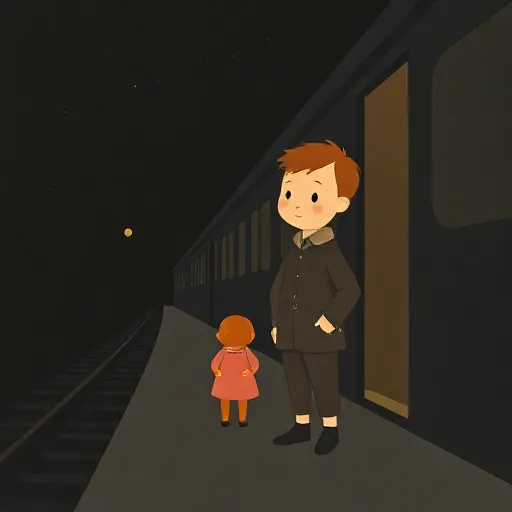
One afternoon in 1911, a young Polish thinker named Stanisław Leśniewski (1886–1939) found himself rushing through a Russian train station. He had to change trains, but he was deep in thought. He had just read about a new logical puzzle called Russell’s Paradox — the discovery that the idea of a “set of all sets that don’t contain themselves” leads to a contradiction. Leśniewski was sure the problem could be fixed, and he started scribbling a solution right there on the platform. He was so wrapped up that he missed his once-a-day connection, and the train left without him.
That missed train turned into a lifelong obsession. Leśniewski spent the rest of his life trying to build a flawless foundation for mathematics — one that avoided the paradoxes and sloppiness he saw in the “set theory” most mathematicians used. Instead of sets, he turned to a simpler, more down-to-earth idea: parts and wholes. This project led him to invent three completely new logical systems, each built on the one before. They are called Mereology, Ontology, and Protothetic. They were difficult, rigorous, and so unusual that even today only a handful of people use them. But the force of his ideas — about what a part is, how names work, and what it means to be perfectly precise — still echoes through logic and philosophy.
A World Without Sets: How Parts Took Over

Why would anyone want to replace sets with parts? After all, we talk about sets all the time: a set of trading cards, a set of planets in the solar system. But when mathematicians treat sets as abstract objects that can contain themselves, spooky paradoxes appear. Leśniewski thought the whole idea of a “set” was a fiction that got in the way of clear thinking. He believed that instead of sets, we should only speak about concrete parts and the wholes they make up.
This was his first system, Mereology — a word he invented from the Greek meros (part). The basic rules are simple: one thing can be a part of another (a wheel is part of a bicycle), and that relation is asymmetric (if A is part of B, B is not part of A) and transitive (if A is part of B and B is part of C, then A is part of C). From “part,” he defined ingredient (something that is either the whole or a part of it) and then a class — but a class was not an abstract set. It was the whole object formed by gathering several things together. If you have a pile of bricks, the “class of those bricks” is just the pile itself — a concrete thing, not a mysterious container. Every object, in his view, is simply a mereological sum of its parts.
This approach meant Russell’s Paradox couldn’t even get started. Since every object is part of itself and no object is a class that doesn’t contain itself, the contradictory set simply doesn’t exist in his world. Leśniewski would later joke that other set theories were their problem, not his. To him, the logic of parts was the only honest way to talk about collections.
When a Sentence Is a Name: The Odd Logic of Ontology

Building Mereology forced Leśniewski to ask a deeper question: what do we even mean when we say “A is B”? That little word is is surprisingly tricky. He decided to create a logic of names and predication, which he called Ontology (from the Greek ontos, “being”). The system took its name from the fact that it connected language to what exists — but in a very different way from traditional logic.
The central symbol was a lower‑case epsilon ε, borrowed from the Greek word for “is.” A sentence like “Fido ε dog” reads as “Fido is a dog.” But what makes such statements true? Leśniewski boiled it down to one long, elegant axiom: A ε b is true if and only if there is at least one A, there is at most one A, and whatever is an A is also a b. In other words, to say “Socrates is a philosopher” you are claiming that the name “Socrates” points to exactly one thing, and that thing is among the many things called “philosopher.” If “Socrates” pointed to nobody, or to two different people, the statement would be false.
This allowed names to denote any number of things — one, many, or even none. The name “unicorn” denotes nothing, but you can still use it in logical sentences without making the whole system collapse. This gave Leśniewski’s logic a special tolerance for empty terms that frustrated other systems. To keep things organized, he invented the theory of semantic categories, grouping expressions by whether they formed sentences (like “Socrates ε philosopher”) or names, and how they could combine. It was like a grammar for logic itself, ensuring no nonsensical strings ever appeared — a safeguard against the confusion he saw in earlier logicians.
The Perfectionist’s Toolkit: Protothetic and the Search for a Perfect Start

Beneath both Mereology and Ontology lay an even more basic logical layer: the rules for connectives like “if,” “not,” and “and,” and the way quantifiers like “for all” and “for some” work. Leśniewski called this deepest system Protothetic (“first theses”). He wanted to start from the fewest possible primitives — ideally just equivalence (“if and only if”) and the universal quantifier — and build everything else by careful definitions.
His approach was painfully exact. He allowed only nominalistic definitions: new expressions in the object language that actually added to what the system could say, not just handy abbreviations. He also insisted that his logical systems were not abstract games but concrete collections of marks — ink on paper — that grew over time as new theorems were added. A logic was something you could point to, not a ghostly set of all possible truths. This extreme view, called inscriptionalism, made his method incredibly demanding. Each new definition had to meet eighteen separate conditions before it could be admitted.
The results were powerful but unwieldy. His student Alfred Tarski (who would become a giant of modern logic) helped him find clever shortcuts, like a single axiom for Protothetic that squeezed the whole system into 82 symbols. Yet the full machinery was so complex that students often needed three semesters just to learn how to extend it step by step. Leśniewski was proud that his systems contained no hidden contradictions and assumed the existence of nothing at all — they were ontologically neutral, meaning no theorem claimed something must exist. But that very purity made them forbidding to almost everyone else.
Why He Argued with Everyone and Changed Logic Anyway
Leśniewski was not an easy person. He had a razor‑sharp mind and could not tolerate what he saw as fuzzy language or careless thinking. He once offended colleagues so fiercely that people were afraid to present papers in Warsaw, knowing he would tear them apart. His disgust toward standard set theory became so intense that he resigned from a major journal, cutting off his own ability to publish. By his final years, only a handful of friends and students remained close.
Yet this difficult man left a remarkable footprint. He built Mereology into the first rigorous theory of parts and wholes, which is now used in computer science, ontology engineering, and the philosophy of biology. His detailed grammatical approach — semantic categories — influenced the development of formal language theory. His fanatical care about the difference between using a word and mentioning it (the use/mention distinction) became standard practice. And his students, especially Tarski, carried his passion for exactness into the mainstream of logic and mathematics, even if they abandoned his actual systems.
Leśniewski died of cancer in 1939, just before the war destroyed nearly all his unpublished manuscripts. What remains is a monument to the idea that being truly careful about the smallest logical steps can turn the way we think upside down. He never convinced the world to abandon sets for parts, but he showed that even the most basic words — “is,” “part,” “and” — hold puzzles deep enough to consume a lifetime.
Think about it
- If you could rebuild mathematics from scratch using only parts and wholes, what would you have to give up — and what might become clearer?
- Leśniewski wanted language to be perfectly exact. Do you think everyday talk can ever be completely precise, or is a little fuzziness useful for humans to understand each other?
- Why do you think Leśniewski’s systems never caught on, even though many of his individual ideas became important?