
Did Leibniz Invent Modern Logic 200 Years Before It Was Born?
A Handshake Across Two Centuries

In 1854, a self-taught English mathematician named George Boole (1815–1864) published a book that would change how we think about reasoning. He had built an algebra of logic — a way to treat thoughts like numbers, with symbols and equations. It was a breakthrough. But soon after, a friend showed him a dusty old volume and pointed to a line written 150 years earlier by Gottfried Leibniz. Boole’s wife later said her husband felt as if Leibniz had “shaken hands with him across the centuries.”
How could that be? Boole had never read Leibniz’s secret logic. In fact, almost no one had. So a puzzle sits at the center of this story: did Leibniz’s hidden ideas actually shape modern logic, or was he simply a brilliant ghost whose work arrived too late to matter?
The Man Who Wanted to Calculate Ideas

Gottfried Wilhelm Leibniz (1646–1716) was a philosopher, a mathematician, a diplomat, and a historian for a German prince. Among his many big dreams, one stood out: he wanted to create a universal characteristic — a perfect language of signs that would let you solve any argument by simply calculating, like an equation.
He called the second part of this plan the calculus ratiocinator, a “reasoning calculator.” The idea was to break every complex idea down into simple building blocks, label each one with a symbol, and then combine them with rules as clean as arithmetic. Using just a plus-sign for “gathering together” and a minus-sign for “taking away,” you could test whether a sentence was true or find a new discovery — all without a single fuzzy word.
Leibniz believed that logic was not just a tool for checking arguments, but “the art of using the intellect” — for judging what is true and for discovering hidden truths. He filled hundreds of pages with these plans. But he didn’t publish most of them. He wrote notes, fragments, and letters, then stacked them away.
Buried in a Library, Lost for 200 Years

When Leibniz died, his mountain of papers stayed at the Royal Library in Hanover, where he had worked. A few early editions of his published works appeared, including his New Essays on Human Understanding in 1765. But they offered only glimpses of his logic — mostly remarks about ancient syllogisms and the hope for a universal art of signs. Deep in the library, the real treasure stayed hidden.
Everything changed in the 1830s. A young German philosopher named Johann Eduard Erdmann (1805–1892) was writing a history of modern philosophy. Frustrated by the incomplete collections of Leibniz’s work, he traveled to Hanover and began digging through the original manuscripts. In 1839 and 1840, he published two thick volumes of Leibniz’s philosophical writings, including fragments that no one had ever seen. These fragments revealed something staggering: Leibniz had already built a logical calculus — an early version of the algebra of logic. One piece, called “Non inelegans specimen demonstrandi in abstractis,” laid out rules for combining and separating ideas with a plus-minus system.
Suddenly, historians and philosophers could read Leibniz’s secret experiments with calculation. But understanding them was another matter.
A Philosopher Reads Leibniz and Dismisses the Calculator
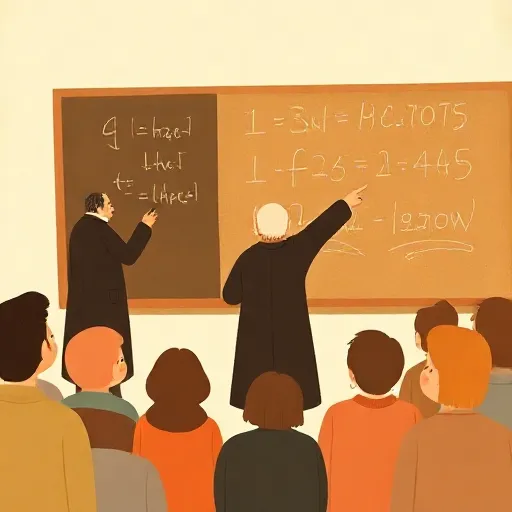
Friedrich Adolf Trendelenburg (1802–1872) was one of the most powerful philosophers in Prussia and secretary of the Royal Prussian Academy of Sciences — the very society Leibniz had helped found. In 1856, Trendelenburg gave a major lecture on Leibniz’s universal characteristic. He praised the dream of a Begriffsschrift, a “concept script” whose signs matched the real structure of things. A number system, he noted, already does this: “5” fits into arithmetic because it mirrors a precise quantity, not because people agreed on a scribble.
But when Trendelenburg looked at Leibniz’s plus-minus calculus, he balked. Real concepts, he argued, are woven together in ways too subtle for a machine. Connecting the properties inside an idea is not like stacking bricks. He recommended giving up the calculating side altogether. If you force logic into a calculator, he warned, you will just replace careful analysis with empty guesswork.
Trendelenburg’s talk spread widely. Many later logicians would read it. But they would not follow his advice.
The Logicians Pick Up the Pieces

By the time Trendelenburg spoke, modern logic was already taking shape — largely without knowing Leibniz’s secrets. George Boole’s idempotent law, A = AA, had become the heart of his algebra of thought in 1854. Only later did a friend spot that Leibniz had written down the very same principle a century and a half earlier. Boole didn’t change his work because of Leibniz; he simply recognized a kindred mind.
The same pattern repeated. William Stanley Jevons (1835–1882), who helped bring modern logic to a wider public, called Leibniz’s anticipations evidence of “wonderful sagacity.” The German mathematician Ernst Schröder (1841–1902) believed Boole had perfected Leibniz’s ideal of a logical calculus. And when Gottlob Frege (1848–1925) published his revolutionary Begriffsschrift in 1879 — a system of writing logic with precise symbols, much like a chemical formula — he too pointed back to Leibniz’s dream. Frege thought his own script was not merely a calculating tool but a genuine lingua characteristica, a language of thought in the Leibnizian sense. Schröder disagreed fiercely, insisting Frege’s system was really just a disguised calculus. Their whole argument was fought on Leibnizian ground.
But here is the catch: all these later logicians found Leibniz after their own systems were already standing. They saw him as a forerunner, not a direct teacher. As the historian Wolfgang Lenzen put it, Leibniz may have been the greatest logician between Aristotle and Frege, yet he “played hardly any role in the history of logic.”
Ghost or Ancestor — Why This Still Matters

So did Leibniz invent modern logic 200 years before it was born? The evidence says no, at least not in a direct way. The algebra of logic and the precise formula languages of the nineteenth century grew from their creators’ own minds, not from a secret manuscript in Hanover. Once Leibniz’s work was published, it sparked recognition and rivalry, but the crucial breakthroughs had already happened.
Yet calling Leibniz a “ghost” would be a mistake. His vision of a universal language, his hope to grind arguments into calculations, and his concrete experiments with symbol-manipulation planted a dream that later generations built in their own soil. When Boole’s widow described that handshake across the centuries, she captured something real: ideas, even lost ones, can meet like old friends.
The story matters for anyone who wonders whether a forgotten notebook will ever be read. Leibniz wrote obsessively but shared only fragments. His best logic slept. If you chase an idea that feels too big, too strange, or too early — write it down anyway. You never know who will one day reach through the pages and shake your hand.
Think about it
- If you invent a brilliant idea but never share it with anyone, does it still count as a discovery?
- Two people can arrive at the same invention without knowing each other’s work. Does that change who deserves credit — and why?
- Leibniz wanted to turn all reasoning into a kind of calculation. Is there any kind of thinking that a computer could never do, no matter how advanced?