
Can You Solve an Argument With Algebra?
A Flash of Light in Lincoln

It is early 1847. George Boole, a self‑taught mathematics teacher running his own small school in Lincoln, England, has been trying for years to turn reasoning into a kind of calculation. Suddenly the answer bursts into his mind. His sister MaryAnn later wrote that he was literally like a man dazzled with excess of light.
What did he see? He saw that logical arguments — the kind you use when you say “all cats are mammals, all mammals are animals, therefore all cats are animals” — could be written as equations in a special algebra. Then you could solve them almost mechanically, like a puzzle.
Boole (1815–1864) was not born into a life of privilege. His father was a shoemaker who loved science more than trade, and the family had little money. But the boy inherited that love of learning and, with access to good books from a local Fellow of the Royal Society, taught himself French, German, Italian, and advanced mathematics. At 19 he opened his own school to support his parents and siblings. For 15 years he taught children by day and studied the work of Laplace and Lagrange by night, building a reputation that would earn him the Royal Society’s first Gold Medal for a mathematician.
But the dazzling idea of 1847 would change logic forever.
Logic Before Boole: Words, Not Symbols

For more than 2,000 years, logic meant Aristotle’s syllogisms. You probably know the pattern:
- All humans are mortal.
- Socrates is human.
- Therefore, Socrates is mortal.
This is powerful, but it’s all words. In the early 1800s, English mathematicians like George Peacock and Duncan Gregory started thinking about symbolical algebra. They noticed that you can separate symbols from their usual meanings and just manipulate them according to laws. For example, they would solve a differential equation by treating the derivative symbol D as if it were an ordinary number in a polynomial — and it worked.
Gregory, who became Boole’s mentor, believed that algebra was about symbols governed by a few simple rules, no matter what the symbols stood for. Boole took the next radical step: What if the symbols stood for classes of things — like “cats” or “blue objects” — and the rules of algebra described how those classes combine?
The Strange Law: x² = x

Boole let the symbol 1 stand for the universe — everything that could possibly be talked about. A capital letter X stood for a class (say, all the red things in the universe). He then introduced an elective symbol, a lower‑case x, which was an operator: apply x to the universe and it selects all the red things. So x(1) = X.
Now came the first law that looks completely bonkers in ordinary math: x² = x. In numbers, only 0 and 1 satisfy that equation. But Boole’s x was an operator. If you select the red things from the universe, and then select the red things from that result, you just get the red things again. The operation “select red” done twice does exactly the same as doing it once. Boole called this the index law; later it became known as idempotence.
From this rule, he built an algebra of classes. The operation multiplication (just writing xy) meant the class of objects that are both X and Y — the intersection. The operation addition (x + y) meant combining two disjoint classes, ones that share no members. And subtraction (x − y) meant removing a class that is entirely contained in the other.
Crucially, Boole insisted that all the ordinary laws of algebra — the ones that work for numbers — must still hold, except where the idempotent law forced a difference. So his algebra was built on top of the algebra you learn in school. That choice would later cause fireworks.
Turning Sentences into Equations

With his algebra in hand, Boole could translate the classic four Aristotelian propositions:
- All X is Y becomes x = xy — the things that are X are exactly the X things that are also Y.
- No X is Y becomes xy = 0 — nothing is both X and Y.
- Some X is Y becomes v = xy, where v is a new symbol meaning “some.”
- Some X is not Y becomes v = x(1 − y).
He could then take an argument, write the premises as equations, and solve for the conclusion. The whole process had a name: Boole’s General Method.
Here is the heart of that method in four moves:
- Reduction: Turn every premise into an equation set to 0, then combine them into one big equation (often by summing their squares).
- Elimination: If you want to get rid of a middle term — like “mammal” in a syllogism — you multiply together versions of the equation where that symbol is replaced by 0 and by 1.
- Expansion: Any algebraic expression can be written as a sum of constituents, the tiny building blocks that correspond to the regions of a Venn diagram.
- Solution: You can solve for one class symbol in terms of the others, just as you isolate x in school algebra.
The result was a recipe. Follow the steps, and the logic takes care of itself.
The Battle Over Addition

After Boole published his masterwork, An Investigation of the Laws of Thought (1854), a sharp young thinker named William Stanley Jevons (1835–1882) objected.
Jevons said: Surely x + x is just x. If you have the class of dogs and you add the class of dogs, you still have just dogs. So the law should be x + x = x.
Boole replied, firmly, that this was impossible in his system. If x + x = x were true, then in ordinary algebra you could subtract x from both sides and get x = 0. That would force every class to be the empty class — nonsense. For Boole, x + x was simply undefined unless x and x were disjoint, which they are not. He wrote to Jevons: it is not true that in Logic x + x = x, though it is true that x + x = 0 is equivalent to x = 0.
Jevons wanted an algebra where the “or” operation was always meaningful, regardless of whether classes overlapped — the inclusive or we use today. Boole insisted on keeping addition as a partial operation. This disagreement birthed a new system: Jevons’s version, cleaned of dependence on ordinary number algebra, would evolve into what we now call Boolean algebra.
In modern Boolean algebra, addition often means union (the inclusive or), and the law x + x = x is happily accepted. But that algebra is not built on the same rules as the numbers from arithmetic class. Boole’s original system was a brilliant hybrid — ordinary algebra with a single, strange extra rule.
Why Your Phone Thinks Like Boole
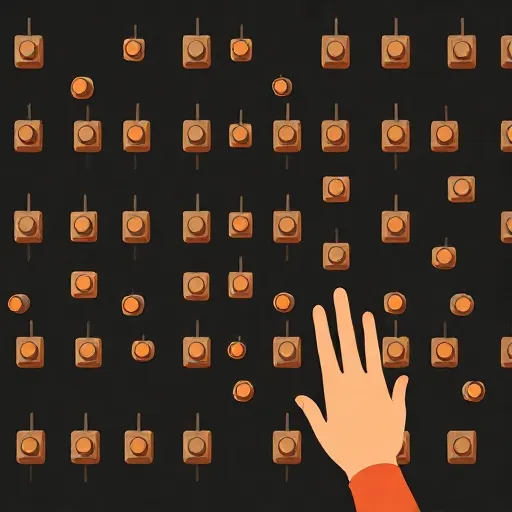
Boole’s work did not stay locked in Victorian books. In the 20th century, engineers realized that electrical circuits could mimic his logic perfectly. A switch is either on (1) or off (0). Two switches in series act like “and” (both must be on for current to flow); two in parallel act like “or”. The whole digital world — computers, search engines, the phone in your pocket — is built on circuits that do Boole’s algebra at unimaginable speed.
When you type “cats AND dogs” into a search box, you are using the very intersection operation Boole called xy. When you filter a list of videos by “new OR funny,” you are using the union that Jevons championed. An argument between two men in 1863 still echoes in the chips that run your life.
Boole did not live to see any of this. He died of pneumonia in 1864, at 49, after walking through a rainstorm and lecturing in wet clothes. But his flash of light — that reasoning could be machinery — gave the world a tool as fundamental as the wheel.
Think about it
- If a friend says “all my favorite games are either puzzle games or racing games,” can you translate that into Boole’s symbols? Try writing it as an equation and see what it lets you infer.
- Boole believed his algebra could unlock the “laws of thought.” Do you think there are rules inside your mind that work like math, or is thinking messier than that?
- A computer has no choice — it follows logic switches faithfully. Does that make a computer’s “decision” similar to yours, or is something else going on when you choose?