Why Is One True Statement a Law and the Other Just a Curious Fact?
Two Sentences, Only One Law
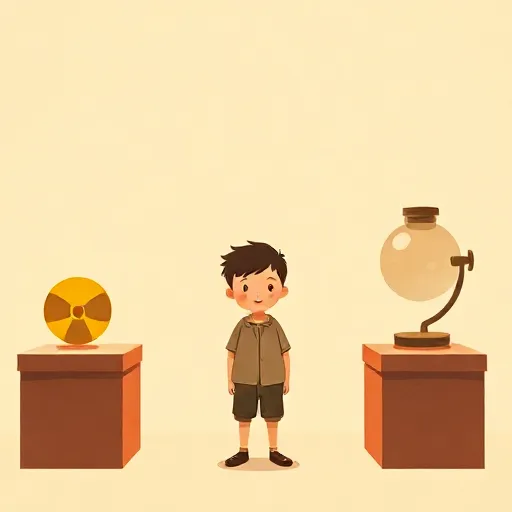
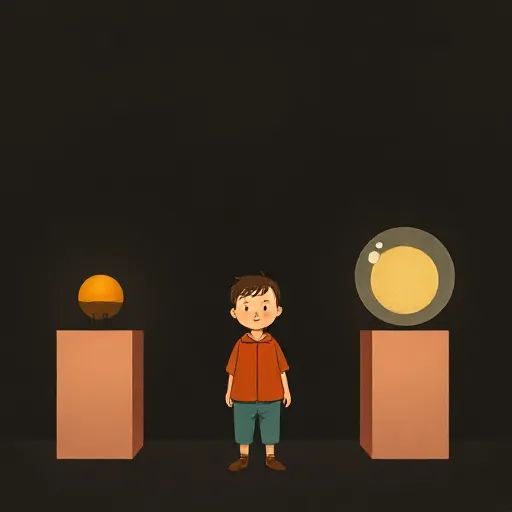
Ms. Rivera writes two sentences on the board:
- All gold spheres are smaller than one mile across.
- All uranium spheres are smaller than one mile across.
Both are true. There is not enough gold in the entire universe to make a ball that big, so the gold sentence is true. And uranium has a critical mass — gather too much in one place and it blows itself apart — so the uranium sentence is also true. Yet the class immediately feels the difference. The second sentence seems like a law of nature; the first just seems like a lucky accident.
Philosophers call the first sentence an accidental generalization — a true pattern that could easily have been false. The second is a candidate for a law of nature. So the puzzle is: what separates the two? Is it something about the world itself, or something about how we organize our knowledge?
The Best Systems Idea: Laws as the Shortcuts of the Universe

One bold answer comes from the philosopher David Lewis (1941–2001). He asks you to imagine writing down every single true fact about the universe — a giant book of everything. Now, can you boil that book down into a short list of core truths, from which all the others logically follow? That short list is a deductive system. The more facts you can squeeze out of a few starting axioms, the stronger the system. The fewer axioms you use, the simpler it is.
Strength and simplicity pull in opposite directions. You could cheat by making every single fact an axiom — one hundred percent strength, zero simplicity. Or you could have a single useless axiom like “2 + 2 = 4” — wonderfully simple, but pathetically weak. Lewis says that laws of nature are the axioms that belong to the true deductive systems that strike the best balance of simplicity and strength.
How does this handle the uranium puzzle? The best systems include quantum theory, which — together with the facts about uranium’s critical mass — logically forces the uranium-sphere sentence to be true. So that sentence earns a spot in the best system, making it a law. The gold-sphere sentence does not get in. If you tried to add it as an extra axiom, you would make the system slightly stronger (it covers one more truth) but you would pay a large price in simplicity — and philosophers like Lewis think the trade-off is not worth it.
This systems view has fans for good reasons. It handles vacuous laws — true statements about things that don’t actually exist. Newton’s first law says that all inertial bodies have no acceleration, even though there are no perfectly inertial bodies anywhere. That’s okay: it can still belong to the best system. It also matches what scientists do: searching for powerful, elegant theories.
But many philosophers worry. Words like “simple” and “best balance” seem to depend on human minds and what we find neat. If laws are supposed to be part of the furniture of the universe, should they depend on our taste? Another worry: some wildly interesting patterns, like “all the planets in our solar system orbit in roughly the same flat disk,” could be added to any true system for a tiny cost in simplicity, yet we don’t call them laws. The systems approach struggles to keep them out.
A Cosmic Glue: The Universals Approach
A rival idea, championed by David Armstrong (1926–2014), Fred Dretske (1932–2013), and Michael Tooley (1941–2023), says the systems view misses something deep. For them, a law is not just a position in a tidy book; it is a real connection between universals. A universal is something that can be shared by many objects — like being gold, being uranium, or being less than a mile across.
Armstrong puts it this way: if it is a law that all Fs are Gs, then the universal F-ness stands in a special relation to the universal G-ness. He calls that relation necessitation, and writes it as N(F, G). Think of it as a cosmic promise: wherever F shows up, G must come along for the ride. The uranium-sphere sentence becomes a law because being uranium truly necessitates being less than a mile in diameter; being gold does not.
This approach dodges worries about mind-dependence. Whether a necessitation holds is not a matter of our tastes. And it seems to explain why laws support counterfactuals — if-you-changed-the-past stories. If the uranium sphere had been the size of a car, it still would have blown apart because the necessitation guarantees it.
But the view faces a sharp challenge, one the American philosopher David Lewis described with his usual wit. What exactly is this relation N? Giving it a name — “necessitation” — does not make it necessary, Lewis joked, any more than having big muscles makes someone named Armstrong strong. This is called the identification problem. Armstrong later suggested that the relation is a kind of causation between types, not just between individual events. Many philosophers remain unconvinced that this solves the puzzle. If we can’t spell out what N is, the cosmic promise starts to sound like magic.
Do We Really Need Laws?

Some thinkers look at all these difficulties and draw a startling conclusion: there are no laws at all. Bas van Fraassen (born 1941) and Stephen Mumford (born 1962) defend antirealism about laws. They don’t deny that the universe has patterns; they deny that those patterns deserve a special title like “law.” Van Fraassen argues that every account of lawhood has fatal flaws, and that we can do science perfectly well without treating some patterns as privileged.
The trouble is that throwing away laws sends shockwaves through the rest of your thinking. Consider an ordinary match. If you strike it, will it light? You would say yes — because you believe there is a law connecting striking, friction, heat, and flame. If there are no laws, then what makes that counterfactual true? Laws also seem tied to causation (one thing making another happen) and dispositions (the match’s tendency to ignite). Antirealists must either show that we can keep talk of causes and dispositions without laws, or accept that much of our everyday reasoning is built on a mistake.
A closely related issue comes from Nelson Goodman (1906–1998). He argued that only lawlike generalizations — those that would be laws if true — can ever be confirmed by observing their instances. If you watch a hundred ravens and they are all black, that gives you some reason to think the next raven will be black. But if you watch a hundred people in a room and they are all sitting, you don’t seriously expect the next person who enters to be sitting. The sitting pattern feels accidental, so instances don’t confirm it. Yet finding a crisp principle that captures this difference has turned out to be maddeningly hard. Sometimes even accidental-looking patterns can gain support from examples, as when you notice that the first nine coin flips land heads — you might reasonably raise your expectation for the tenth, even though “all flips land heads” would be an accident, not a law.
Why It Matters Every Time You Drop a Ball
Back in Ms. Rivera’s classroom, the difference between the two spheres is not just a scientist’s game. It is the same difference that lets an engineer design a bridge that won’t fall, or a doctor trust that a medicine will slow an infection. We rely on laws every time we expect a dropped pencil to hit the floor, a phone call to travel no faster than light, or a bike to coast to a stop because of friction.
The debate does not end with a neat answer. Some philosophers think laws are the most economical summaries of the universe’s history. Others think they are real glue hidden in the fabric of things. A few think they are only a useful fiction. Your own life is full of moments where you must decide whether a pattern you see — in a friend’s behavior, in a video game, in the weather — is a real rule or just a run of luck. Scientists do the same, with far greater stakes. That is why the question of what makes a law a law is not dusty or distant. It lives anywhere you ask, “Will it happen again?”
Think about it
- If a computer read every true fact in the universe, could it ever decide on its own which ones are laws and which are accidents? What would it have to value?
- You notice that every time you wore your lucky socks, your basketball team won. Is that pattern a law of nature, an accident, or something in between? Why?
- Could two people agree on all the observable facts but still disagree about what the laws are — even if neither person makes a mistake? What would they be disagreeing about?