
Does an Electron Have a Definite Spin When Nobody’s Looking?
A Proof That Didn’t Quite Work

In 1932, the mathematician John von Neumann (1903–1957) thought he had settled a big question: can a quantum particle have hidden properties that secretly determine what you’ll measure? He published a proof that said no, hidden variables are impossible. For decades, most physicists accepted his word.
But in the early 1960s, a young Irish physicist named John Bell (1928–1990) pored over von Neumann’s reasoning and found a crack. Von Neumann had demanded that a certain addition rule must hold for any properties you could assign to a particle, even properties you can’t measure at the same time. Bell showed that was too strict. If you only require the rule for properties you can measure together, the proof collapses.
Bell’s discovery reopened an old dream: maybe particles really do have definite, hidden instructions inside them—like a character in a video game who has a strength stat even when you’re not looking at the stats screen. That dream would soon face a tougher challenge.
The Hidden-Property Dream
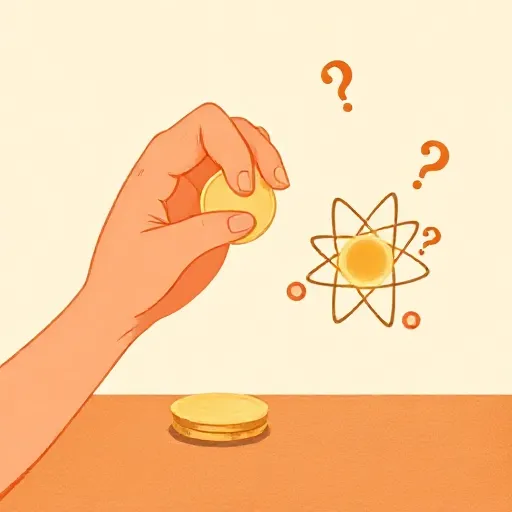
Think about a regular coin. You toss it, cover it with your hand, and you know it has either heads or tails, even before you peek. Many physicists and philosophers wanted to believe that electrons, atoms, and photons work the same way. They might have hidden variables—definite values for every property, like position, spin, and energy—at every moment. Quantum mechanics only gives probabilities, they argued, because we’re missing information about those hidden variables.
To make this dream work, two assumptions seemed natural. First, value definiteness (VD): all properties of the particle have definite values at all times, even when nobody measures them. Second, noncontextuality (NC): the value of a property doesn’t depend on how you measure it. If you check a particle’s spin with machine A one day and machine B the next, you should get the same result, as long as you’re really measuring the same spin direction.
These sound like common sense. But together with quantum mechanics, they turn out to be a recipe for trouble.
A New Rule: Add Only What You Can Measure Together

After Bell criticized von Neumann, mathematicians built a tighter argument. The key was to enforce the addition rule only for properties you can measure at the same time—called compatible observables. For example, you can simultaneously measure the energy of an electron in two perpendicular directions. If one is 2 units and the other is 3 units, then the sum should be 5 units.
In mathematical terms, this is the Sum Rule: if C = A + B, and A, B, and C are all compatible, then the value v(C) must equal v(A) + v(B). There’s a similar Product Rule for multiplication.
Andrew Gleason (1921–2008) proved a deep theorem in 1957 that pushed this idea. He showed that on any three-dimensional (or higher) space of quantum states, the only way to assign probabilities that obeys the mathematics of quantum mechanics is to use a smooth, continuous curve. Hidden-variable theories that assign a hard yes or no to every property—a 0 or 1—would produce a jagged, all-or-nothing pattern. That already hinted that hidden variables would have to break some common-sense assumption.
The Sum and Product Rules together lead to a concrete coloring rule: for any three mutually perpendicular directions (called orthogonal rays) in a three-dimensional space, exactly one of them must be “true” (value 1) and the others “false” (value 0). You can think of it as painting each possible yes/no question white (true) or black (false). In every trio of perpendicular directions, you must have exactly one white and two black.
The Puzzle of 18 Colored Dots

In 1967, the mathematicians Simon Kochen (b. 1934) and Ernst Specker (1920–2011) set out to find a finite set of directions where this coloring rule creates a logical contradiction. They succeeded with a complicated map of 117 points in three dimensions.
Decades later, physicists found much simpler examples. One of the clearest, by Adán Cabello (b. 1966) and his team in 1996, works in a four-dimensional space and uses only 18 directions—like 18 dots on a four-dimensional sphere.
Here’s the trick. The 18 dots are arranged to form nine groups of four. Inside each group, the four dots are mutually perpendicular. According to the coloring rule, every group must have exactly one white dot. That means, across all nine groups, there must be nine white dots—an odd number.
But look closer: each of the 18 dots appears in exactly two different groups. So every time you paint a dot white, it counts as a white dot in two groups. The total number of white-dot appearances across all groups must therefore be even (because you’re double-counting each white dot). Nine cannot be both odd and even. No matter how you try to color the dots, you end up with a paradox.
So it’s impossible to assign definite true/false values to all 18 questions at once while obeying quantum mechanics. The hidden-variable dream hits a wall: you can’t paint the dots.
Three Ways Out

The Kochen-Specker theorem doesn’t say hidden variables are impossible. It says you must give up at least one of three things: quantum mechanics itself (which hardly anyone wants to do), value definiteness, or noncontextuality.
Give up value definiteness. Instead of all properties having definite values at all times, only a carefully chosen set does. For example, in Bohmian mechanics (also called pilot-wave theory), particles have well-defined positions, but other properties like spin are not fundamental—they emerge only during measurement. Some modal interpretations go further and let the set of definite properties change depending on the quantum state.
Give up value realism. You could deny that every mathematical operator corresponds to a real property. If the sum of two measurable properties doesn’t automatically count as a real property itself, the puzzle can’t get started. But philosophers point out this move quickly turns into a form of contextuality anyway, because you’re saying the same mathematical combination is a real property only in some experimental situations and not others.
Embrace contextuality. Here you keep value definiteness but drop noncontextuality. That means a particle’s spin could have one value when you measure it together with a set of compatible properties, and a different value when you measure the exact same spin direction together with a different set. The property isn’t owned by the particle alone; it depends on the whole measurement arrangement. Reality becomes relational, not fixed.
Reality Is a Conversation

You might think this is just a footnote from the 1960s. But the Kochen-Specker theorem still shakes up how physicists and philosophers think about reality. If a particle cannot have all its properties fixed before measurement, then the old picture of a universe made of tiny, independently existing objects with everything pre-determined is in trouble.
Today’s quantum computers rely on exactly this strangeness. A qubit, the basic unit of quantum information, can be in a superposition of 0 and 1—not secretly one or the other, but genuinely both possibilities at once. The theorem tells us you can’t imagine hidden instructions inside the qubit that tell it how to behave in every possible measurement without running into the dot puzzle’s contradiction—unless you accept contextuality. The answer you get from a quantum computation can depend on the whole measurement setup, not just on a pre-programmed list.
So the next time you hear about quantum weirdness, remember the impossible coloring puzzle. It shows that our most basic assumption—that things have definite properties the way a coin has heads or tails, even when no one’s looking—may break down at the smallest scales. The world might be more like a conversation: what becomes real depends partly on the questions we ask.
Think about it
- If you could design an experiment to test whether an electron has a definite spin before you measure it, what would your experiment look like?
- Is it more unsettling to believe that some properties don’t exist until measured, or that the same property can have different values depending on the context? Why?
- Imagine a video game avatar whose strength stat changes depending on which menu you open. Would you say the avatar has a real strength? What would it take to convince you one way or the other?