

Did You Really See the Moon When You Weren't Looking?
An Impossible Cat and a Missing Rule

In 1935, the physicist Erwin Schrödinger (1887–1961) proposed the most famous cat in the history of science — a cat that is both dead and alive at the same time. He was not joking. He was trying to show that the theory he had helped create, quantum mechanics, led to a deeply strange picture of the world if you took it seriously.
The problem is not about cats. It is about a gap in the rules. Quantum mechanics describes how atoms, electrons, and photons behave. But when you read the theory closely, it never explains how a cloud of possibilities turns into a single, definite fact — like a pointer on a dial or a spot on a screen. That missing explanation is called the measurement problem, and it has been burning for almost a century. If you solve it, you might change how we think about what is real.
The Two Rules That Make the World Blurry

Quantum mechanics runs on two formal features that every version of the theory shares. First is the superposition principle. Imagine you are playing a video game where your character can save the game at any moment. Normally, you are in one place at a time. But in the quantum world, a particle can be in a kind of saved‑state that mixes several positions, speeds, or energies at once. The official term for that saved‑state is a statevector. It is like a recipe that lists all the possible results and their weights.
The second feature is entanglement. When two particles interact in the right way, their statevectors become so tied together that you cannot describe one without describing the other — even if they end up on opposite sides of the galaxy. Schrödinger himself said that entanglement was not just one odd detail but the characteristic trait that forced quantum mechanics to break away from all earlier physics.
Together, these two features imply that physical properties are often objectively indefinite — a particle does not have one position or one energy until a measurement is made. And the probabilities you get from the quantum recipe are not just guesses about something you do not know; they are built into nature itself. That is a huge shift. In normal life, if you flip a coin and do not look, you assume it is either heads or tails. Quantum mechanics denies that assumption for atoms.
The Moment of Looking

If a particle can be in a blur of several states, why does your hand never blur through the table? The standard answer, worked out in the 1920s and 1930s, is brutal and brief: when you measure an observable quantity — say, the position of an electron — the statevector suddenly jumps into one definite value. The technical name for that jump is the wave‑packet reduction or collapse postulate. According to the orthodox view, before the measurement, the electron literally has no definite position. Afterward, it does. Nothing in the theory picks which outcome you get; only the probabilities are fixed.
But here is the catch. The measuring device is itself made of atoms. So the device should also be described by quantum mechanics. If you take the collapse postulate away and follow only the smooth, unbroken quantum equations, you get a monstrous result: the device ends up in a superposition of macroscopically different states. The pointer on the dial is at zero and at three at the same time. The Cat is dead and alive. The theory, on its own terms, cannot tell you why you only see one outcome.
The orthodox reply was blunt: the theory is complete, and it makes no sense to ask what a particle is like before you measure it. Properties belong only to measurement results, described in ordinary classical language. As John S. Bell (1928–1990) later pointed out, this turned a deep flaw into a virtue. It also made the split between the quantum world and the classical world fundamentally shifty — you can slide it around but you can never pin it down. That shiftiness is the measurement problem.
When Atoms Decide: The Collapse Idea
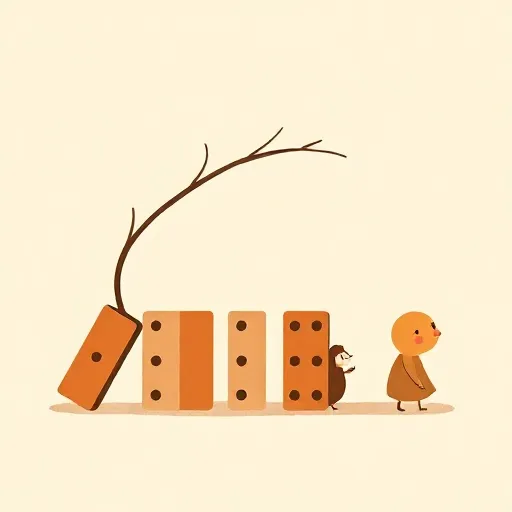
In the 1950s and 1970s, a different kind of thinker began to ask: what if the collapse is not a sudden magic trick done by a human observer, but a real, physical process that happens by itself? This gave rise to Collapse Theories, which modify the standard equations so that small systems stay quantum and large ones naturally become classical.
The first complete model was the GRW theory, named after GianCarlo Ghirardi, Alberto Rimini, and Tullio Weber. Imagine that every particle in the universe, at random moments, gets a tiny “tap” that nudges it toward a specific location. These taps are rare — a single proton gets tapped on average once every hundred million years — but a large object made of trillions of particles gets tapped constantly. As a result, when a pointer tries to be in two places at once, the taps quickly kill one version and leave the other. The cat is not both dead and alive for more than a split second.
The trick is what physicists call the trigger mechanism. If even one particle in a macroscopic body gets a localization tap, the whole body falls into one definite shape. The GRW model picks the sharpness of the tap (about a hundred‑thousandth of a centimeter) and the average tapping rate so that atoms barely feel it, but chairs and pointers behave perfectly classically. Later came the Continuous Spontaneous Localization (CSL) model, which replaced the sudden taps with a soft, continuous noise that gently herds states into one place. The physics ends up similar, but the math handles identical particles more gracefully.
Catching the Collapse in the Lab
Because Collapse Theories change the basic equations of quantum mechanics, they make slightly different predictions. For decades, the differences were too small to measure. But technology has been racing ahead. Scientists have been searching for a faint noise — a kind of quivering — in the motion of tiny mirrors, cold clouds of atoms, and even in lumps of germanium buried underground. That quivering would be the footprint of a spontaneous collapse.
So far, no signal has shown up — which is itself news. The experiments have already ruled out some versions of the theory. The original GRW frequency was one tap per particle per billion years. The physicist Stephen Adler proposed cranking it up by a factor of a billion, so that a human eye catching a few photons would already trigger a collapse. But that higher rate has been solidly excluded by experiments measuring the faint radiation that atoms would spit out if they were continually being tapped. The truth, if collapse happens at all, seems to lie somewhere in between.
The search matters because it tests something deeper than any single equation. If collapse is real, then what we call “classical reality” is just what happens when a quantum system gets big enough for the taps to dominate. The moon, as Albert Einstein once asked in a famous walk with his colleague Abraham Pais, really is there when nobody looks — because it cannot help being there. The random tugs of collapse pin it in place.
Your Brain, Your Choices, and the Edge of the World

One surprising consequence of these theories is that they locate the border between the quantum and the classical not in a mysterious “observation” by a mind, but in the raw number of particles displaced. When photons from two possible spots on a screen hit your eye, the signal travels through neurons until millions of charged ions shift position. At that point, the superposition is so top‑heavy that it falls over in less time than it takes to form a thought. The brain, in these models, is just the place where the collapse happens in the right window of time — not because it is special, but because it is large.
This opens a haunting question: if a collapse theory is right, does consciousness get a vote? Some versions of the story suggest that when a superposition involves two distinct brain‑states, the probabilities of what you end up perceiving might deviate from the textbook numbers by a tiny fraction — maybe one percent. Testing that with today’s tools is science fiction, but the very fact that the idea can be written down as a mathematical model shows how far the conversation has come from simply shrugging and accepting that the moon vanishes when you blink.
Einstein wanted a world where macroscopic objects behave like themselves even when no one is looking. Collapse Theories offer exactly that — a single set of rules that dances like quantum mechanics at small scales and walks like classical physics at large scales, without needing a separate “observer” to step in. They are not the only answer, and they might not be the right one. Bohmian mechanics, which keeps particles always definite, is another path. But collapse models prove that you can take the quantum formalism seriously, change it in a controlled way, and arrive at a world that looks very much like the one you live in.
Think about it
- If a particle “decides” where to be only when it is measured, can we ever say it had a place before the measurement? Why might that rule feel different when we talk about the moon instead of a single atom?
- Suppose scientists never find a signal of spontaneous collapse. Would that prove the orthodox view is correct, or simply that collapse is too subtle to see? How would you decide?
- When you close your eyes and imagine your room, the room you picture is definite and solid. What makes the room you perceive more real than the room you imagine — and could you imagine a universe where the distinction disappears?