

Would You Cheat If You Could Get Away With It?
The Ring That Makes You Invisible

Imagine you find a ring that makes you invisible the moment you put it on. No teacher, no friend, no security camera could ever catch you. You spot a wallet someone dropped. Inside is cash and an ID. You could return it — or you could slip it into your pocket and nobody would know. What would you do?
This exact thought experiment comes from Plato’s (c. 428–348 BCE) Republic. A young man named Glaucon tells the story of a shepherd who finds just such a ring and uses it to grab whatever he wants, free of consequences. Glaucon’s challenge questions whether, if we could get away with unfairness, anyone would bother to be just — to treat others fairly and give them what they deserve. Is justice just a deal we put up with because we’re scared of getting caught, and if we weren’t scared, we’d all cheat?
That question kicks off one of the oldest fights in philosophy: what makes justice a virtue — a good trait of character? Is it worth having for its own sake, or is it just a handy tool we use to avoid trouble? For over two thousand years, thinkers have wrestled with whether being fair is a deeply important part of a happy life, or merely a useful arrangement we stumble into so we don’t live in chaos.
Plato’s Answer: Your Soul as a City

Plato refused to believe that justice is just a second-best deal. He thought being just actually makes your whole self healthy. To explain, he compared a person’s mind to a city. A city has three groups: rulers who plan, soldiers who enforce, and merchants who produce food and goods. When each group does its own work and doesn’t meddle with the others, the city runs smoothly. That smooth running, Plato said, is justice.
Now zoom in to one person. Plato argued the soul, too, has three parts: reason (the thinking part), spirit (the part that gets fired up about honor and standing up for things), and appetite (the part that wants food, comfort, fun). A just person is one where reason rules, spirit backs it up willingly, and appetite accepts that guidance. When all three parts “do their own job,” the person is in harmony — not torn apart by cravings or pride. That harmony, Plato insisted, is its own reward. A just person is happier than an unjust person, no matter how rich or powerful the unjust person looks from the outside. So for Plato, the virtue of justice is valuable for its own sake, because it is a healthy soul.
Aristotle (384–322 BCE) agreed that justice is a core part of a good life, but he sharpened the definition. He said justice is about not grabbing more than your fair share — the ancient Greeks called this pleonexia, overreaching. He broke justice into two shapes. Distributive justice deals with how good things are shared: if you contribute twice as much as someone else, you deserve twice the reward. Rectificatory justice deals with fixing a wrong: if one person scams another out of some money, the scammer should lose exactly that amount and it should be restored to the victim. Justice, for Aristotle, is like a balancing scale. Yet he himself left us a puzzle: do we figure out what is fair by looking at the rules of a society first, or does a fair person just see what is right and the rules follow? That puzzle would echo through centuries.
Justice as a Tool for Peace
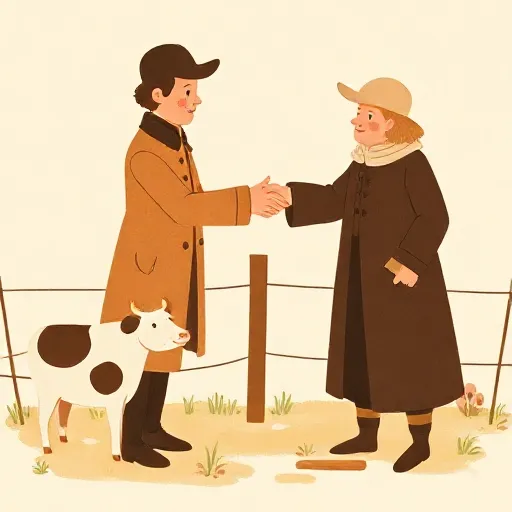
Not everyone agreed with Plato and Aristotle that justice is a shining part of a happy soul. The ancient Greek thinker Epicurus (341–270 BCE) thought happiness is simply freedom from stress — ataraxia, a calm mind. To get that calm, we need to live together without fighting. Justice, Epicurus said, is just an agreement not to harm each other. It’s an instrumental good — valuable not for itself, but as a tool for the real prize: tranquility.
The Scottish philosopher David Hume (1711–1776) built a detailed version of this instrumental story. Hume asked: why do we follow rules of justice at all, when our natural feelings often push us the other way? We’re born with limited generosity and we live in a world where there’s not enough stuff for everyone to have whatever they want. So we need a way to keep what is “mine” safe from what is “thine.” Without that, everyone would be grabbing and life would be miserable.
Hume argued that justice is an artificial virtue. It doesn’t spring from a natural passion like love or kindness. Instead, it grows slowly, like two rowers in a boat who learn to pull together without ever signing a contract. Little by little, people notice that if everyone respects property rules, all are better off. Self-interest nudges us to follow those rules, and sympathy with the public good makes us approve of the whole system. So for Hume, justice is a useful habit we develop because it works — and nothing more. Its value comes entirely from the happiness and stability it produces. He even said that in a world where everyone had plenty and was perfectly generous, we’d never need it.
Justice from Rules, Not Character

By the time we reach Immanuel Kant (1724–1804), the spotlight had shifted from building character to building a system of rules. Kant separated justice (which he called “right”) from virtue altogether. Justice, for Kant, was a framework of laws that could be enforced from the outside — a condition that holds between people when each respects the freedom of others. Virtue was a matter of inner motivation. This split turned the ancient picture on its head: instead of a just soul grounding just laws, the just laws came first, and an individual’s virtue of justice was simply the habit of obeying them.
The most influential modern version of this rule-first approach came from the American philosopher John Rawls (1921–2002). Rawls asked what a just society would look like, and his answer became the heart of his theory: justice as fairness. To figure out the right principles, he invented a powerful thought experiment: the original position. Imagine you and other people must agree on the basic rules for your society, but you all sit behind a veil of ignorance. No one knows what their own talents, wealth, or place in society will be — you might end up rich, poor, healthy, or struggling. Rawls thought that in that position, people would choose rules that protect everyone’s basic freedoms and make sure that any inequalities actually help the worst-off.
What about being a just person in your own life? For Rawls, an individual’s virtue of justice is simply a steady desire to follow those fair social rules. Justice as a personal trait is derivative — it flows from the system, not the other way around. This norm-first pattern now dominates most political thinking, but it leaves a nagging question: can a good rulebook really replace a good heart?
Caring vs. Justice: A Different Voice

In the 1980s, psychologist Carol Gilligan (born 1936) looked at studies of moral growth and heard a voice that had been missed. The famous psychologist Lawrence Kohlberg had ranked the highest form of moral thinking as the ability to apply universal principles of justice — like human rights — in a reversible, logical way. But his evidence came mainly from boys. When Gilligan listened to girls, she found they often spoke a different moral language. Instead of abstract rules and rights, they talked about relationships, about who is connected to whom, and about the responsibility to care for people in concrete need.
Gilligan didn’t say that women are morally superior. She argued that the “care voice” and the “justice voice” are two legitimate ways of thinking about what is right. This opened up a deeper challenge: is justice really the master virtue? Some thinkers, following the care perspective, argued that virtues like love, compassion, and empathy might be more fundamental. This wasn’t entirely new — the medieval thinker Thomas Aquinas (1225–1274) had already placed the Christian virtue of charity above justice. But now the challenge came from careful observation of how real people actually make moral choices.
If an ethic of care makes relationships the center of morality, then justice might be just one piece of the puzzle — important for setting boundaries and making things fair, but incomplete on its own. The fight between justice‑first and care‑first views is still lively today, especially in discussions about how schools, families, and governments should handle conflict.
What Would You Do?

So back to that ring. Plato’s challenge isn’t just about ancient shepherds; it’s sitting on your desk right now. When you could copy someone’s homework, jump the lunch line, or keep a secret to yourself that would hurt a friend — no one will know — the question is alive. Are you fair because you’re afraid of consequences, or because being fair is part of who you want to be? And if rules alone could make a society run, would it matter at all what kind of person you are inside?
The debate in these pages doesn’t settle that question. It gives you tools. From Plato and Aristotle, you inherit the haunting idea that cheating damages your own soul, not just your reputation. From Hume, you get the sharp observation that sometimes we don’t have a natural passion for fairness — we have to build it. From Rawls, you learn to ask what kind of rules you’d choose if you had no idea whether you’d be born the bully or the bullied. And from Gilligan, you learn to listen for voices that are often left out — friends who might care more about staying connected than about keeping score.
Philosophers still argue over whether the virtue of justice is primary or derivative, a tool or a treasure. But that very argument is a reminder: every time you choose to give someone their due, you’re stepping into a story thousands of years old — and you get to decide what part you play.
Think about it
- Imagine you find a ring that makes you invisible. Would you ever return a wallet you found? Why or why not?
- Think of a time you had to share something — maybe a dessert or a turn in a game — with a friend. Did you use a rule (like “each gets half”) or did you think about what each person needed? Which felt more fair?
- If you had to design the rules for a new game but you didn’t know what position you’d play, what kind of rules would you choose? Would they be the same rules you’d pick if you knew you’d be the strongest player?