

Can You Search for Superman Without Searching for Clark?
The Reporter, the Hero, and the Name Switch

Lois Lane is in downtown Metropolis, her eyes scanning the rooftops. She is looking for Superman. But Clark Kent, her mild-mannered coworker, is standing right behind her, adjusting his glasses. Lois doesn’t know that Clark Kent is Superman. So if she is searching for Superman, is she also searching for Clark?
Your first instinct might be: of course not! She isn’t thinking about Clark at all. But Superman and Clark are the same person. Normally, if two words pick out the very same thing, you can swap them without changing the truth of a sentence. For example, if you say “Clark Kent is a reporter,” and Superman is Clark, then “Superman is a reporter” must be true too.
Yet with verbs like seek, want, fear, and imagine, swapping one name for another can turn a true sentence into a false one. Lois seeks Superman, but she does not seek Clark. Something special is going on. Philosophers call verbs like these intensional transitives, and to understand them is to understand some of the deepest puzzles about how words hook onto thoughts and reality.
Three Tricks These Verbs Play

Intensional transitive verbs don’t just mess with names. They show three distinct “marks” of a non‑ordinary logic. The first you’ve already seen: substitution‑resistance. Lois seeks Superman, but she doesn’t seek Clark, even though they are the same individual. The sentence’s truth‑value changes when you substitute one name for another. This is impossible with ordinary, extensional verbs like “kick” or “eat.”
The second mark is the specific/unspecific ambiguity. Imagine Oedipus seeking a member of his family. He might be looking for a particular person — Jocasta, though he doesn’t realize she is his mother. That’s a specific reading. But he might also be looking for just any family member, with no particular person in mind. That’s an unspecific reading, sometimes called a notional reading. With extensional verbs this doesn’t happen. You can’t hug a member of your family but no particular one.
The third mark is existence‑neutrality. You can search for a fountain of eternal youth, or want a unicorn, even if no such thing exists. But you cannot trip over a unicorn unless one exists. Intensional verbs let you reach toward things that aren’t there, while extensional verbs demand real objects.
These three tricks appear in different combinations. Verbs like “look for” and “want” show all three. Verbs like “draw” and “imagine” resist substitution and are existence‑neutral, but not every unspecific reading is available — you can draw a dog without drawing a specific dog, but “draw every dog” forces a specific reading. Verbs like “need” are existence‑neutral and allow unspecific readings, yet they often let you swap co‑referring terms: you need H₂O whether you call it “water” or not. So the three marks don’t always travel together.
Frege’s Secret Key: Sense and Reference
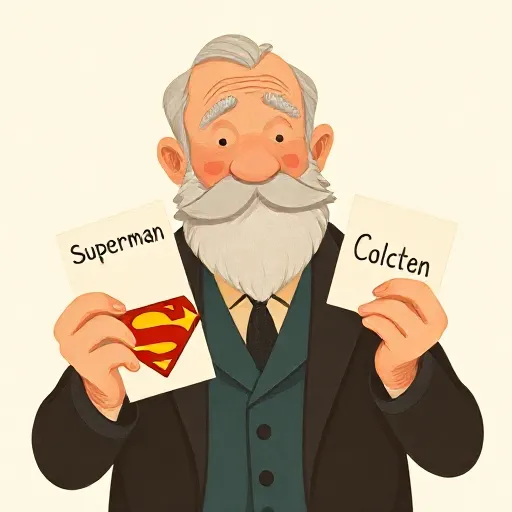
Why does substitution fail? The most famous answer comes from the German philosopher Gottlob Frege (1848–1925). Frege argued that every meaningful expression has two layers: its reference (the thing it picks out in the world) and its sense (the way that thing is presented, or the “mode of presentation”).
In ordinary sentences, swapping two expressions with the same reference shouldn’t change truth. But inside the scope of an intensional verb, Frege proposed, expressions don’t just contribute their customary reference; they contribute their customary sense. So when you say “Lois seeks Superman,” the verb “seeks” doesn’t simply hook Lois to the man Kal‑El. It hooks her to the Superman‑way‑of‑thinking‑of‑Kal‑El. If you swap in “Clark Kent,” you get a different sense, even though the man is the same. Thus, “Lois seeks Clark” can be false while “Lois seeks Superman” is true.
Frege’s idea elegantly handles substitution‑resistance for names. But it leaves other puzzles open. Why can you search for a unicorn that doesn’t exist? On Frege’s picture, the verb operates on a sense, not a real object, so existence‑neutrality fits too. Yet many philosophers think a single mechanism — the switch from reference to sense — cannot also account for unspecific readings. Moreover, Frege’s approach depends on an adequate account of what the sense of a name is, which is itself a deep controversy.
When Wanting and Needing Disagree

Some intensional verbs differ sharply from one another. Compare want and need. A thirsty person who knows water quenches thirst but falsely believes H₂O is rat poison will want water but not want H₂O. Substitution fails for “want.” Yet the same person still needs H₂O, regardless of those mistaken beliefs. With “need,” you can freely swap co‑referring expressions — as long as they aren’t just accidentally co‑extensive. For example, an impresario might need more singers but not more dancers, even if all the singers are dancers and vice versa. The property of being a singer is not the same property as being a dancer, so the terms are not interchangeable there.
This split suggests that substitution‑resistance and unspecific readings don’t share a single cause. “Need” allows unspecific readings but permits substitution of truly co‑referring terms, while “want” blocks substitution. So whatever explains unspecific readings must be available for both verbs, but the mechanism blocking substitution seems present only for “want” (or maybe it’s present but somehow ineffective for “need”—philosophers debate this).
The Detective and the Proposition

Here’s another twist, known as Prior’s Puzzle after the philosopher Arthur Prior. Consider these two sentences:
- Holmes fears that Moriarty has returned.
- Holmes fears the proposition that Moriarty has returned.
The clause “that Moriarty has returned” and the description “the proposition that Moriarty has returned” seem to name the very same thing — a proposition. Yet (1) can be true while (2) is false. Holmes might tremble at the thought of Moriarty’s return but feel no anxiety about an abstract object, a proposition. Somehow, replacing the clause with a proposition‑description changes the truth‑value.
This matters because many theories of thought and language treat verbs like “fear” and “believe” as relationships between a person and a proposition. Prior’s Puzzle shows that even if the clause and the description pick out the same proposition, you can’t always swap them. Some philosophers explain this by saying the transitive and clausal forms of the verb have slightly different meanings — they’re polysemous. Others locate the trouble in the description itself, arguing that “the proposition that p” doesn’t actually denote the same thing as “that p.” Still others, using event semantics, say the clausal version supplies a content role, while the transitive version supplies a theme role. Whatever the answer, the puzzle reveals that how we wrap a thought in words can twist its truth conditions.
So What? Why Words Trap Your Thoughts

These linguistic puzzles aren’t just abstract games. They touch on how we talk about desires, fears, hopes, and commands every day. When you say “I want a bike, but no particular one,” you’re using an unspecific reading that would be nonsense with “own.” When you admire a fictional hero, you admire something that doesn’t exist in the ordinary way, yet your admiration feels genuine. The logic of intensional verbs forces us to think carefully about what, exactly, our words are doing.
It also affects big philosophical questions. Can a computer truly “want” something in the same way you do? When we say a group “seeks justice,” are we ascribing a single mental attitude, or is that just a metaphor? The puzzles of substitution and existence‑neutrality show that mental states and language are more tangled than they first appear.
Philosophers from Frege to Richard Montague (1930–1971) have built intricate systems to capture these phenomena. Montague developed a semantics where quantified phrases, like “a woollen sweater,” can be treated as direct arguments to intensional verbs without hiding whole sentences underneath. That lets “want a woollen sweater” remain existence‑neutral and substitution‑resistant while still being logically manageable. But even his approach struggles with certain inferences: if you want a woollen sweater, does it follow that you want a sweater? Intuitions split. Some say yes; others imagine cases where you’d refuse a perfectly good cotton sweater because what you specifically desire is woollen. These debates remain live.
The next time you can’t quite put a feeling into words, remember: even words like “want” and “fear” don’t behave as tidily as we pretend. The way we name our thoughts can change the thoughts themselves. And that stubborn fact has kept philosophers busy for over a century.
Think about it
- Imagine a friend says, “I want a dog, but no particular one.” Could there be a situation where this is true, yet there is no dog you’d be willing to give them — because, maybe, every real dog has something they dislike? Does that mean they don’t really want a dog?
- If a scientist could map every neuron in your brain and predict all your choices, would your desires still be your own, or would “want” just become another word for “brain state”?
- A detective fears the return of a villain. But the villain died years ago, and the detective knows it. Is her fear still real? What is she afraid of, if the villain no longer exists?