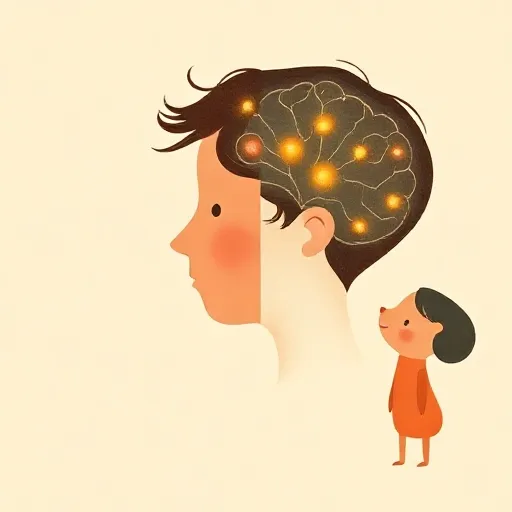

Is That Voice in Your Head Really Talking?
Do You Hear That, or Is It Just Me?

It’s late. You’re in bed, trying to fall asleep, when a sentence pops into your head: “I should stop thinking about that awkward moment today.” You didn’t say it out loud. Nobody else heard it. But somehow you heard it. So what was that? A voice? A thought? Something in between?
Philosophers call that silent internal chatter inner speech. It’s the voice that reads along with you, reminds you to grab your lunchbox, or winces at a memory. But what is it, exactly? Is it really speaking — just without sound — or is it something else, like a mental recording of what speech would sound like? This might seem like a tiny puzzle, but the answer reaches deep into how we think, how we know our own minds, and why some people hear voices they don’t recognize as their own.
Talking Without Making a Sound

One big camp of philosophers holds that inner speech is actual speech. We’re not just imagining words; we’re producing them silently. The British philosopher Gilbert Ryle (1900–1976) thought of it this way, and the Soviet psychologist Lev Vygotsky (1896–1934) offered a developmental clue. Young children often talk to themselves aloud — a habit called egocentric speech. Vygotsky argued that over time, kids internalize that chatter. The talking doesn’t stop; it just goes underground, becoming silent inner speech that keeps its fundamental speaking nature.
If that view is right, then when you think “I should go to sleep,” you really are saying it, just like you might whisper to a friend. Proponents of this actual speech view point to several signs. First, introspectively, it sure feels like we perform speech acts — we ask ourselves questions, make inner promises, even scold ourselves. Those seem like genuine assertions, not just make-believe. Second, we use inner speech to focus our attention, motivate ourselves, or evaluate our own actions, much as outer speech directs others. And the structure matches: we can produce a quick inner “Here!” when we recall something lost, or craft long inner sentences when weighing a hard decision — parallels that suggest inner and outer speech are two sides of the same coin.
The philosopher Sam Wilkinson adds an important twist. He draws a line between imagery (a mental image of, say, a duck) and imagination (the whole attitude of imagining a duck). Imagery, he notes, can be part of many attitudes: remembering, judging, planning — and, crucially, asserting. So the auditory image of words inside your head isn’t just an idle fantasy; it can be the medium for a real inner assertion, just as spoken sound is the medium for an outer one.
But a stubborn challenge remains. Normally, a mental image represents something. A visual image of a duck isn’t a duck; it’s a picture of a duck. So if inner speech is made of auditory images, doesn’t that mean it’s only a representation of speech sounds, not speech itself? Some thinkers answer this by rethinking what makes something a word token. Wade Munroe suggests that something counts as a real word token if its production is guided by your unconscious knowledge of that word — its meaning, its grammar, its sounds — stored in your mental dictionary. Since inner speech production taps into exactly that knowledge, it can produce genuine words, not just images of words. On that view, the inner voice isn’t a recording; it’s a live performance.
Thought, or Just Noises in Your Head?
If inner speech is real speaking, then it must have content — the meanings that words carry. But here things get tricky. What, exactly, do inner speech episodes represent? Some philosophers insist they have only phonological content — that is, they represent the raw sounds of speech (the phonemes, like the “b” in “bat”) and nothing more. Ray Jackendoff (born 1945) famously compares inner speech to the “talking voice in the head” that we experience as organized sound, while the actual understanding of what the voice says happens unconsciously, in a separate mental code. On this view, hearing yourself think “cats are animals” is like hearing a snippet of a song: you perceive the sound-pattern, but the meaning is processed backstage, out of awareness.
The opposite camp, the semantic content view, says inner speech episodes only carry meaning, not sounds. Christopher Gauker argues that the auditory imagery that often accompanies inner speech is actually a misrepresentation — a bit like a cartoon version of speech that mistakenly adds sonic features to a neural event that is perfectly silent. For him, inner speech is meaning-laden brain activity, full stop.
Many philosophers land in the middle with mixed contents views: inner speech carries both sound-like and meaning-like properties. But that raises a puzzle called the binding problem. How can a single mental state represent two completely different things at once — a pattern of phonemes and a proposition? They are as different as a burp and a belief. One popular solution is to say that what feels like a single inner sentence is actually two (or more) mental states tightly coordinated in time. One handles the sounds; another handles the meaning; they fire so closely together that they seem fused. Peter Carruthers, for example, suggests that your mind first generates a sensory representation of word-sounds and then, through the same comprehension machinery you use to understand a friend’s speech, assigns meaning to it — all below consciousness. The two streams are bundled into a single inner episode, like a video and its subtitles playing in sync.
This is where inner speech starts to touch thought itself. If inner speech expresses meaning, does it express a thought that already exists, or is it the thought? Most of these content-driven views agree on one point: the thought is often distinct from the inner speech. Inner speech is more like a voice-over for thinking, not the thinking itself. But as we’ll see, that has surprising consequences for how you know your own mind.
Eavesdropping on Yourself

Here’s a weird idea: what if you don’t directly know your own thoughts? What if you have to infer them from your inner voice, like a detective overhearing a conversation? That is the inferentialist picture, and it traces back to Ryle’s claim that we come to know our thoughts by “eavesdropping on our own silent monologues.”
Take Carruthers’ version. He thinks that genuine thoughts — your beliefs, judgments, decisions — are never conscious. Only sensory states, including inner speech as sound-imagery, reach awareness. So when you produce the inner sentence “I’d better not have another cookie,” you don’t feel the belief itself. You hear the words and, combining that with what you see yourself doing (lingering by the cookie jar), you draw the conclusion: “Oh, I guess I believe I should stop.” It’s the same kind of inference you’d make about someone else. Critically, you can get it wrong — you might misread your own inner murmurings, just as you can mishear a friend.
Alex Byrne offers a shorter route. He says there’s a simple rule your mind can follow: if the inner voice speaks about X, believe that you are thinking about X. The rule isn’t about interpreting meaning the way you do with others; it’s a special inner tool that reliably spits out knowledge of your own thoughts — most of the time.
But critics push back. If inner speech is full of vague or ambiguous phrases (think “that’s cool” — does it mean temperature, approval, or something else?), then simply hearing the sounds might not tell you which thought you’re having. And some argue that self-knowledge doesn’t feel like detective work at all. It feels direct, unmediated, like knowing you’re in pain. The debate remains live because it twists our everyday assumption that the voice in your head is simply you, transparent and known.
When the Voice Stops Being Yours
Not everyone experiences their inner voice as their own. In auditory verbal hallucinations — one of the most striking symptoms of schizophrenia — a person hears speech that seems to come from outside, often making commands or comments. Some also suffer thought insertion, the unnerving feeling that another person’s thoughts have been placed inside their mind.
Many researchers think these experiences are caused by inner speech gone awry. The leading explanation is the comparator model. Your brain, when you’re about to move or speak, generates a silent prediction of what sensations that action will produce. It then compares that prediction against the actual sensory feedback. When the match is good, you feel that the action is yours. When it’s not — because the prediction is missing or faulty — you can lose the sense of ownership. If the inner speech production system cranks out words but the prediction and comparison stumble, your own inner voice can feel alien, like a stranger talking in your head.
This theory explains why people with schizophrenia often have broader trouble anticipating the consequences of their own actions. And it’s backed by brain scans showing that during auditory hallucinations, both speech production areas and speech perception areas light up — as if the person is speaking and hearing at the same time, but without recognizing the speaker as themselves. The view isn’t fully settled; some argue that thought insertion, which often lacks any auditory character, is hard to account for with a sensory-feedback model. Still, the link between inner speech and these experiences shows that the silent voice is not just a quirk of consciousness — it’s tied to our most basic sense of self.
Why You Should Still Listen

Back in your bedroom, the sentence “I should stop thinking about that awkward moment” has real work to do. It’s not just noise. Inner speech helps you hold numbers in your head when you do mental math, plan your afternoon, and switch your attention from one task to another. It’s a tool for thinking, not just a show.
The debates about whether it’s genuine speech, pure sound, or meaning-stuffed imagery matter because they reshape how we understand our own minds. If inner speech is a slightly blurry echo of our thoughts, then self-knowledge might be a little less transparent than it feels. If it’s fully real speaking, then the line between “inside” and “outside” speech gets thinner, making it easier to see how that line can sometimes break. And if it’s a construction site where sound and meaning get stuck together, then consciousness is even more layered than it appears.
Next time you catch yourself thinking in words, you don’t have to settle the argument. You can just notice how weird and wonderful it is. The voice in your head is so familiar that we rarely stop to ask what it really is. But as philosophers and scientists keep showing, it’s one of the deepest and most personal mysteries you carry around silently all day.
Think about it
- If you could “turn off” your inner voice for a day, do you think it would be harder or easier to make decisions? Why?
- Suppose a machine could read your inner speech aloud before you even felt you’d thought it. Would that change who you think is in control of your mind?
- When you hear a song stuck in your head, is that the same kind of thing as inner speech, or something different? What makes you think so?