
Is Hamlet Real? And What That Tells Us About Everything
A Ghost in the Pages

It’s 1931, and a philosophy professor in Lwów, Poland, is bent over a manuscript. His name is Roman Ingarden (1893–1970), and he’s wrestling with a question that sounds almost childish: when you read about Hamlet, does the prince really exist? Not as flesh and blood, of course. But in some other way — a way that’s different from a rock, different from a number, and different from a dream.
Ingarden believed that answering this question could solve a much bigger puzzle. Is the entire real world something that stands on its own, or is it all just a kind of story running inside our minds? He spent his whole career drawing the line between things that exist only because we think them and things that exist no matter what. Along the way, he gave us a new way to understand art, stories, money, flags — and even the room you are sitting in right now.
Ingarden studied with Edmund Husserl (1859–1938), the founder of a movement called phenomenology. They were close, but they disagreed fiercely about one huge idea. Husserl came to believe that the world as we know it depends entirely on consciousness — a view called transcendental idealism. Ingarden thought that was a dangerous mistake. To prove that the world we live in is real and not a mental creation, he first had to show exactly what makes a fictional object different from a real one.
The Great Split: Real Objects and Mind‑Made Things
For Husserl, the “real world” is something that consciousness builds up out of its own experiences. Outside of our actual and possible experiences, talk of a world “out there” is, he thought, literally nonsense — a word with no meaning. Ingarden saw that if this were true, the whole universe would exist the same way a daydream does: created by and dependent on a mind.
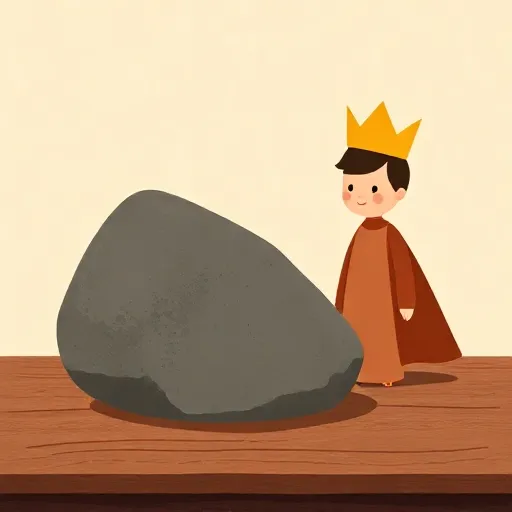
But is a daydream like a stone? Ingarden thought not. A stone doesn’t need anyone to think about it in order to stay a stone. It can be discovered, picked up, thrown, forgotten, and it will still be exactly what it is. A fictional character, on the other hand, is completely helpless without a mind. Harry Potter didn’t sneak into existence on his own — J.K. Rowling had to invent him, and we have to keep him in our thoughts. If every mind that ever imagined Harry vanished, Harry would be gone.
Ingarden summed this up with a technical word: fictional objects are heteronomous. They depend entirely on something else — consciousness — for their very existence and for every single quality they have. Real things are not heteronomous. So treating the whole world as if it were one big heteronomous story would mean ignoring the most basic difference between the two kinds of being.
He didn’t stop there. Ingarden wanted to build a whole menu of ways things can exist.
Four Ways to Exist

Most people think everything either exists physically (like a chair) or doesn’t (like a unicorn). Ingarden thought that was far too simple. He identified four fundamental modes of being:
- Absolute being — the kind only God could have. A being with absolute existence would need nothing else at all. If the entire universe disappeared, it would still be there, unchanged.
- Ideal being — timeless, unchanging things, like numbers or perfect geometric shapes. The number seven doesn’t grow older, doesn’t depend on your mind, and can’t be destroyed.
- Real being — the everyday world of trees, mountains, rivers, and your own body. These things exist in space and time, come into being, change, and eventually wear away. They exist whether or not anyone thinks about them.
- Purely intentional being — the home of fictional characters, works of art, and anything whose whole nature is given to it by conscious acts. These objects are heteronomous: without the minds that create and sustain them, they simply aren’t there.
With this framework, Ingarden could tackle the big question: does the real world have real being or purely intentional being? The answer matters enormously. If the world were purely intentional, it would be like a novel — and we’d all be characters in it. But we keep bumping into a world that doesn’t behave like a story. You can’t just wish a thunderstorm away. So realism, Ingarden thought, wins: the real world is not a fiction.
Inside a Novel: Four Layers of Meaning

To prove this point, Ingarden needed to show what purely intentional objects actually look like up close. His most famous work, The Literary Work of Art (1931), takes a story apart like a watchmaker opening a clock.
He found that every literary work is built out of four layers:
- Word sounds — the rhythm, rhyme, and melody of language, even when you read silently. A line like “the murmuring pines and the hemlocks” doesn’t just mean something; it sounds a certain way.
- Meaning units — the sense carried by words, phrases, and sentences. These connect to ideal concepts, so “king” doesn’t mean “leaf.”
- Schematized aspects — the half‑formed images that flicker in your mind as you read. You picture Hamlet, but you don’t picture every pore on his face. The text gives you a skeleton; your imagination fills in some of the gaps.
- Represented objects — the characters, places, and events the story is about.
Each layer has its own kind of beauty, and a great work gets them to sing together. Ingarden called this a polyphonic harmony — like a choir where every voice adds something, and the magic lies in how they interact.
Crucially, a story is always full of gaps, which Ingarden called places of indeterminacy. What did Hamlet eat for breakfast? The play doesn’t say. When you read, you silently fill in many of those gaps based on your own background. The version of the story that lives in your head — Ingarden called it a concretization — is a little different from anyone else’s. That’s why two people can read the same book and still argue about it, and why neither is necessarily wrong.
Even Buildings Need Our Minds
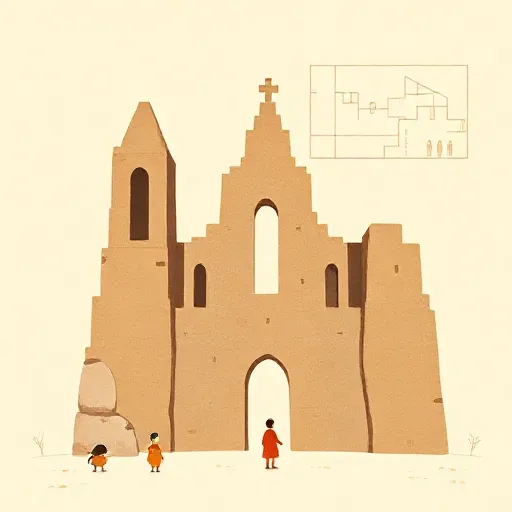
What about things that seem stubbornly real — not wispy like a story, but solid like a building? Ingarden examined architecture because it looked like a strong objection to his whole view. After all, Notre Dame in Paris is as solid as the ground it stands on.
But he argued that the architectural work — the cathedral as a work of art — is not just a heap of stones. It’s doubly founded. First, it needs the physical building, real and independent. Second, it needs the creative intentions of the architect and the reconstructive acts of everyone who sees it as a work of art. Without those mental acts, you have a stack of materials, but you don’t have a cathedral in the full sense.
Ingarden then took the same idea and applied it to everyday objects. A flag is a piece of cloth, but what makes it a flag is a web of shared meanings and rules. You don’t clean pots with it; you salute it. A church is a building that becomes a sacred place only through acts of consecration and the beliefs of a community. Money, schools, nations — all of these are founded partly on physical stuff and partly on what we all agree to think about them.
This was his middle path. You don’t have to choose between “everything is just matter” and “everything is just a story.” Ingarden’s world is a rich mix, where most of the things you care about daily live in the overlap.
Your World, Half Real and Half Made Up

Ingarden never finished his giant project on how the world exists, and for a long time his work was hard to find — written in Polish during and after a war, while the philosophical world mostly ignored him. But the questions he asked haven’t gone anywhere.
Think about your own life. Is your school a “real” thing? It’s certainly not a rock. The building is real, but the school as a school — with its rules, its teams, its reputation — lives in the shared understanding of everyone in it. If every memory of it vanished overnight, the classrooms would still stand, but the school would have vanished in the ways that matter.
Ingarden’s map of existence helps you see why you can’t just pretend a country’s borders don’t exist, even though they’re not carved into the earth. It also shows why you can’t reduce a symphony to vibrating air or a novel to ink on paper. Reality is layered, and some of the most important layers are the ones we build together.
Think about it
- If everyone in the world forgot about a particular law tomorrow, would it still exist? Why or why not?
- Can a fictional character ever be more famous or influential than a real person? What does that tell us about the way we exist?
- If you perfectly rebuild an ancient temple stone by stone, is it the same building? What if no one alive remembers the original?