The Sorting Game That Exposes Your Hidden Biases
Frank’s Surprising Score
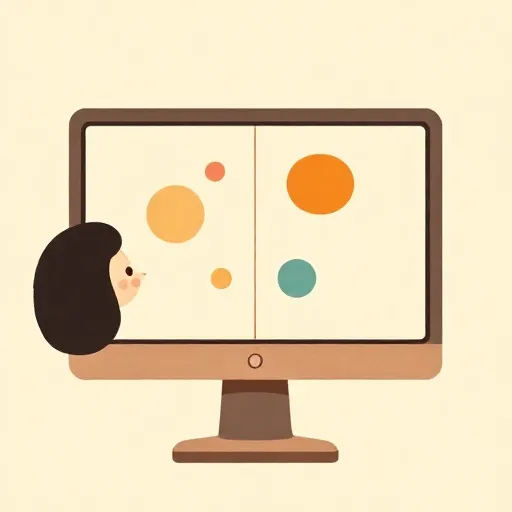
Frank sat down at a computer. The instructions were simple: press the left key for words like “male” or “business,” and the right key for “female” or “family.” Then the categories switched. Suddenly “male” and “family” went together, and “female” with “business.” Frank tried to keep up, but he was slower the second way. The test, called the Implicit Association Test (or IAT), showed that Frank had an automatic mental link between men and careers and between women and home — even though Frank would never say he believed such a stereotype.
Psychologists call this an implicit bias: a preference or association that operates without your conscious control. Unlike explicit attitudes, which you can state aloud, implicit biases are measured indirectly. In the late 20th century, researchers noticed that people sometimes acted in biased ways that didn’t match their stated beliefs. They borrowed ideas from cognitive psychology about automatic processing (fast, effortless, hard to stop) and controlled processing (slow, deliberate, effortful). Implicit measures like the IAT are designed to catch automatic associations before your controlled mind can edit them. Over 70% of white participants in one large study more easily linked black faces with negative words and white faces with positive words — a finding that has been replicated millions of times.
Two Minds in One Brain?
One popular idea is that each of us has two attitudes about the same thing. Your explicit attitude is what you report: “I value equal opportunity.” Your implicit attitude is a hidden automatic link that may contradict it. When Frank’s fingers stumbled on the second sorting task, his implicit attitude might have been exposed. This dual-attitude view suggests we discover our hidden attitudes by taking tests, just as we discover our cholesterol levels.
But not everyone agrees that implicit biases are attitudes at all. The philosopher Tamar Gendler (20th–21st century) calls them aliefs — mental states that bundle a representation, a feeling, and a behavior into one reflexive package. For example, if you see a black man in a dark alley, an alief might fire off “Black man! Dangerous! Run!” even if you believe there’s no danger. Aliefs are fast, automatic, and not sensitive to your reasons. In contrast, some psychologists argue that implicit biases are actually beliefs you hold without realizing it. On this view, Frank might genuinely believe, at some level, that women are less suited for careers, even though his conscious belief says otherwise. Your mind can hold two conflicting beliefs at once, and they show up in different situations. This contradictory-belief approach challenges the idea that you need to be conscious of a thought for it to count as a belief.
Do You Know What Your Brain Is Doing?
Many people are shocked when they see their IAT results, as if they discovered a secret part of themselves. But recent studies suggest we might have more awareness than we think. In “bogus pipeline” experiments, when people believe a machine can detect their true feelings, their IAT scores and their self-reports become more similar. Also, when asked to predict their own IAT scores, people do a pretty good job. This points to content awareness: you know what your implicit biases are about, even if you don’t like to admit it.
However, you might be unaware of the source (where the bias comes from) or the impact (how it affects your behavior). For example, you might not realize that your automatic association between black men and danger could influence how you see a person on the street. This limited awareness raises hard questions: if you only partly know your own hidden biases, do you truly have self-knowledge? Some philosophers argue that without full awareness, our minds are not transparent to us, making it tricky to take full ownership of every automatic flicker.
Who’s to Blame?
If you have a bias you didn’t choose and might not fully know about, are you to blame when it affects your actions? Many philosophers say that responsibility requires awareness or control. Philosopher Jennifer Saul (20th–21st century) argues that a person should not be blamed for an implicit bias they are completely unaware of and that comes simply from living in a biased culture. Studies back this intuition: people are less willing to blame someone for discrimination if the behavior is described as caused by a “subconscious” bias rather than a conscious choice.
On the other hand, if we are partly aware of our biases — as the prediction studies suggest — maybe we share some responsibility. Think of it like a bad habit, such as biting your nails. You might not notice every time you do it, but you can learn to become aware and try to stop. Another angle is control. Even if you can’t directly turn off an automatic association, you can control how it affects your behavior. For instance, if you know you have an implicit bias against women in science, you could remove names from applications and grade blindly. This is a way of taking responsibility without having direct control over the bias itself.
Rewiring Your Reflexes
Psychologists have tested many ways to reduce implicit bias or block its effects. Some strategies try to change the underlying associations. Evaluative conditioning repeatedly pairs a biased target (like a black face) with positive words (like “genius”) to shift the automatic link. Counter-stereotype exposure shows you images that break common stereotypes — female scientists, warm elderly people — to weaken old associations.
Other strategies focus on controlling your responses rather than changing the associations. Implementation intentions are “if-then” plans: “If I see a black face during the shooter test, I will think safe.” This helps people override the automatic impulse. Studies find that these interventions can work in the short term, but it’s unclear how long the effects last. Changing deep-rooted reflexes takes practice, just like learning to ride a bike. And not all biases respond to the same tricks — what quiets a gender-career bias might not touch a racial one.
Why It Spills Out of the Lab
Implicit biases don’t just live in lab computers. They show up in job interviews, police stops, doctor visits, and classrooms. Researchers have found that a doctor’s implicit racial bias can affect the treatment they recommend. Police officers with stronger automatic associations between black people and weapons are quicker to misidentify a tool as a gun in split-second simulations. Even more striking, the average implicit bias score in a city predicts racial disparities in actual police shootings. This doesn’t mean every biased act is intentional, or that individual bias is the only problem. Housing segregation, economic inequality, and other structural factors play huge roles. But implicit biases can make those problems worse by adding automatic discrimination on top of them.
The good news is that understanding your own hidden biases is the first step. By recognizing that your brain takes shortcuts, you can design situations to catch yourself — like Frank, who might now carefully review his hiring decisions after seeing his IAT score. The test isn’t a final verdict on who you are; it’s a mirror that can help you see something you’d otherwise miss.
Think about it
- If a test reveals you have an implicit bias you never knew about, is it really “yours” — or is it something society put in your brain?
- Schools and companies sometimes use implicit bias training. Should they also use the IAT to test people? What might go wrong?
- Imagine you’re on a jury. Would you trust your own judgment if you knew unconscious biases might affect it — and if so, what would you do to guard against them?