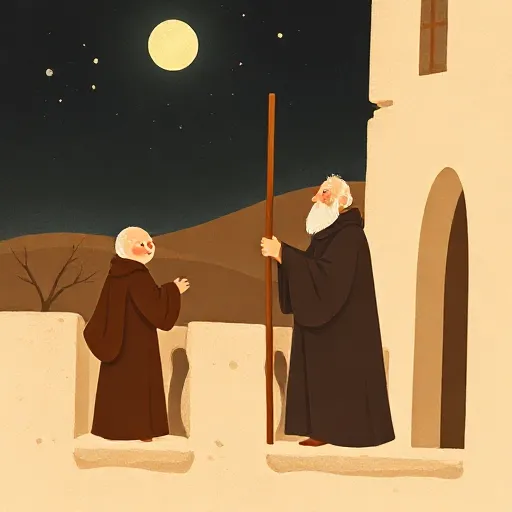

Do the Stars Decide Your Fate? A Wandering Poet Said It's Complicated
A Poet Packs His Bags and Leaves Everything Behind

In 1140, a Jewish poet and scholar named Abraham Ibn Ezra (around 1093–around 1167) did something that changed his life forever. He packed up and fled his home in Tudela, a city in what was then Muslim Spain. A fierce North African dynasty called the Almohads was sweeping through the region, demanding that Jews and Christians convert or leave. Ibn Ezra chose to leave.
He was about 47 years old. He had spent his entire adult life in one place, earning a modest living as a poet. Now he became a wanderer. For the next three decades, he moved from city to city — Rome, Lucca, Rouen, London, Béziers — never settling for long. And in those thirty years of wandering, he produced nearly everything we remember him for: books on Hebrew grammar, handbooks on arithmetic, guides to astronomy, and most of all, biblical commentaries spiced with philosophical ideas.
Ibn Ezra was not a philosopher in the usual sense. He never built a grand system. He never wrote a single sustained argument about the nature of reality. Yet his ideas traveled further than those of almost any other medieval Jewish thinker. He became, in the words of one scholar, “the most important cultural broker of the medieval period.” What made him so influential — and why do people still argue about what he really believed?
The Soul’s Longing: A Prisoner in a Body

If Ibn Ezra had a favorite philosophical topic, it was the human soul. He returned to it again and again, not in dry academic prose but in poetry that still feels startlingly personal. His hymn “Tzom’ah nafshi” — “My soul thirsts” — is one of the most powerful expressions of spiritual longing ever written in Hebrew.
What did he believe about the soul? Ibn Ezra held that the soul is the one unchanging, eternal part of a human being. It is the only thing in the created world that bears any resemblance to God. The body, by contrast, is temporary and full of distracting desires. In his commentary on the biblical book of Ecclesiastes, he put it this way: the soul is like a traveler who has been taken prisoner in a foreign land. It yearns to break free and go home.
His prose on this subject reads almost like poetry itself. The soul, he wrote, must “whiten” and “sanctify herself above the impurities of disgusting bodily lusts.” Only then can she grasp the real truth, which will be “inscribed upon her in such a way so as not to be erased when she departs the body.” The script written on the soul, he added, is “the writing of God.”
Strikingly, Ibn Ezra admitted that he did not have all the answers. In one passage, he confessed that we do not know whether the soul is a substance (a thing that exists on its own) or an accident (a property that depends on something else). We do not know whether it survives the death of the body. We do not even know why it was bonded to a body in the first place. His honesty about these mysteries was unusual for a medieval thinker — and it made readers trust him.
Do the Stars Rule Your Life?

Ibn Ezra’s biggest intellectual obsession was astrology. Today we may think of astrology as a superstition, but in the twelfth century it was a serious branch of learning, closely tied to astronomy and mathematics. Ibn Ezra wrote astrological handbooks that circulated in both Hebrew and Latin. His Latin translations helped spread astrological knowledge throughout Christian Europe.
His core idea was bold: the physical universe is split into two realms. The celestial realm — the stars and planets — sits above. The terrestrial realm — everything on Earth, including human bodies — sits below. And the terrestrial realm is completely under the sway of the celestial one. The stars shape events on Earth the way the moon shapes the tides.
But Ibn Ezra added a crucial twist. Humans can connect to a third realm, a divine realm above the stars. By turning toward God, you can outmaneuver the stars, so to speak. This does not mean you escape earthly suffering. Ibn Ezra was a pessimist about that — his commentary on Ecclesiastes is full of dark reflections on the misery of life. What the connection to the divine realm gives you is spiritual stamina. You gain the inner strength to endure whatever the stars dish out.
This position created a fascinating tension. On one hand, the stars determine everything that happens in the material world. On the other hand, your soul can rise above that determination. Ibn Ezra never fully resolved the tension. He left it there, for his readers to wrestle with.
He also made a point that ruffled some feathers. In his astrological writings, he said there is no difference between Jews and non-Jews when it comes to how the stars govern them. Every people is associated with certain planets and signs, and Jews are no exception. His philosophy was universal and humanist, not particularist and Jewish. Some of his readers quietly ignored this implication. Others noticed and argued about it for generations.
The Argument That Shook a Friendship

Ibn Ezra had a close friend and fellow poet named Judah Halevi (a twelfth-century thinker). The two men respected each other deeply. They also disagreed about something fundamental, and their debate became one of the most famous in Jewish intellectual history.
The argument started with a deceptively simple question about the Bible. When God introduces himself in the Ten Commandments, he says: “I am the Lord your God, who brought you out of Egypt.” Halevi wanted to know: why did God identify himself with the Exodus — an event that mattered only to the Jewish people — rather than with the creation of the universe, which matters to everyone? If, as the philosophers say, God is best known through his works in nature, why not say “I am the God who made heaven and earth”?
Halevi’s question cut to the heart of something. Was Judaism a universal path open to all of humanity, or was it a special covenant with one particular people? Halevi leaned toward particularism: Jews were different, and their relationship with God was unique.
Ibn Ezra’s reply was characteristically layered. First, he defended the philosophers’ view: the opening words of the commandment — “I am the Lord” — already hint at the knowledge of God that anyone can obtain from studying creation. Adding “who made heaven and earth” would be redundant. Second, he brought in astrology: the stars had decreed that the Israelites should not have escaped slavery at that particular moment. By overruling the stars, God proved both his existence and his power over the cosmos he created. So the Exodus story actually supports the universal claim — it shows that the Creator is also the Redeemer.
Halevi was not satisfied. He went on to write the Kuzari, one of the most influential works of Jewish thought, which developed his particularist vision in full. Ibn Ezra stuck to his universalism. The two friends never resolved their disagreement. But the fact that they kept talking — and kept respecting each other — says something important about what philosophy can be.
What Kind of Thinker Was He?

For centuries, scholars have tried to pin a label on Ibn Ezra. Was he a Neoplatonist, a follower of the tradition that traced back to the ancient Greek philosopher Plotinus and emphasized the soul’s journey back to its divine source? Was he an Aristotelian, like his younger contemporary Moses Maimonides (the great twelfth-century Jewish philosopher)? Or was he a mutakallim — a practitioner of kalam, a style of rational religious argument that was common in the Islamic world but looked down on by the professional philosophers?
There is evidence for all three. His deep interest in the soul, his obsession with numbers and their hidden meanings (a tradition called arithmology), and his poetry of longing all sound Neoplatonic. His emphasis on rational analysis and his use of logical categories sound Aristotelian. His actual named sources — the early medieval thinker Sa’adiah Gaon and the cryptic mystical book Sefer Yesira — come from the world of kalam and proto-Kabbalah.
The truth is that Ibn Ezra probably did not care about fitting into a single tradition. He pulled ideas from wherever he found them. He was interested in insights, not in building a tight, fully coherent system. As one scholar puts it, he had “many divided, and often competing, loyalties.”
This eclecticism frustrated some of his readers. It also freed him. Because he was not trying to defend a single philosophical system, he could follow his curiosity wherever it led. He could be a Pythagorean when thinking about numbers, a Neoplatonist when writing about the soul, and a kalam theologian when discussing God’s names — all in the same week.
His most creative philosophical work, a rhymed prose allegory called Hayy ben Meqitz, shows this freedom at its best. It tells the story of a narrator who meets a mysterious ageless guide named Hayy, bathes in the fountain of life, and journeys through eight celestial kingdoms before arriving at the threshold of “the One, who has no second.” The tale borrows from Islamic philosophical allegories but weaves in biblical verses so skillfully that it feels entirely at home in Hebrew. It is philosophy as adventure story.
Why a Wandering Poet Still Matters

Ibn Ezra’s influence was enormous and immediate. His biblical commentaries — short, witty, and sprinkled with tantalizing hints at secret meanings he called sodot — became bestsellers. In the fourteenth century, a whole genre of supercommentaries sprang up: commentaries on his commentaries. These writers argued over what Ibn Ezra had really meant, and many of them insisted that he and Maimonides were secretly saying the same thing — even though Maimonides rejected astrology.
Centuries later, the philosopher Baruch Spinoza (1632–1677) credited Ibn Ezra with being the first person, as far as he knew, to question whether Moses had really written every word of the Torah. That observation alone secured Ibn Ezra’s reputation among Christian biblical scholars for generations.
But his deeper legacy is harder to pin down — and more interesting. Ibn Ezra never built a system. He never resolved the tensions in his thought. He left his readers with fragments: a haunting poem about the soul, a cryptic comment about the stars, an unresolved argument with his best friend. And somehow, those fragments proved more powerful than many systematic treatises.
Think about what that means. Can you be a philosopher without writing a single proper philosophy book? Can poetry and commentary do the work that arguments and proofs are supposed to do? Ibn Ezra’s life suggests the answer might be yes. His ideas traveled not despite his fragmented style, but because of it. Every reader could find something different in his hints and silences.
In the end, his story raises a question that any curious twelve-year-old can wrestle with: what does it mean to be free? If the stars — or your genes, or your circumstances — shape so much of your life, is there still room for you to choose who you become? Ibn Ezra looked up at the night sky and saw a world governed by cosmic forces. And then, in the same breath, he insisted that your soul can rise above them. He never explained exactly how. He left that for you to figure out.
Think about it
- If scientists could predict every choice you will ever make by studying your brain, your genes, and your upbringing — would it still be fair to praise or blame people for what they do?
- Ibn Ezra spread his biggest ideas through poems and short commentaries, not thick philosophy books. Can someone be a great thinker without ever writing a careful, step-by-step argument?
- Ibn Ezra and Judah Halevi were close friends who disagreed deeply about something that mattered enormously to both of them. Can you stay friends with someone whose beliefs about the world are completely different from yours? What makes that possible — or impossible?