
Could You Swap Lives With Your Best Friend and Nothing Else Change?
What would a world where you are your friend look like?
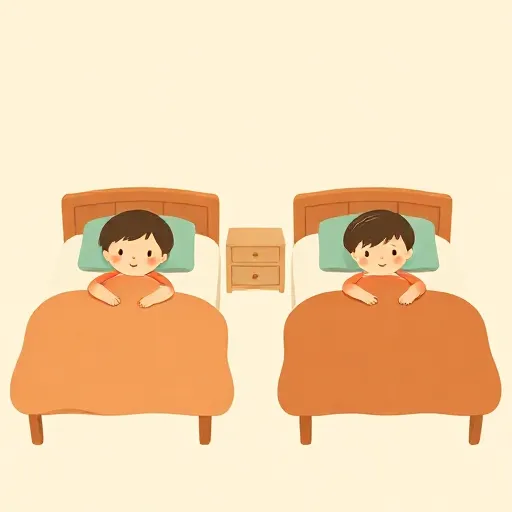
You wake up in your own bed, and everything looks exactly as it did yesterday. The same posters are on the wall, the same cereal boxes on the kitchen counter. But when you look in the mirror, the face staring back belongs to your best friend. Your friend, in turn, is now in your body. Yet the world runs on identically: the same people say the same things, the same events unfold. Could this be a genuinely different situation from the real world, or is it just the same world described in a confusing way?
This puzzle sits at the heart of haecceitism, a view about possibility and identity. To understand it, we need the idea of a maximal possibility—a complete, full story of how the entire universe could be. Your actual life is part of the actual maximal possibility. Haecceitism claims that there are distinct maximal possibilities that differ only in which specific individuals occupy which roles, with no change at all in the qualities of anything. In the swapped-friends world, every physical and mental quality is exactly the same, but the “who” behind each role has been exchanged. The opposing view, anti-haecceitism, denies that such purely who‑based differences exist. According to anti-haecceitists, any shift in who is who must come with some difference in what qualities are present.
To make this precise, philosophers divide properties into two kinds. Qualitative properties are like being red, having a certain mass, or being round—properties that don’t name any particular individual. Non-qualitative properties are tied to specific individuals, like being Napoleon or being five feet from Kenji. Haecceitism says there can be maximal possibilities that include exactly the same qualitative possibilities but differ only in their non‑qualitative ones.
The secret ingredient: haecceities and qualities

When philosophers try to explain what makes you you, they sometimes point to a special kind of property called an haecceity (pronounced “heck‑see‑ity”). An haecceity is a “thisness”—a property like being identical to Austin or being Socrates. If such properties exist, they belong to exactly one individual and could not possibly belong to anyone else. You might think haecceitism simply means believing in haecceities, but that is not quite right. You could deny that properties exist at all (as a nominalist does) and still hold that there are distinct possibilities that differ only in who plays which role. Conversely, you could think haecceities are real while rejecting the modal claim that a world could be exactly like ours except for a switch of individuals. So haecceitism is primarily a thesis about what possibilities there are, not a direct claim about the existence of special properties.
Nevertheless, haecceities help us talk about non‑qualitative differences. Qualitative properties draw the map of a world: its colors, shapes, laws, and patterns. Non‑qualitative properties add name‑tags to the map. The core question of haecceitism is whether you can rearrange the name‑tags while leaving the map completely untouched and still get a different world. As we will see, many philosophers think you can; many others find that idea deeply suspicious.
Could you imagine yourself as someone else? Arguments for haecceitism

One powerful way to argue for haecceitism is through imagination. Suppose you have an identical twin. Try imagining, from the inside, living your twin’s life while your twin lives yours. Everything about the world stays the same: the same people, the same conversations, the same events. Yet it feels as if there is a real difference—you are now the one eating your twin’s breakfast. The philosopher David Lewis (1941–2001) offered a similar thought: imagine a universe where history repeats itself exactly, over and over. It seems you can picture yourself being in the seventeenth repetition rather than the fortieth, even though the two repetitions share all qualitative facts. If you can clearly and distinctly conceive of such a scenario, that may be a reason to think it is really possible.
Robert Merrihew Adams (1937–present) gave an especially vivid case. Imagine a world containing two perfectly identical globes, Castor and Pollux. Now imagine a second world, exactly like the first up to a certain moment, but then Castor vanishes and Pollux continues forever. Imagine a third world where Pollux vanishes instead. From the outside, these two worlds look qualitatively identical. But imagine being a person living on Castor before the moment of vanishing. From that inside perspective, the difference between being annihilated and having the other globe annihilated feels enormous. If that difference is real, then there are maximal possibilities that differ only haecceitistically.
Some philosophers push further with a step‑by‑step argument known as Chisholm’s Paradox, named after Roderick Chisholm (1916–1999). Start with Adam and Noah. Adam actually died at 930, but he could have died at 931. That slightly different Adam could then have died at 932, and so on, until you reach an ancient person who has all of Noah’s actual qualities, yet is still Adam. If identity is transitive through these tiny steps—if Adam remains Adam across each change—then there is a possible world qualitatively just like the actual one but with Adam and Noah swapped. That would be a pure haecceitistic difference. You can avoid this conclusion only by giving up some logical rule about possibility, or by insisting that each tiny step is not really possible.
The case against swapping: why haecceitism might be mistaken

Many philosophers find haecceitism hard to accept. Graeme Forbes (born 1954) argued that a difference in identity with no qualitative backing is unintelligible. The Eiffel Tower, for instance, is a particular iron tower. Could there be a world where a different tower stands in its place, yet everything—its metal, its design, its history—is exactly the same? Forbes suspects that such a “bare identity” difference cannot be made sense of. Facts about who is who, he thinks, must be grounded in qualitative facts.
A different worry comes from modal intuition. Imagine a god setting up a universe. After fixing all the qualitative properties—every shape, every law, every pattern of events—would there still be a choice about which individuals fill those roles? To many, it seems not. Once the qualitative story is told, all the individuals are already in place. Relatedly, the Identity of Indiscernibles says that things that share all their properties are identical. Applying this to possible worlds, if two worlds are qualitatively indistinguishable, they must be the same world. But many think that principle simply assumes anti‑haecceitism rather than arguing for it.
It is worth noting that some philosophers try to have it both ways. Lewis’s counterpart theory holds that individuals are world‑bound—no one exists in more than one possible world. Yet a single world, and the resemblance relations among its parts, can represent many different haecceitistic possibilities. Lewis called this “haecceitism on the cheap.” It accepts that there are distinct maximal possibilities differing only non‑qualitatively, but denies that extra possible worlds are needed to house them. So even among haecceitists, there is disagreement about exactly what the view commits you to.
Why it matters: you, your qualities, and the core of who you are

Haecceitism is not just an abstract game. It touches a question you have probably asked yourself: what makes you you? If haecceitism is true, then there is a bare “you‑ness” that cannot be captured by any list of your qualities—your memories, your personality, your appearance. A world where a perfect duplicate replaces you would be a different world, even if no one could ever tell. If haecceitism is false, then you are nothing over and above your qualities; a copy that shares all your qualities would literally be you. This has real stakes for debates about cloning, mind uploading, and whether you could survive as a digital copy.
The puzzle also presses against a strict form of physicalism, the idea that all facts are fixed by physical facts. If all physical properties are qualitative, then haecceitism says two physically identical worlds could still differ in who is who. That would mean physics, by itself, does not settle everything. Moreover, in the philosophy of space, the “Hole Argument” asks whether a universe where everything is shifted five feet to the left is a genuinely different possibility from the original. If you accept haecceitism about locations, you might have to accept such a difference. So the question of whether purely non‑qualitative differences exist threads through some of the biggest discussions about reality.
Think about it
- If you could be turned into your best friend while your friend becomes you, and no one could ever tell, would you feel like you had become a different person? Would your memories matter?
- Imagine a universe where everything is exactly the same as ours, except you and your pet hamster have swapped roles. Does that world seem possible? What makes you think it is or isn’t?
- Suppose a machine could duplicate you perfectly, down to every thought. Would the copy be you? What does your answer say about whether there is more to you than your qualities?