
Why Was a Monk Called the 'Torturer of Infants'?
The Monk with a Horrible Nickname
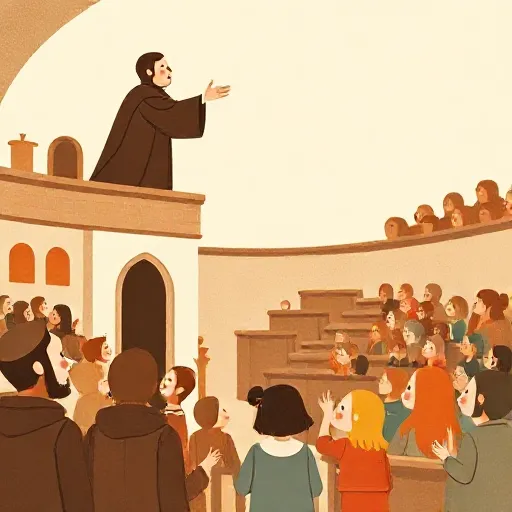
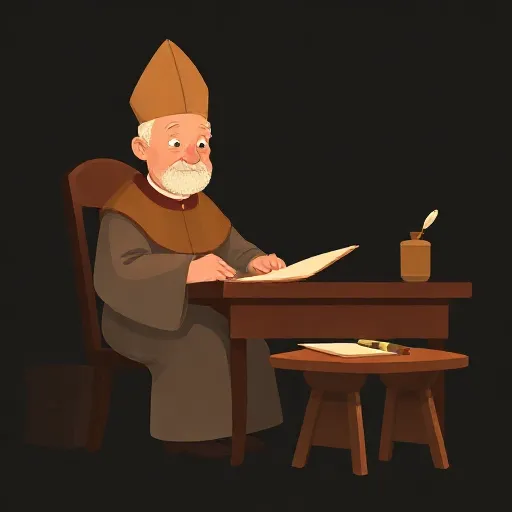
“Torturer of Infants” – that’s what people called Gregory of Rimini (c.1300–1358). It’s a shocking name for a monk. But Gregory, an Augustinian friar, earned it because of his ideas about God’s plan for human souls. He argued that God alone, from all eternity, decides who will be saved and who will be damned, with no help from anything a person does. Even babies who die without baptism, in his view, could be condemned by an inscrutable divine choice. That belief made him one of the most controversial thinkers of the Middle Ages.
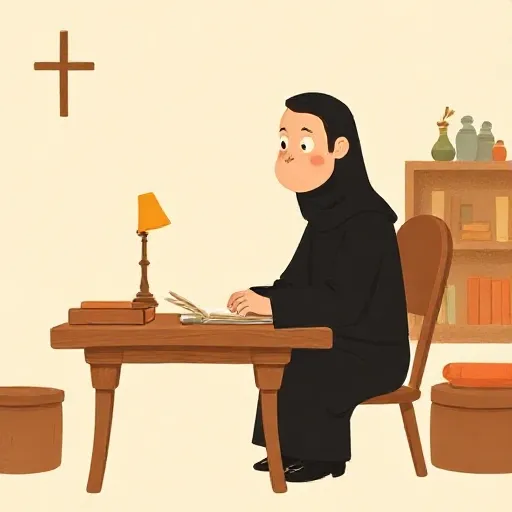
Gregory was born around 1300 in Rimini, Italy. He joined the Augustinian order and studied theology at the University of Paris in the 1320s. He then taught in several Italian cities before returning to Paris in the early 1340s to lecture on the Sentences, a standard theology textbook. His lectures turned into a massive commentary – one of the clearest, most detailed works of the 14th century. By 1345 he became a Master of Theology, and later he was elected head of his entire order. But his nickname stuck, and it points straight to the problem that obsessed him: if God knows the future, are any of our choices really free?
Can God Know the Future and Still Leave You Free?

The puzzle Gregory wrestled with starts with a simple question. Suppose God knows you will eat cereal tomorrow morning. If God knows it, then it must be true that you will eat cereal. But if it is already true, can you avoid eating cereal? It seems like you have no real choice. That is the problem of future contingents – events that depend on free choices, which could go either way. When they look true in advance, they appear inevitable.
Peter Auriol (d. 1322), a Franciscan philosopher, tried to solve it by denying something ordinary: he said statements about future free actions are neither true nor false. They are like a coin spinning in the air – not heads, not tails, until it lands. So God does not know them as already fixed, because there is nothing to know yet. That way, Auriol kept both God’s perfection and human freedom.
Gregory found this answer wrong and even dangerous. He was convinced, by logic and by the Bible, that God does know the future. Prophecies only make sense if God knows what will happen. So Gregory insisted that the Principle of Bivalence – the idea that every proposition is either true or false – holds for all statements, even about the future. If “you will eat cereal” is true, it is true now and always has been. But does that mean you eat cereal necessarily? Gregory said no.
The Logic of an Unchangeable Future

Gregory built a careful defense using two distinctions that medieval thinkers loved. First, he separated immutability from necessity. Something is immutable if it is fixed and cannot change. A movie you have already recorded is immutable – the ending will not switch – but it was not necessary; the director could have shot a different ending. In the same way, Gregory argued, God’s knowledge makes the future unchangeable, but it does not make it absolutely necessary. God could have willed a different world, and the facts about tomorrow would have been different.
Second, he used the trick of “composite and divided senses.” In the composite sense, “What God knows cannot be false” is a necessary truth – because God’s knowledge is perfect. But in the divided sense, the thing God knows – say, your choice of cereal – is not itself necessary; it is just a contingent event. Think of it this way: necessarily, if God knows you will eat cereal, then you will. But it is not necessary that you eat cereal. That subtle shift allowed Gregory to say God’s knowledge is certain, yet your actions remain free in a logical sense.
This solution became known as the opinio communis, the “common opinion.” Gregory did not invent it – he borrowed from earlier Oxford scholars – but he presented it with unmatched clarity. He even corrected small mistakes he found in his allies’ versions. Still, he knew the logic only went so far. It preserved a kind of contingency, but it relied on the idea that God’s will is the only truly free thing in the universe. That idea became terrifying when he turned to the question of salvation.
Why God’s Choice Alone Decided Souls

The real storm broke over predestination, the doctrine of who goes to heaven and hell. Most theologians held that God predestines the saved out of mercy, but that the damned are responsible for their own damnation because of their sins. Peter Auriol tried to keep this human role by saying God sets up general rules: if you put an obstacle in the way of grace (the obex gratiae), you block salvation. Your obstacle is the positive cause of your reprobation, while lacking an obstacle is only a negative cause of predestination. That way, humans contribute something.
Gregory rejected that outright as Pelagianism – the idea, condemned by the Church, that people can earn salvation by their own efforts without God’s grace. He went further than almost anyone. He argued that Scripture clearly teaches double predestination: God from eternity actively chooses some people for heaven and others for hell. He quoted Romans 9:13, “Jacob I have loved, but Esau I have hated,” to show that God’s love and hate are not caused by anything in the persons. There is no reason, Gregory said, why one person is saved and another damned except God’s inscrutable will. Not even free choices matter. This applied to adults and, yes, to infants who die unbaptized – they, too, would be destined for damnation by God’s mere decision.
That is why people called him the “Torturer of Infants.” From his logic, if God’s will alone decides everything, then a loving God could still condemn innocent babies without any fault of their own. Gregory did not shrink from the conclusion; he thought it was inspired by Augustine and Paul. Others were horrified. Peter Auriol’s approach, while criticized, at least let humans share in their destiny. Gregory’s answer was consistent, but it made God appear cruel to many.
From a Medieval Classroom to Your Own Choices

Gregory’s ideas did not vanish. Martin Luther and John Calvin, the great Protestant reformers, later agreed with his double predestination. They even thought the logical tricks of the opinio communis were feeble attempts to escape the hard truth: if God knows and wills everything, human free will is an illusion. In their view, Gregory had shown the correct conclusion, even if he tried to soften it.
The core question, though, outgrew its religious clothing. Today, without any talk of God, we still wonder: if everything in the universe follows fixed laws (whether divine or physical), can any choice be truly free? Does it matter if a scientist could predict your every move from the neurons in your brain? Gregory’s medieval debate foreshadowed the modern conflict between determinism and free will. The tools he used – distinguishing between unavoidable and necessary, between what follows from a fact and what is forced – still appear in philosophy classrooms.
So next time you face a decision, whether to study or watch videos, ask yourself: do you feel like you are making a real choice? Gregory might say yes, but his God might already know the answer. Auriol might say it is genuinely open. The argument is not over – and maybe it never will be.
Think about it
- If a supercomputer could perfectly predict every decision you will ever make, would you still be responsible for your actions? Why or why not?
- Can you imagine a world where your choices are free even though every event has a cause? What would “free” mean then?
- Gregory’s opponents called his view cruel. Is a belief that not everyone can be saved cruel if it is consistent? How do you decide when a logical conclusion becomes too harsh to accept?