
Do You Have a Secret Theory of Other People’s Minds?
Do You Have an Invisible Theory Hidden in Your Mind?

Your friend is suddenly quiet, staring at the ground. You know something is wrong, and you have a hunch: she probably thinks you forgot her birthday. You just read her mind, in a way. But how did you do that?
Many philosophers and psychologists think you have a secret toolkit for this kind of detective work. They call it folk psychology (FP) — our everyday ability to make sense of actions by thinking about what goes on inside people’s heads. A big idea in this camp is called theory-theory (TT). The name is clunky on purpose: it says that FP is itself a theory, and the claim that it is a theory is also a theory. The core thought is that when you try to understand someone’s mind, you use the same sorts of tools a scientist uses — a hidden set of rules that explain the unobservable causes of behavior.
The philosopher Wilfrid Sellars (1912–1989) cooked up a famous story to make this vivid. He imagined a time when our Rylean ancestors were pure behaviorists — they only noticed outward actions, never inner thoughts. Then a genius named Jones came along. Jones noticed that people sometimes talk aloud to themselves, and he wondered: what if there are silent versions of that talking inside our heads? From that guess, the whole idea of inner mental states was born. Once you assume thoughts are real but invisible, you need a little theory to connect those hidden thoughts to what people do. In everyday life, that theory is your theory of mind (ToM).
David Lewis (1941–2001) pushed this further. He argued that mental words like “belief” and “desire” get their meaning from a network of everyday platitudes — the kind of truisms everyone knows, like “if a person wants something and believes doing a certain thing will get it, they’ll tend to do that thing.” For Lewis, those platitudes work like the laws in a scientific theory. When you use them to predict or explain someone’s actions, you are really doing a kind of mindreading. On the TT view, you are like a spectator, standing outside the other person’s mind and inferring what must be going on inside.
The Little Scientist Test: When Children Pass (and Fail) the False-Belief Task
If we all walk around with a ToM, where does it come from? One popular version, known as scientific theory-theory, says you built it yourself, just like a tiny scientist. Alison Gopnik (born 1955) and her colleagues propose that each child actively collects evidence, runs mental experiments, and revises their own ToM over time. You started life with a basic ToM, and as you got older you added new concepts — especially the tricky one of belief.
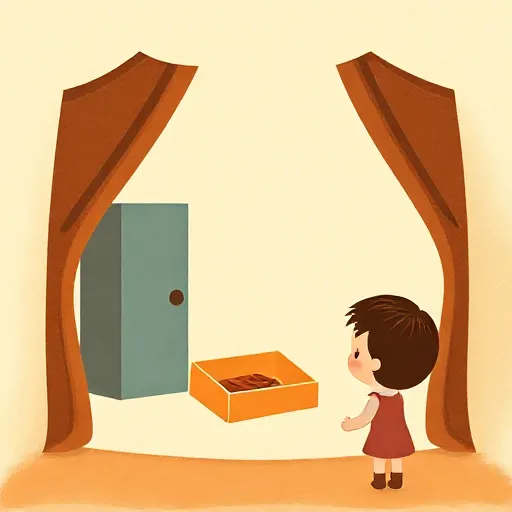
To see whether a child truly understands belief, researchers use a classic experiment: the false-belief test. In the original version, children watch a puppet named Maxi place his chocolate in cupboard X. Maxi leaves, and his mother moves the chocolate to cupboard Y. When Maxi returns, the child is asked: where will Maxi look for the chocolate? A child who says “cupboard Y” doesn’t yet grasp that Maxi holds a false belief. In the early studies, no child under about four years old passed. This suggested that a fully mature ToM, with a working concept of false belief, arrives somewhere between ages three and five.
But new twists complicate the picture. Using non‑verbal tasks — tracking where infants look — some researchers found that babies as young as 13 to 15 months seem to anticipate that a person with a false belief will act accordingly. That creates a puzzle: why do three‑year‑olds fail the verbal test if even babies might have the concept? Some TT thinkers say the core concepts never change, only that older children still lack the performance skills (like language or memory) to show what they know. Others propose a two‑system view: a fast, early‑developing minimal ToM for simple situations, and a richer, slower adult ToM that kicks in around age four.
What’s especially striking is that not all kids around the world pass the false‑belief test at the same time. Studies in Samoa, China, and Iran found that the order in which children master different mental concepts (desires, beliefs, hidden emotions) can vary across cultures. In some Pacific societies, people often say it’s impossible to know what another person thinks or feels. Children in those communities take longer to display standard false‑belief understanding. This hints that your ToM is not just a built‑in gadget — it’s shaped by the conversations and practices your culture hands you.
But Do You Really Need a Theory to Read Minds?

Theory-theory is one of the biggest explanations on the table, but it has a major rival: simulation theory (ST). Simulation theorists agree that you mindread all the time, but they deny that you consult a set of internal TOM laws. Instead, they think you put yourself in someone else’s shoes — you use your own mind as a model.
Imagine you see a classmate staring at a closed snack machine, and you instantly guess she feels disappointed. On the ST account, you don’t call up a mental law like “if a person desires a snack and sees the machine is broken, they feel disappointment.” Rather, you take your own thoughts offline: you pretend to believe the machine is broken, you pretend to want a snack, and then you let your own emotional gear spin. The output — disappointment — you then attribute to your classmate. The philosopher Alvin Goldman (born 1938) described this as a three‑stage process: identify an intentional action, feed pretend beliefs and desires into your own reasoning system, and then classify the resulting mental state. Mental state concepts like “disappointment” come into play only at the final stage, when you label what you just simulated.
If simulation can do all the heavy lifting, then a rich ToM full of laws might be unnecessary. Some researchers now favor hybrid views: maybe you use theory for some situations and simulation for others, or a little of both at once. The fight over which, if either, explains the core of your folk‑psychological know‑how is far from settled.
When Your Gut Reaction Bypasses the Lab Coat
A different group of critics argues that both TT and ST misdescribe everyday social life. Philosophers influenced by phenomenology — the careful description of lived experience — point out that you rarely feel like a scientist when you talk with a friend. Dan Zahavi and Shaun Gallagher, for example, emphasize that you directly see emotions in a person’s face and gestures; you often respond to them without inferring anything at all. When someone tells you why they did something, you trust or question their story, not run a hidden calculation. The need to “bridge a gap” between you and others may not be your natural starting point.
The philosopher Daniel Hutto (2004, 2008) proposed the narrative practice hypothesis. He argues that you learn to make sense of actions by growing up inside stories — the bedtime tales, gossip, and everyday narratives that show how beliefs, desires, hopes, and fears tangle together. On this view, your competence is not a set of rules stored inside your skull. It’s a practical skill, like knowing how to ride a bike, and it is shaped by the narrative habits of your culture.
Other pluralists go further. They say folk psychology is not mainly about prediction and explanation at all. Zawidzki’s mindshaping hypothesis, for instance, suggests that the main job of FP is to mold people’s minds so that they become more predictable in the first place — through imitation, teaching, and social pressure. On this picture, the spectator‑style theorizing that TT champions is a backup strategy, used only in special circumstances when our usual ways of coordinating break down.
Why a 12‑Year‑Old Philosopher Should Care
You might wonder: does it really matter whether you walk around with a miniature theory in your head? The answer touches everything from friendship to fairness.
If TT were the whole story and we all used the same universal ToM, then cultural differences and personal quirks in how we understand each other would be hard to explain. But the cross‑cultural evidence shows that people in different parts of the world prioritize different ways of making sense of actions — some focus on mental states, others on situations or traits. Recognizing that can make you a more careful listener.
The debate also affects how we think about neurodiversity. For a long time, researchers assumed that autistic people have a broken ToM because many fail standard false‑belief tasks. Today, many neurodiversity advocates argue that we should stop labeling those differences as deficits. Instead, they point out that there are many cognitive styles, each with its own strengths. Accepting that doesn’t mean giving up on understanding others — it means expanding our picture of what understanding can look like.
And on a personal level, the next time you try to guess what your best friend is thinking, you might catch yourself. Are you running a mini‑theory? Putting yourself in her shoes? Just feeling what she feels? Or asking her outright? The answer might be a messy mix of all of them. Philosophers haven’t finished their work because you, the living, breathing mind‑reader, are wonderfully complicated.
Think about it
- If you could have a device that perfectly predicts what anyone will do next, would you want to use it on your friends? Why or why not?
- Do you think learning to read minds from stories and conversations is different from being born with a brain gadget that does it automatically? Does it matter?
- Some people say we never really know what another person thinks — we only have guesses. If that’s true, how should you treat your best guesses about someone else’s feelings?