Can You Love Both Science and Faith? A Medieval Scholar’s Secret Plan
The Debate That Started It All

In 1263, a Jew known only as “the scholar” knocked on the door of a pious man in Spain. The scholar had been reading books by Greek and Muslim philosophers — Aristotle, Alfarabi, Avicenna. The pietist was horrified. To him, those books were a trap, full of ideas that could destroy faith in the Torah. The scholar sat down and began a long conversation. He wanted to prove that studying the “true sciences” was not forbidden by Jewish law. By the end of the day, the pietist was convinced. The scholar promised to write three books that would guide any curious Jew into philosophy without danger. That fictional conversation, written by Shem-Tov Falaquera (c. 1223–after 1290), became his most famous work, Iggeret ha-Vikkuah (The Epistle of the Debate). It was Falaquera’s opening move in a lifelong mission: to show that wisdom and Torah are not enemies, but partners.
Falaquera lived in a time of fire. A few decades earlier, a fierce controversy had split Jewish communities over the writings of Maimonides (1138–1204), who had tried to reconcile Aristotle with the Bible. Some rabbis wanted to ban the study of Greek science entirely. Falaquera hoped that if he could answer the objections calmly and clearly, he might prevent future bans. So he wrote this dialogue, where the scholar defeats the pietist’s fears point by point. The key idea: philosophy, far from weakening religion, reveals the deepest truths hidden inside Scripture. But Falaquera knew that not everyone was ready for those truths.
From Poetry to Philosophy: A Midlife Decision

Long before he wrote about debates, Falaquera loved poetry. By his own account, he composed over twenty thousand stanzas of rhymed verse — an art at which he excelled. But around his fortieth year, something shifted. In his book Sefer ha-Mevaqqesh (The Book of the Seeker), finished in the autumn of 1263, he announced that he had passed the midpoint of life and felt his rational soul beginning to wake up. His body would now decline; his mind would rise. He called this new work a “bill of divorcement” from the poetry of his youth, and declared himself betrothed to wisdom instead.
Why such a dramatic break? Falaquera, like many medieval philosophers, worried that poetry persuades people through beauty and rhythm, not through truth. It can make false ideas sound noble. So he turned away from rhyme and devoted himself to gathering and translating the great works of science and philosophy. He had already been flirting with wisdom for years, producing seven early philosophic books. Now, in middle age, he would make that marriage his whole life’s work.
A Trilogy to Guide the Seeker
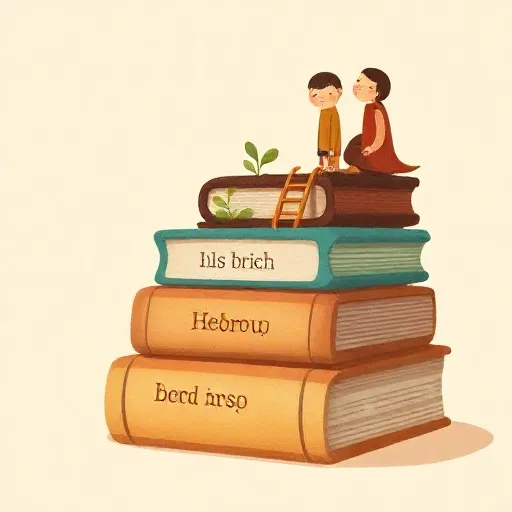
The three books the scholar promised in that debate became real. Falaquera wrote them as a trilogy to lead a reader step by step from everyday goodness to the deepest causes of the universe. The first, Reshit Hokhmah (Beginning of Wisdom), opens with moral virtues — because, as Falaquera explained, anyone who wants to study science must first learn to be a decent person. It then lays out a map of all the sciences, based on the Muslim philosopher Alfarabi (c. 870–950), showing how language, logic, nature, and theology fit together.
The second book, Sefer ha-Ma‘alot (Book of Degrees), guides the reader toward human perfection. It brims with short, attributed quotations from Aristotle, Plato, Maimonides, and others, mixed with verses from the Bible and rabbinic texts. The third and longest, De‘ot ha-Filosofim (Opinions of the Philosophers), is a full encyclopedia of Aristotelian natural science and metaphysics — the first of its kind in Hebrew. In it, Falaquera explained everything from the heavens to the soul, mostly by translating the commentaries of Averroes (1126–1198). All three books were written in clear, accessible Hebrew, so that any educated Jew could begin to study the sciences without needing Arabic. It was a complete curriculum, designed not for professors but for a curious believer.
The Art of Blending Books

Falaquera rarely simply translated a book. He was more like a master blender: he took passages from different authors, trimmed them, stitched them together, and often left out the original names. This gave him a quiet power. By choosing what to keep and what to cut, he could gently reshape a philosopher’s message. In Reshit Hokhmah, for instance, he summarized Alfarabi’s list of sciences and added a line Alfarabi never wrote: “These sciences do not contradict the Torah, and it is permissible for Jews to study them.” At the same time, he quietly left out Alfarabi’s suggestion that religion is only an imitation of philosophy, useful for crowds but unnecessary for the wise.
Sometimes Falaquera Judaized his sources, weaving in biblical verses or rabbinic sayings as if they were part of the original argument. The result looked, at first glance, like a simple compilation of ancient wisdom. In reality, it was a carefully crafted bridge between Greek thought and Jewish faith. He was not trying to deceive in a dishonest way; he was packaging difficult ideas so they could travel safely through a suspicious world. But the same skill also allowed him to speak in two voices — one for the crowd, another for the thoughtful few.
The Secret Hidden in a Commentary

Falaquera’s boldest book was not meant for the average reader. It was Moreh ha-Moreh (Guide of the Guide), a commentary on Maimonides’ secretive masterpiece, the Guide of the Perplexed. Maimonides had begged future readers never to explain his book, but Falaquera saw that people were already misreading it. So he wrote the first scholarly study of Maimonides’ philosophic sources, identifying the Arabic and Greek texts behind every chapter. In this technical work, he sometimes criticized Maimonides and, very quietly, revealed his own deepest beliefs.
One explosive example concerns the creation of the world. In his popular books, Falaquera wrote clearly that God “brought into existence all the created beings from nothing” and that this is a “root of the Torah.” He admitted that most philosophers believed the world is eternal, but he added that some accept creation — though “not in the way that we believe in it.” Only in the Moreh ha-Moreh does he finally say what that way is. There he writes: “It appears to me that there is no need to say that the Creator brought into existence the existent from non-existence.” Instead, God brought the world into being after it did not exist, by giving form to matter that was already there. This was essentially the view Maimonides had attributed to Plato — creation from eternal matter, not from absolute nothing. And Falaquera hints that this, not the popular teaching, is the true secret meaning of the Torah. He spoke this thought only in a commentary that ordinary believers would never open.
Falaquera was not a heretic; he was a moderate Maimonidean who believed that the Torah and philosophy agree if you know how to read them. But he understood that some truths, spoken loudly, could tear a community apart. So he hid them in plain sight, in a book wrapped in another book.
Why It Still Matters: Reason and Faith in Your World

You live in a world where people still argue about whether science and religion can get along. Some say a table of chemical elements leaves no room for God; others say a sacred text answers every question. Falaquera’s life offers a different path — one that was neither a surrender of the brain nor a rejection of faith. He spent his days copying out Arabic arguments about the stars and the soul, convinced that every true scientific discovery would ultimately match the wisdom hidden in Scripture, if only we knew how to interpret it.
But his story also raises hard questions about honesty and courage. If you discovered something that would upset your family or your community, how would you share it? Would you speak it plainly, or would you write a book that only experts could understand? Falaquera chose the second path, hoping to protect people from confusion while still keeping the truth alive for those ready to seek it. For centuries, his deepest thoughts stayed tucked inside a commentary, waiting for a careful reader. The question he leaves you is not whether science and faith can be friends — he was certain they could — but how openly we can talk about that friendship, and who gets to hear the whole story.
Think about it
- Imagine you discover that a story your family believes literally might be a metaphor. Should you tell them? Why or why not?
- If someone writes two books — one for beginners that simplifies, and one for experts that tells a more complicated truth — is that lying? What would you do?
- Falaquera thought philosophy was not for everyone. Should some knowledge be kept secret? Who gets to decide?