

What If Your Identity Is an Accident? Mexican Existentialism’s Answer
A New Philosophy for a Concrete Crisis

In 1947, a handful of students in Mexico City began meeting to read books by Jean-Paul Sartre and Martin Heidegger. They called themselves the Hyperion Group, after a rebellious Greek Titan. Their teachers were Spanish philosophers who had fled the Spanish Civil War, bringing existentialism across the Atlantic. But the Hyperion Group quickly realized that the European story didn’t fit their own. They were not bourgeois Parisians or Germans wrestling with world wars. They were Mexicans, living in a country shaped by colonization, displacement, and an identity crisis that felt like it had no end.
One of their guides was the Spanish thinker José Ortega y Gasset (1883–1955). Years earlier, Ortega had proposed a short, explosive principle: “I am myself and my circumstance, and if I don’t save it, I don’t save myself.” Your circumstance is everything that surrounds you concretely—mountains, streets, language, history, your neighborhood, your generation. It’s not a vague “humanity” but the actual world you live in. For the Mexican existentialists, this meant that their philosophy could not be a copy of Sartre’s. It had to begin with Mexican reality: the colonial past, the sense of being on the periphery, and the struggle to find an identity that wasn’t defined by the colonizer.
Leopoldo Zea (1912–2004) turned this into a call for freedom through commitment. Real freedom, he argued, isn’t about choosing anything you want. It’s about willingly tying yourself to your concrete circumstances and taking responsibility for them. You might commit to abstract ideals like “humanity” or “justice for all,” but those commitments feel thin. Zea said your deepest responsibility is to the people, the street corners, the suffering you can actually touch. Freedom and responsibility are two sides of one coin: where there is no responsibility, there is no real freedom. Choosing to avoid all commitment—just drifting—isn’t freedom either; it’s a refusal to be free.
The Accident at the Center: Uranga’s Big Idea

Emilio Uranga (1921–1988), the group’s most daring thinker, looked at the European ideal of the “complete human being” and called it a myth. In philosophy, a substance is supposed to be something that stands on its own, solid and self-sufficient. An accident, by contrast, is something that depends on a substance and can be taken away—like the color of a leaf depending on the leaf itself. European culture often treats “the human” as a substance: rational, stable, fully in control. Uranga argued that Mexicans, and colonized peoples generally, experience existence as an accident. They feel fragile, replaceable, insufficient. This accidentality is being “less than” the ideal.
But Uranga flipped the script. Accidentality isn’t a weakness; it’s the truth about everyone. No human being is a substance. We all depend on circumstances we didn’t choose. Our lives are “oscillation between being and nothingness.” We can be uprooted, displaced, ignored. Recognizing this, he thought, strips away the delusion of substantialization—the false belief that some people are fully self-sufficient and therefore more “real” than others. When you believe in that myth, you divide the world into those who count and those who are accidental. Uranga saw that myth behind the treatment of immigrants, refugees, and anyone pushed to the margins. The cure is to accept that insufficiency is the very condition of being human. Mexicans, he said, have “an ear” for this truth because their history has never let them pretend otherwise.
The Feeling of Being Pulled Apart: Zozobra

If accidentality is what you are, then zozobra is what you feel. Uranga borrowed this word from a Mexican poet and gave it a philosophical job: it names the sickening sense of wobbling between two possibilities, unable to trust any solid ground. It’s not ordinary fear. It’s the feeling that every choice might lead to ruin, and nothing you can hold onto is safe. He described it as a mode of being that incessantly oscillates between two possibilities, between two affects, without knowing on which of these to depend, on which of these to cling to for justification. You feel like you’re standing on quicksand.
Underneath zozobra lies an even older Indigenous concept: nepantla. In the Nahuatl language, nepantla means “in the middle” or “between.” Uranga considered it the central category of a Mexican ontology. To exist as nepantla is to be suspended between worlds—never fully part of one tradition or the other, always in transit. This in-betweenness can feel like a curse, but it also frees you from fixed identities. You are not forced to be one thing forever. The mood that comes with that openness is often anxiety—zozobra—but it’s also a kind of clarity.
This connects to a striking attitude toward death. Uranga and others said that for the Mexican, death does not take anything away because you never truly owned anything in the first place. Your life is already accidental, already fragile. So death isn’t a distant terror you run from; it’s a fact you coexist with. You live “on the edge of death,” not as a morbid obsession but as a sober acknowledgment that life is never fully yours. That thought can make every present moment feel more real.
Laughing at the Rules: Relajo and the Apretado
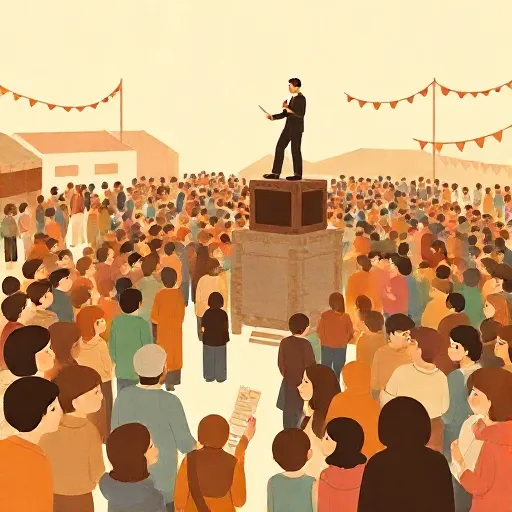
Jorge Portilla (1918–1963) focused on how people respond to the values their society hands them. He noticed a very Mexican way of saying “no” to those values without starting a revolution: it’s called relajo. Relajo is a suspension of seriousness. You hear a demand to be respectful or orderly, and you respond with a joke, a disruption, a gesture that says, “I don’t take this value seriously.” It’s not a direct argument; it’s a shared performance that invites others to join you in refusing the demand. Portilla thought relajo reveals how much we need others—without a crowd to laugh along, the suspension doesn’t work.
But the person who lives only for relajo is a relajiento. This is someone unwilling to commit to anything, a “good humor witness to the banality of life,” living wholly in the now with no future. At the opposite pole stands the apretado (a “stick-in-the-mud” or “goody-two-shoes”). The apretado carries their values like a second skeleton, rigidly identified with rules and order. They are “compact masses of value,” never able to question what they stand for. Portilla thought both extremes were traps: the relajiento falls into a nihilistic blank, and the apretado becomes a fanatic.
The healthier middle ground is irony. Irony keeps a critical distance from values without demolishing them. An ironic consciousness can question inherited traditions without throwing away everything that holds a community together. Portilla saw irony as a freedom that opens a door to truth, while relajo only sees the door and won’t open it, and the apretado nails it shut. Another Mexican thinker, Rosario Castellanos (1925–1974), used irony to poke holes in the patriarchal claim that women had no place in philosophy. She wrote, with a straight face, that women would be “bored to death” by intellectual work—knowing her own life refuted that prejudice.
Living for Others: Caso’s Radical Charity

Decades before the Hyperion Group, Antonio Caso (1883–1946) wrote a book that classified three ways of existing: existence as economy, existence as disinterest, and existence as charity. Existence as economy is pure self-preservation—getting the maximum benefit with minimum effort. It’s a life in which every other person is a resource for you. Caso called this the most rational way to live, because biology pushes you to survive. Existence as disinterest is spending your extra energy on art and beauty, things that have nothing to do with keeping you alive. But the highest form, existence as charity, is the most irrational of all: you sacrifice your own resources—time, energy, security—for the good of other people.
Charity, for Caso, is a free act. No rational calculation can tell you that giving away what you have is good for the self. Reason says: that is foolish. But the moral voice says: this is what makes you truly human, not a beast governed by egoism. To live charitably is to commit to concrete others, in flesh-and-blood situations, not to abstract ideals. When the later Mexican existentialists talk about freedom as committed responsibility, you can hear an echo of Caso’s idea that a good life is one poured out for other people.
Why Mexican Existentialism Still Matters

Many critics have attacked this tradition. Some said its claims about “the Mexican” were really state ideology, meant to erase ethnic and cultural differences by inventing one national character. Others complained that the philosophers confused history with deep ontology. These are serious objections, and they remind us that no philosophy speaks for everyone. Still, the core concepts have outlived their moment.
Why do they matter for a young reader today? Because you might know what it feels like to be caught between cultures, friend groups, or expectations that don’t quite fit you. The experience of nepantla—of being in the middle—is not only a Mexican story. It’s a story people live at school cafeterias, in families with mixed backgrounds, and anywhere you are told you’re not “enough” of one thing. Mexican existentialism says that feeling insufficient doesn’t mean you are broken. It means you’re alive, and that your freedom begins when you stop chasing an impossible solidity and start committing to the messy, concrete world that actually needs you.
Think about it
- Can you think of a time when you were caught between two groups (like different friend groups, cultures, or sets of rules)? How did that feeling of being “in between” shape what you did?
- Some Mexican existentialists thought that recognizing your own fragility could be freeing. Do you agree, or do you think it would make you feel powerless?
- If you had to choose one concrete thing in your life right now to truly commit yourself to—not an abstract idea like “kindness” but an actual project, a place, or a group of people—what would it be, and why?