
Can You Be Guilty Because the Numbers Say So?
The Bus That Got Away

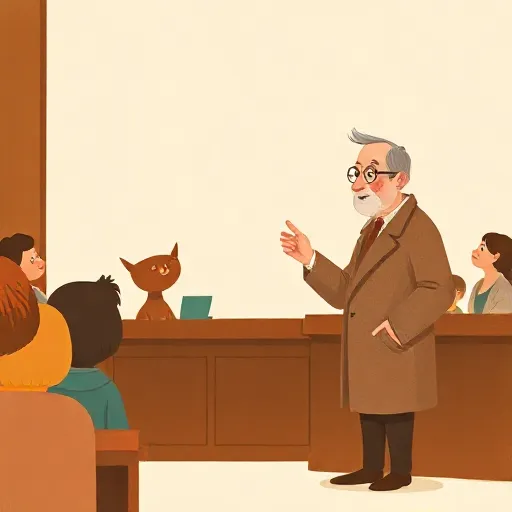
A man steps off a curb and a bus roars past, knocking him over. He cannot remember the colour. But he knows that in this town, 75% of the buses belong to the Blue Bus Company and only 25% to the Red Bus Company. He sues Blue Bus. You are on the jury. The only “evidence” is a statistic. Should he win?
This is not just a made‑up puzzle. Real judges and legal thinkers have argued about it for decades. It raises a question that matters every time someone walks into a courtroom: what counts as evidence — and how much is enough to decide someone’s fate?
What Exactly Is “Evidence”?

When lawyers talk about evidence, they can mean three different things. First, evidence can be the physical stuff you bring to court: a witness’s spoken words (oral evidence), a signed document (documentary evidence), or an object like a knife allegedly used in a crime (real evidence). You can see all of these with your own eyes and ears.
Second, “evidence” can mean a fact that you want to prove with those objects. For example, the fact that the accused was near the crime scene is evidential fact — it supports the idea that he might be involved. But you still have to establish that fact using evidence in the first sense, such as a witness who saw him there.
Third, and most importantly for our puzzle, evidence is a premise for an inference. If the accused’s fingerprints are found in a room where something was stolen, you can infer he was in that room. That inference then makes his involvement more likely. But if the fact is something like “his favourite colour is blue,” that normally gives no reason to think he committed a theft. In this third sense, irrelevant evidence is a contradiction: if a fact can’t support a reasonable inference, it is simply not evidence at all.
The Golden Rule of Relevance

Courts do not let you talk about just anything. A fact is only useful if it is relevant. In law, relevance means that a piece of information makes a disputed fact more probable than it would be without it. Think of a blood‑type example. Suppose blood at a crime scene is type A. The accused also has type A. If half the population has that blood type, then the chance of finding type A at the scene is 1.0 if he is guilty, but only 0.5 if he is innocent. The ratio is 2 to 1. That shift in probability makes the blood evidence relevant.
Many legal thinkers, following the American scholar James Bradley Thayer (1831–1902), say relevance is just a matter of logic and ordinary experience. The law itself does not tell you whether a fact is relevant; your everyday common sense does. But other thinkers, like John Henry Wigmore (1863–1943), argued that the law demands a bit more — a “plus value.” A fact might be slightly relevant in daily life, but a court could still block it if it would waste time, confuse the jury, or stir up unfair prejudice. Most systems today separate those extra concerns under a different heading: admissibility. Relevance is the first door; even if you open it, another door may still be locked.
When Judges Say “No”
Even relevant evidence isn’t always allowed in. First, it must be material. That means the fact you are trying to prove must actually matter to the case. In a trial about a stolen bicycle, the owner’s favourite colour is immaterial — the law doesn’t care. Next, some evidence is inadmissible because of other legal rules. The most famous example is hearsay: if a witness says “My friend told me he saw the crime,” that statement cannot usually be used to prove what the friend said was true. The friend needs to be in court and questioned directly.
The English philosopher and legal reformer Jeremy Bentham (1748–1832) hated most of these exclusionary rules. He believed the aim of a trial is to find the truth, so all relevant evidence should be let in — the only exceptions being when it would cause extreme delay or cost. Bentham thought judges could weigh the value of each piece of evidence themselves, without rigid rules. His critics replied that without some gates, trials could become messy and unfair. Even today, courts are caught between Bentham’s ideal of free proof and the worry that juries might be misled.
How Much Evidence Is Enough?

You now understand what evidence is and why some of it gets blocked. But here is the deepest puzzle: once all the evidence is in, when is it sufficient to decide a case? The law uses standards of proof. In a civil trial, the plaintiff must show their claim is more likely true than not — called the preponderance of the evidence. In a criminal trial, the prosecutor must prove guilt beyond a reasonable doubt, a much heavier burden.
Numbers seem to fit perfectly. In our bus case, a 75% chance that a Blue Bus caused the accident is clearly more likely than not. So mathematically, the man should win. Yet most lawyers, and many of us, feel that this is not enough. Another classic example comes from a prison yard. Twenty‑five prisoners are exercising. Twenty‑four of them attack a guard and kill him, while one prisoner refuses to join in. No one can tell who the innocent one was. A single prisoner is chosen at random and prosecuted. The statistical probability of his guilt is 96% — far above “beyond a reasonable doubt” on a number scale. But hardly anyone thinks he should be convicted.
Why do bare statistics feel so flimsy? Some philosophers argue that knowledge requires more than a high probability — you need a causal story linking the specific defendant to the specific event. Others say that legal proof is about comparing the best explanations of the evidence. In the bus case, the story “a Red Bus did it” is just as coherent as “a Blue Bus did it,” even though the numbers favour one. Statistical evidence alone doesn’t give you a complete explanation; it just tells you what is usual in the world.
There is yet another twist called the conjunction paradox. A legal claim often has several parts, or “elements,” that must all be proved. Even if each element is shown to a 51% likelihood, the chance that all of them are true together could drop below 50%. Courts have struggled with whether they should demand a high probability for the whole story, or only for each brick that builds it.
Why It Still Matters to You

You will probably never have to sue a bus company, but you already deal with evidence every day. When a rumour starts at school, when you see a broken window and wonder who did it, or when you judge whether someone is telling you the truth, you are acting like a one‑person jury. The questions are the same: what should count as a reasonable clue, and when do you know enough to reach a conclusion that affects someone’s life?
Legal systems keep wrestling with these puzzles because there is no perfect formula. A pure numbers rule can give answers that feel deeply unfair. A system that relies only on gut feeling can hide bias. By watching how courts struggle, we learn something about fairness itself: it demands both sharp reasoning and a respect for the story behind every scrap of evidence.
Think about it
- If a computer could predict with 90% accuracy that a person will commit a crime, would it be fair to punish them before they do anything wrong?
- In a school hearing, is a rumour that many people repeat as good as a single direct witness? Why or why not?
- Suppose a friend tells you they saw another friend take your lunch. The accused friend says they didn’t do it. What would you need to hear or see before you felt sure?