What Does It Mean to Say a Glass Is Fragile?
The Simple Answer: It Would Break If Struck

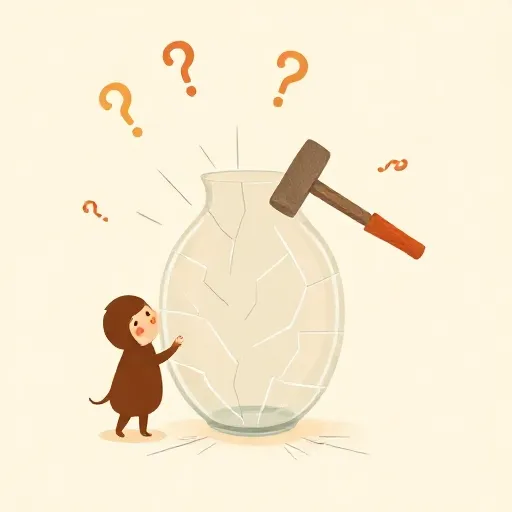
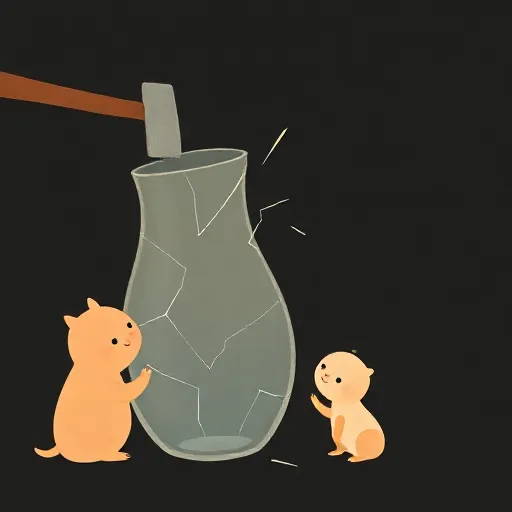
Picture yourself at the kitchen table. You tap a water glass gently — nothing happens. You tap it a little harder, and it shatters. Someone says, “Well, that glass was fragile.” What did they just tell you?
They didn’t describe the glass’s molecules or its weight. Instead they said something about how it would behave: that it would break if struck hard enough. Philosophers call properties like fragility, solubility, or flexibility dispositions. A disposition isn’t about what something is right now — it’s about what it would do in certain circumstances.
For decades, many philosophers thought the meaning of a disposition could be captured entirely by a simple conditional — an “if … then” statement. The Simple Conditional Analysis (SCA), backed by thinkers such as Gilbert Ryle (1900–1976), Nelson Goodman (1906–1998), and W. V. Quine (1908–2000), says exactly that:
An object is disposed to produce a certain manifestation when a stimulus occurs if and only if it would produce that manifestation if the stimulus occurred.
For example, a lump of salt is soluble because it would dissolve if you put it in water. A glass is fragile because it would break if struck. The SCA seems obvious — almost too obvious to need defending.
Clever Tricks That Break the Simple Idea

Yet philosophers soon discovered that the straightforward SCA runs into trouble. They invented imaginative scenarios where an object clearly possesses a disposition, but the “if … then” sentence comes out false — or vice versa.
In the 1990s, C. B. Martin (1927–2008) introduced finks. A fink is something that instantly changes an object’s disposition as soon as the stimulus appears. Imagine a dead electrical wire — a wire that is not live. Attach it to an electro-fink: a device that senses when the wire is about to be touched by a conductor and, at that very moment, makes the wire live. According to the SCA, the wire is live if and only if it would conduct electricity when touched. But because of the electro-fink, the wire would conduct if touched. The SCA therefore wrongly calls the dead wire live.
A second type of troublemaker is a mask (also called an antidote). Mark Johnston and Alexander Bird pointed out that a fragile glass, carefully packed in shock‑absorbing foam, is still fragile — but if you struck it, it wouldn’t break. The packing material does not remove the glass’s fragility; it simply prevents the breaking. Again the SCA fails, predicting that the protected glass is not fragile.
Then there are mimickers. David Lewis (1941–2001) asks us to imagine a styrofoam dish. It isn’t fragile, but when struck it makes a distinctive noise. Unfortunately for the dish, the Hater of Styrofoam lives next door. Every time he hears that noise, he rushes in and tears the dish apart. So the dish would break if struck. According to the SCA, it must be fragile — which it isn’t. The Hater’s interference mimics the manifestation of fragility without the real disposition being present.
Finks, masks, and mimickers show that a simple “it would do M if C” cannot be the whole story. A dead wire isn’t live, a wrapped glass is still fragile, and a styrofoam dish isn’t fragile — no matter what the bare conditional says.
Fixing the Definition: Making “Fragile” Foolproof

Philosophers have not given up on defining dispositions with conditionals. Many think the SCA can be rescued by being much more precise about the stimulus conditions.
One defense, championed by Sungho Choi and others, says we should build the absence of interfering factors right into the stimulus. The fragile glass’s disposition is not simply to break when struck; it is to break when struck without packing material or other maskers. The dead wire’s real disposition is to conduct when touched in the absence of finks. By specifying the conditions so carefully, the “if … then” statement once again matches whether the object truly has the disposition. Suddenly the counterexamples lose their bite.
This strategy of “getting specific” has a price. A disposition like fragility no longer has a single, tidy stimulus. Instead it comes with a long, invisible list of things that must not be going on. Critics worry that this makes the analysis circular — telling us that the glass would break unless it doesn’t, which explains nothing.
David Lewis took a different route. He argued that genuine dispositions must be intrinsic — they belong to the object itself, not to its surroundings. His Revised Conditional Analysis (RCA) says an object is disposed to M when C if and only if the object has some intrinsic property (like a particular molecular structure) such that, if C occurs and the object keeps that property for long enough, C and the property together cause M. Lewis’s RCA neatly handles finks: the dead wire’s molecular property never includes the electro‑fink’s meddling, so the analysis calls the wire dead. But masks and mimickers still slip through, since a glass can keep its intrinsic structure and yet fail to break because of external packing.
Other philosophers, such as Manley & Wasserman and Barbara Vetter, have proposed even more elaborate accounts — talking about proportions of possible cases or focusing only on what the object can do. The debate is far from settled, and each fix seems to introduce new complications.
Why Defining “Fragile” Tells Us About the Universe
Why does it matter so much to a twelve‑year‑old whether we can neatly define fragility? Because the struggle over dispositions is really a struggle over what the world is made of.
If every disposition can ultimately be explained by a categorical property — a non‑dispositional property like a molecule’s shape or a spring’s coil — then dispositions are not basic features of reality. They are just handy labels for complex physical setups. This view, called categoricalism, says that once you list all the categorical properties and the laws of nature, you have listed everything that exists. Fragility is nothing over and above atoms and forces.
But what if some dispositions resist being reduced? Some philosophers argue that fundamental particles have bare dispositions — dispositions with no deeper categorical base. An electron’s electric charge, for instance, might be nothing more than a pure power to attract or repel. This rival view, dispositionalism, claims that the bottom layer of reality is made of powers, not inert stuff. On this picture, properties are defined by what they do, not by any hidden inner nature.
The tension appears even in surprising places. Imagine a tricky triangle that stays triangular — until someone starts counting its corners. An intrinsic, finkish property inside the triangle makes it suddenly turn rectangular whenever a count begins. Does that mean triangularity is itself a disposition, one that requires the absence of counting‑finks? The line between dispositional and categorical becomes blurry.
Philosophers are still drawing battle lines, because the answer shapes how we think about laws of nature (are they necessary or could they have been different?), about causation, and about whether science can ever give us a complete picture of reality without any leftover “what‑it‑would‑do” language.
So next time you call a glass fragile, you’re stepping into a centuries‑long argument. Is the fragility in the glass, or is it a compact way of describing how the glass relates to hammers, floors, and packing peanuts? The answer isn’t obvious, and that’s exactly what makes disposition‑talk so powerful — and so puzzling.
Think about it
- If a super‑scientist could perfectly predict whether any object would break when struck, would we still need the everyday word “fragile”? What would the word add?
- Can you imagine a real‑life machine that works like an electro‑fink, secretly giving an object a power only when you test it? Would the object really have that power all along?
- If everything in the universe is just a bundle of powers to affect other things, does anything have a “silent” inner nature — or is everything defined by what it does?