Can Something Exist Without Depending on Anything Else?
René Descartes and the Search for Independence
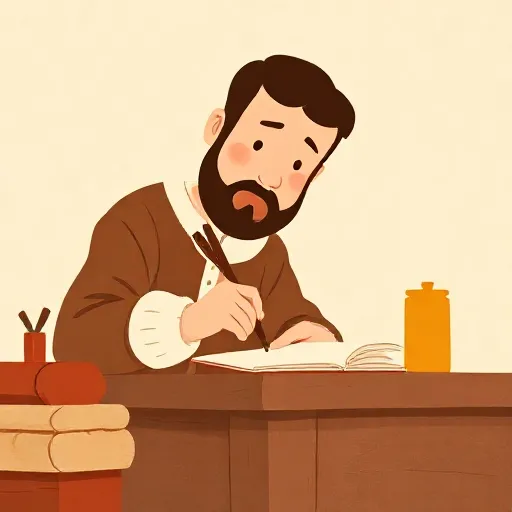
In 1641, the French thinker René Descartes (1596–1650) sat down to describe a special kind of thing: a substance. He wrote that a substance exists in such a way that it does not depend on any other thing for its existence. That sounds simple enough—a rock is a rock, right? But hold on. Is there really anything in the world that relies on absolutely nothing else to exist? A rock needs its atoms. A living thing needs food and air. Even a number, if it exists, seems to be there on its own—but does the number 2 need something else? Descartes was pointing at a puzzle that philosophers still wrestle with today.
That puzzle is about ontological dependence. This is not the ordinary kind of depending—like a plant depending on sunshine to grow, which is a causal story about one thing making another happen. Ontological dependence is deeper. It asks: could one thing exist at all if another thing didn’t? Your bed depends causally on the carpenter who built it, but even if the carpenter vanished, the bed might still be there. Yet some items seem to need a specific other just to be what they are. A set, like the set containing only your best friend, could not exist without your best friend. That “could not” feels like a necessity—not just a rule, but something built into the very being of the set.
The First Proposal: “Necessarily, You Exist Only If I Exist”
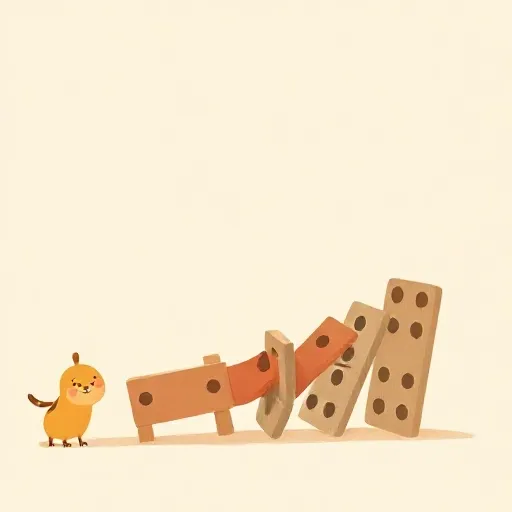
Imagine you want to define ontological dependence with a tidy rule. Here’s a first try, popular for much of the twentieth century: we say x depends on y just in case necessarily, x exists only if y exists. That means in every possible way the world could be, whenever you have x, you must have y. (Philosophers call this a modal-existential analysis, because it uses necessity—‘modality’—and existence.)
This handles some examples well. The set {Socrates} depends on Socrates because in any possible world containing that very set, Socrates must be there too. An assassination of Julius Caesar depends on Caesar, because without the man himself, that specific event could not have happened. This species of dependence is often called rigid existential dependence: a particular thing depends on another particular thing.
But problems pile up fast. For one thing, the rule makes everything depend on numbers. The number 2 exists necessarily—there’s no possible world without it. So take anything you like, say a cupcake. Necessarily, if the cupcake exists, then 2 exists (because 2 exists no matter what). According to our rule, the cupcake would ontologically depend on the number 2. That feels absurd—the cupcake shouldn’t care about the number 2.
Another trouble is symmetry. Think about Socrates and his life—the entire event of his being born, living, and dying. Necessarily, Socrates’s life exists only if Socrates does. But also, if Socrates exists, then his life exists—Socrates can’t exist without his life. The rule tells us that Socrates depends on his life just as much as his life depends on him. Yet intuitively, his life is the dependent one: it exists because Socrates did, not the other way around. The rule lacks a sense of direction, an asymmetry we can feel.
What a Thing Is — Essence and Identity
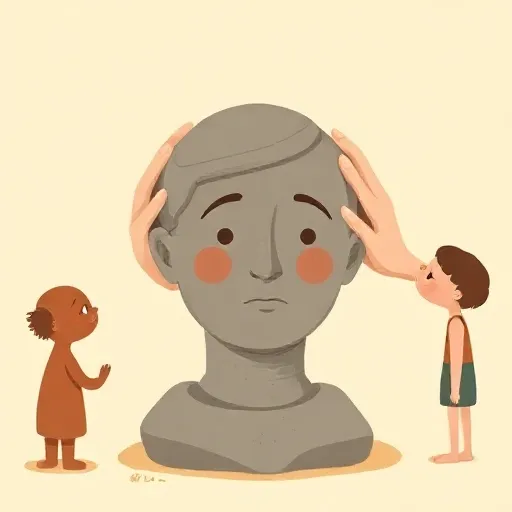
To find that missing direction, many philosophers turned to the notion of essence—what a thing is, in its deepest nature, not just how it happens to be. Suppose you have a lump of clay that you form into a statue. In one clear sense, the statue depends on the clay: it could not be that statue without that particular bit of matter. But the clay doesn’t depend on the statue; the same clay could have been a bowl. The dependence runs one way, and it’s anchored in what each thing essentially is.
The philosopher Kit Fine pressed this point with a story about sets and their members. The singleton set {Socrates} is the set whose only member is Socrates. It is part of the very essence of {Socrates} to have Socrates as a member—that’s what makes it the set it is. But it is not part of Socrates’s essence to belong to that set. Socrates could have existed without anyone ever forming the set {Socrates}; his identity doesn’t require it. So {Socrates} depends on Socrates, but not vice versa. This is essential dependence.
A helpful way to express this is identity-dependence. To say that x depends for its identity on y means that which particular thing y is helps fix which particular thing x is. More precisely: x depends for its identity on y if there is some relation R such that it is part of the essence of x to be R-related to y. For {Socrates}, the relation is “has as its sole member.” Part of the essence of the set {Socrates} is that it is the set whose sole member is Socrates. That binds its identity to Socrates. Identity-dependence is naturally asymmetrical—if x depends for its identity on y, then y does not depend for its identity on x. You can’t have two things fixing each other’s identities without going in a circle.
Are There Truly Independent Things?
Once we have a grip on identity-dependence, we can revisit Descartes’ dream of a substance—something that doesn’t depend on anything else. Using the idea of identity, a substance would be a particular thing that does not depend for its identity on anything else. A human being might count: while your cells change, your identity doesn’t seem fixed by any one of them. A statue made from a chunk of clay would not be a substance in this sense, because its identity is tied to that clay.
This opens up huge questions about what is fundamental—what exists “at the bottom” and supports everything else. Some philosophers think the fundamental level is tiny, like atoms or even smaller particles. On that view, everything else depends for its identity on those bits, but the bits themselves don’t depend on anything smaller. Others suggest the opposite: maybe the entire universe is the fundamental substance, and ordinary objects like tables and planets are just parts of it that don’t have independent identities. Still others wonder whether dependence could go on forever, with no rock-bottom entities at all—like a world made of infinitely divisible gunk, where every part depends on still smaller parts.
This isn’t just a puzzle for scientists in white coats. It touches questions that might pop into your head on a quiet afternoon: Is your desk just a heap of atoms, or does it have its own reality? If every part of you relies on something else, are you truly an individual? The search for what is ontologically independent is really a search for what is most real—and that search is far from over.
Why This Still Matters
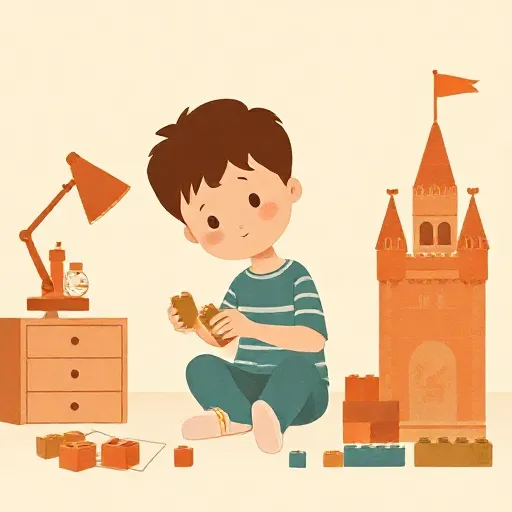
You’ve probably built something with LEGO bricks. The castle you create depends on the bricks in a physical, causal way—without them, no castle. But does the castle ontologically depend on those specific bricks? If you replaced one red brick with an identical one, it would still be the same castle design. So the identity of the castle isn’t fixed by any single brick. That’s a tiny taste of the reasoning philosophers use to separate different kinds of dependence.
Understanding ontological dependence helps us think about what we treat as basic in our own lives. When psychologists say your personality depends on your childhood, is that a causal dependence or something deeper? When you wonder whether you would still be “you” if your memories were different, you’re playing with identity-dependence. The technical vocabulary—rigid existential dependence, essence, identity-dependence—gives you tools to ask these questions precisely. And the open-ended debate about fundamentality reminds you that no one has yet discovered a single, self-sufficient building block of reality. Everything might lean on something else—and maybe that’s okay.
Think about it
- If you replace every atom in your body over time, are you still the same person? Does your identity depend on any particular atom?
- Imagine a world where everything depends on something else without end. Could such a world make sense, or would that be like hanging a picture on a hook that hangs on another hook forever?
- Do you think the number 2 would still exist if the universe disappeared? If so, does that make numbers more independent than physical objects, or just different?