
Are Numbers Just Positions in a Giant Pattern?
A Classroom Puzzle: Two Ways to Build 2

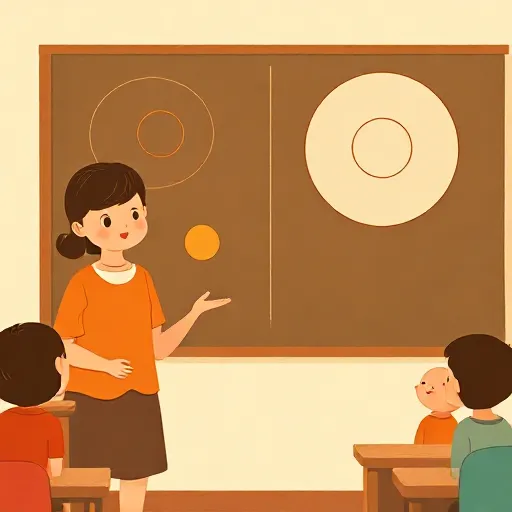
Imagine your math teacher draws two pictures on the board. The first shows the number 2 as a set containing two smaller sets — one empty, and one that itself contains an empty set. The second shows 2 as a set containing a set that contains an empty set — like a box inside a box. Both drawings obey the rules that make counting work. But they are not the same object. So, what is 2 really?
This isn’t just a made-up puzzle. In 1965, the philosopher Paul Benacerraf pointed out that you can build all the numbers using only sets in many different, equally good ways. In one version (the von Neumann ordinals), 0 is the empty set, 1 is the set containing 0, 2 is the set containing 0 and 1, and so on. In another version (the Zermelo ordinals), each number is just a set containing the previous number alone. The counting pattern is the same, but the set-objects are different.
Benacerraf drew a radical conclusion: numbers should not be identified with any particular sets. In fact, they shouldn’t be taken to be objects at all. Instead, numbers are positions in a structure — a pattern like the natural numbers 0, 1, 2, 3. What matters about the position “2” is not what it is made of, but where it sits in the pattern: after 1 and before 3.
This idea launched a whole way of thinking about mathematics called structuralism. It says math is the study of structures, not of particular objects. But what does that really mean? And does it solve the puzzle — or just push it to another level?
What Matters Is the Pattern, Not the Stuff
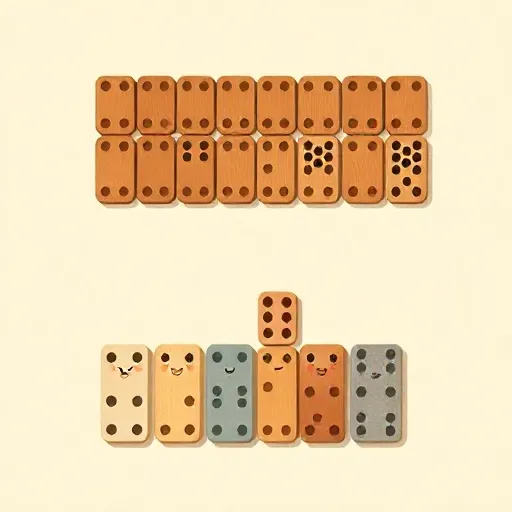
Think about a game of tic-tac-toe. You can play it with paper and pencil, with chalk on the sidewalk, or with digital Xs and Os on a screen. The rules and the positions — the corners, the center — are the same. The material doesn’t matter. In math, the same idea holds for numbers.
Structuralists say arithmetic cares only about the relations between numbers: 2 is the successor of 1, 1 is the successor of 0, and the whole chain has no beginning except 0. As long as a system of objects follows those rules, it will produce all the same true arithmetic statements. Two systems that have the same relational pattern are called isomorphic. To a structuralist, any two isomorphic systems are just different copies of the same abstract structure.
Benacerraf argued that this is exactly why we can’t pin down “the real 2” as a particular set: there are infinitely many isomorphic copies, each with different internal makeup. The number itself, then, must be a position in that pattern.
This solved one puzzle, but opened another: what kind of thing is a “position in a structure”? Is it something that really exists, like a chair or a planet? Or is it just a way of talking? The next battle was over that very question.
Should the Pattern Be a Real Thing?
Philosophers who wanted to take structuralism seriously split into two main camps.
Stewart Shapiro, writing in the 1980s and 1990s, said: yes, abstract structures exist as real objects. They are not made of physical stuff, but they are just as real in the world of mathematics. He called his view ante rem structuralism (Latin for “before the thing”), meaning the structure exists independently of any examples that might fill its positions. Think of it like a job description — the role of “class president” exists even before someone is elected to fill it. For Shapiro, the natural number structure is like an empty pattern that any concrete sequence can instantiate.
On the other side, Geoffrey Hellman developed a position he called modal structuralism. He wanted to avoid saying that abstract structures exist. Instead, he translated every mathematical statement into a statement about what must be true if there is a system satisfying certain rules, and what is possible. For example, “2+3=5” means: necessarily, in every possible system that fits the Dedekind-Peano axioms, the item that plays the role of 2 plus the item that plays the role of 3 equals the item that plays the role of 5. Plus, we add the assumption that such a system is possible. This is a form of eliminative structuralism — it eliminates the need for abstract structure-objects.
The two approaches differ fundamentally. Shapiro’s ante rem structuralism is non-eliminative: it keeps abstract structures as objects in their own right. Hellman’s modal structuralism is eliminative: it replaces talk about structures with talk about possibilities and necessities. Both agree that mathematics is essentially structural, but they disagree about what that means for reality.
The Practical Mathematician’s Indifference
While philosophers argued, most mathematicians had a simpler attitude. They often work within set theory and choose one specific representation for numbers — usually the von Neumann ordinals, because they work well for infinite sets. But they are openly indifferent about the choice. If pressed, they’d say: “Any isomorphic system would do; we just picked one for convenience.”
This view, sometimes called set-theoretic structuralism or relativist structuralism, doesn’t claim that the natural numbers “really are” the von Neumann ordinals. It just says our talk about numbers is relative to a chosen model, and that’s fine because all such models give the same theorems. This is an eliminative stance in one sense (no separate abstract structures are assumed), but it still keeps sets as real objects. Many mathematicians find this enough to get on with their work.
So you have at least three ways to be a structuralist: a full-blown ante rem structuralist (Shapiro), a modal eliminativist (Hellman), or a pragmatic set-theoretic structuralist who just picks a model and doesn’t worry about the philosophy.
When Places in the Pattern Look Identical

As structuralism developed, critics spotted a tricky problem. Some patterns have positions that are structurally indiscernible — they play exactly the same role in the network of relations. A famous example comes from the complex numbers: the numbers i and –i are perfect mirror images. If you swap them in every equation, nothing changes. Yet intuitively, we think i and –i are two distinct numbers. How can structuralism handle that?
This is called the identity problem. If all that matters about a mathematical object is its structural properties, then two objects with exactly the same structural properties should be identical. But i and –i seem to show that’s not true. The structure itself doesn’t seem to care which is which.
Another challenge: the number 8 has the non-structural property of being the number of planets in our solar system. That property isn’t about its place in the counting pattern. So does the abstract number 8 have that property? Structuralists have to explain why such accidental properties don’t belong to the pure number.
These puzzles have kept philosophers busy. Some say we need to distinguish between essential structural properties and accidental ones. Others try to rigidify the structure by adding extra labels. Still others argue that our usual talk about distinctness of i and –i is just a convention. The debates continue.
Why You Should Care About What Numbers Are

You might wonder: does any of this matter when you’re just trying to solve for x? Surprisingly, it does. Every time you rely on the sameness of 2+2=4 no matter if you write it with sticks or stones, you’re using the structuralist insight. The idea that math is about patterns and relations is deeply embedded in how we design algorithms, program computers, and even understand nature. The question of whether those patterns are real or just helpful stories influences how we think about truth and knowledge itself.
The fight over numbers forces us to ask: when we say a fact is “true,” what kind of truth? If the universe were filled only with different kinds of objects, would 2+3=5 still be true? Could we have a mathematics without things? These are not just dusty academic puzzles — they shape how we see the world and our place in it.
Next time you count your steps or arrange your game pieces, remember: you’re moving through a structure, and philosophers are still arguing about what that structure really is.
Think about it
- If you rewrote all the rules of chess using only pictures, but kept the same relationships between pieces, would it be the same game?
- Could there ever be a number that is exactly like 7 in every structural way but isn’t 7?
- Suppose you build a calculator out of marbles instead of circuits. If it gives the same answers, is it doing the same math?