
Can Unbreakable Rights Make Everyone Happier?
A Man Who Saw Patterns Everywhere

It is 1850, and a young English writer named Herbert Spencer (1820–1903) paces in his study. Piles of notes cover his desk — scribbled thoughts about stars, snails, and governments. Spencer has a hunch. He suspects that everything in the universe, from a swirling cloud of gas to a busy city, is constantly changing from simple to complex. He will spend the rest of his life trying to prove it.
Spencer was not just a philosopher. He wrote thick books on biology, psychology, and especially sociology. But underneath all that writing was one big idea: the whole universe, including human societies and our sense of right and wrong, evolves. He called his master plan the Synthetic Philosophy. And it started with a set of basic laws about how everything moves and grows.
The Universe Is Getting Messier — And That’s the Point

Spencer believed three simple rules explain all change. First, Force — or energy — never disappears; it just keeps moving. Second, anything that starts out homogeneous (all the same throughout) is unstable; it cannot stay uniform. A tiny wobble will make it grow uneven. Third, once unevenness begins, it multiplies wildly — one change causes many others, which cause even more.
Think of a tray of water. If you heat it evenly, nothing much happens. But if one spot heats up a little faster, the water starts to swirl. Warm blobs rise, cool blobs sink, and soon the whole tray is filled with twisting currents. Spencer believed the entire cosmos works this way. It began as a cloudy sameness and is endlessly sorting itself into more and more distinct parts — becoming ever more heterogeneous.
He summed up his vision like this: evolution is change from an incoherent, simple sameness to a connected, complicated variety. That holds for rock formations, for living bodies, and — crucially — for human communities. Societies, he insisted, are not fixed. They evolve too.
How Societies Evolve: From Fistfights to Free Markets

Spencer mapped out four great stages of social evolution. First come primitive groups, where families cooperate casually. Then, as populations grow and groups crowd each other, they start to fight. Survival now depends on staying united and obeying a boss. Clan chiefs become kings, and militant societies appear — rigid, ranked, and ready for war.
But war also forces people to invent better tools, divide labor, and trade. Slowly, the iron grip of military rule loosens. Society shifts into a third stage: the industrial type, where the state shrinks and mostly protects people from force and fraud. Contracts replace commands. In this stage, Spencer believed, people begin to enjoy real freedom — not because they are left alone, but because everyone’s liberty is limited only by everyone else’s equal liberty.
He even imagined a fourth stage, a peaceful, self-regulating market utopia where government withers away. But he was never entirely sure it would last; he knew every kind of order can slide backward into chaos.
One Simple Rule: Your Freedom Ends Where Mine Begins

Spencer’s whole moral and political theory rests on a single line he wrote in 1851: “the liberty of each, limited by the like liberty of all.” Call it the principle of equal freedom. It says you are free to do whatever you like, so long as you do not take away anyone else’s equal freedom. If your action blocks another person from the same liberty, it is wrong.
From this principle, Spencer drew what he called moral rights — the most basic protections every person needs. Two stood above all others: the right to life and the right to liberty. These rights were not just nice ideas; they were indefeasible. That means they could never be overridden. Not to prevent a disaster, not to help a million people, not for any reason. If breaking them would bring a huge benefit, you still must not do it.
Why? Because only when every person is free to use their own mind and body in their own way can anyone be truly happy. Happiness, for Spencer, comes from exercising your own faculties — from building, thinking, choosing, and growing. Without secure rights, that exercise is constantly under threat. So even if violating a right seems like it would make many people happier in the short run, in the long run it poisons the whole system that makes happiness possible.
Can Happiness and Unbreakable Rights Go Together?
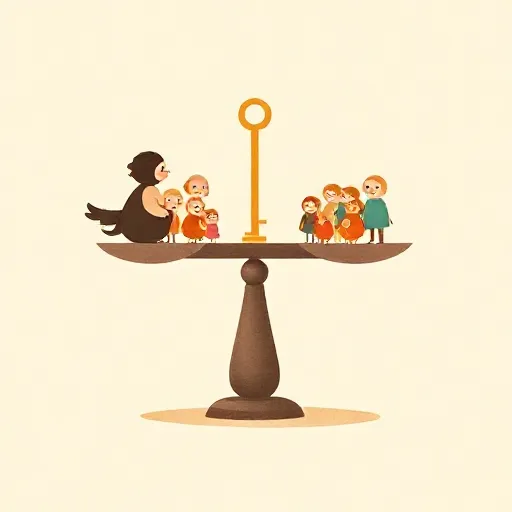
Spencer called himself a utilitarian. That means he thought the ultimate test of right and wrong is whether an action promotes human happiness. But his kind of utilitarianism was strange: it told you never to calculate happiness case by case. Instead, you must always follow the unbreakable rule of equal freedom and its corollary rights. He believed that was the best recipe for happiness — not just someday, but always.
Mill, his older contemporary, agreed that rights are crucial, but he thought they could give way in extreme emergencies. Spencer disagreed. He believed that whenever a society truly internalizes equal freedom, its members flourish and prosper together. Groups that respect rights out-compete groups that do not. So rights never need to be sacrificed; respecting them is always the winning strategy, even if we cannot always see how.
This bold claim drew fire. Henry Sidgwick (1838–1900), a careful fellow utilitarian, argued that no set of moral rules can be proved universally perfect. We cannot know ahead of time that respecting a right in every possible future case will maximize happiness. Spencer, he said, was pretending to be rigorously scientific while really just betting on a grand guess.
The problem does not go away. If rights are truly unbreakable, then even in a nightmare scenario — a world where keeping a promise would lead to catastrophe — you must keep it. That sounded heroic to Spencer, but to many others it felt dangerously blind.
The Ideas We Still Fight Over

Near the end of his life, Spencer changed his mind about some specific rights. He had once believed that every citizen had a “right to ignore the state” and walk away from its protection. Later, he decided that was mistaken — because everyone benefits from social order, you cannot just opt out. He also gave up on his earlier demand that all land should be shared equally. His principles shifted as he watched real societies struggle.
That flexibility makes him more interesting, not less. It shows that even a thinker who loved unbreakable rules had to adjust when facts got in the way. And it leaves us with a live question: can we build a world where strong rights and the general good never collide? Or is the tension between “my liberty” and “our happiness” something we must keep negotiating, case by case?
Next time you argue with a friend about whether a rule should bend to help someone in need, you are walking in Spencer’s footsteps. You are asking whether some rights are so important that nothing can touch them. It is a fight that started in the 19th century and has never really ended.
Think about it
- If a new law would save many lives but takes away a single person’s right to choose what happens to their own body, should it be allowed? Why or why not?
- Spencer thought that giving everyone the same freedom would eventually make everyone happier. Can you imagine a situation where equal freedom leads to less happiness for some people? What should we do then?
- Spencer believed moral instincts get better over generations. Do you think people today are more moral than people a thousand years ago? What might make you agree or disagree?