Can a Computer’s Make‑Believe World Teach Us About the Real One?
The Board Game That Surprised Everyone
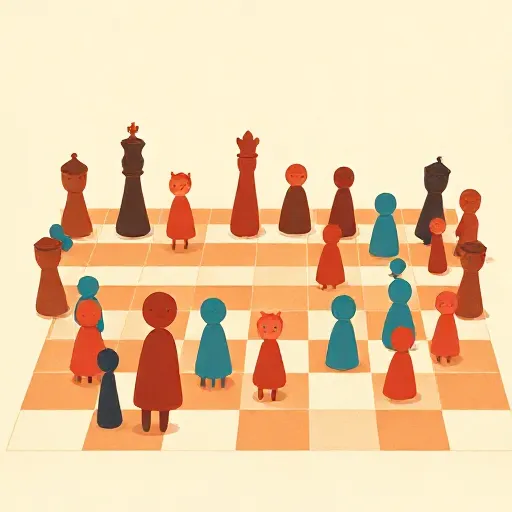
In 1971, economist Thomas Schelling built a simple computer model that sounded like a board game. He imagined a chessboard where each square was a house, and each house could hold at most one person. The people belonged to two groups — maybe blue and red. An agent was happy if at least a certain fraction of its neighbors were the same color. Happy agents stayed put; unhappy agents moved to a free house.
Schelling expected that heavy segregation would appear only if the agents strongly preferred neighbors of their own kind. But when he ran the simulation, he was surprised. Even when agents were content with just a slight majority of neighbors like themselves, the board quickly sorted into almost completely separated clusters. A mild “I’d rather not be the only one” turned into a deeply divided neighborhood.
The simulation was not a real city. It was a tiny digital world with very simple rules. Yet it made visible a pattern that real societies show. That is exactly what computer simulations do: they build simplified worlds on a chip so we can learn about the messy one outside.
What Exactly Is a Computer Simulation?

In the narrowest sense, a computer simulation is a computer program that moves, tick by tick, through the states of a mathematical model. The model represents some system — a storm, a galaxy, a flock of birds, a society. The program takes the system’s state at time t (wind speed here, temperature there, position of every bird) and calculates what it will be at time t+1. Then it does it again for t+2, over and over, producing a long string of numbers that act like a movie of the system’s change.
Scientists often use simulations when they have equations that cannot be solved with pen and paper. Many models describe continuous change — like how fluid flows or how gravity pulls — in the language of differential equations. But to hand those equations to a digital computer, they must be turned into tiny, discrete steps. That process is called discretization. The computer does not find a perfect answer; it finds an approximation that can be made as precise as we need, by making the steps small enough.
More broadly, a computer simulation is not just one run of a program. It is a whole study: choosing a model, figuring out how to code it, computing results, and then making sense of the output. When philosophers talk about the reliability of simulations, they usually mean this larger process, because the trustworthiness of a simulation depends on much more than the equations alone.
Equations vs. Agents: Two Paths to a Model

Simulations usually fall into two big families. Equation‑based simulations are common in the physical sciences. They start from global mathematical laws — like Newton’s equations for gravity or the equations that describe moving fluids. A galaxy formation simulation, for example, tracks how the gravity between many particles changes their positions over time. A weather model treats the atmosphere as a continuous fluid and updates temperature, pressure, and wind on a giant grid of cells.
Agent‑based simulations work differently. They are used mostly in the social and behavioral sciences — and in ecology, epidemiology, or anywhere many individuals interact. Instead of a set of global equations, each agent follows its own local rules. Schelling’s chessboard is a classic example: every agent only cared about its immediate neighbors and decided whether to stay or go. There was no big equation dictating the whole board. The segregation pattern emerged from the bottom up, out of millions of tiny rule‑following steps.
Many modern simulations mix scales. A climate model, for instance, cannot afford a grid fine enough to resolve every cloud. So it uses a trick called parameterization: inside each grid cell, a simple formula links the average humidity to the likely amount of cloud cover. The formula does not exactly describe the tiny cloud processes; it is a practical stand‑in. These shortcuts sit at the heart of the question every simulation must face: can we trust what we never directly see?
Can You Trust a Simulation’s Results?

The trust problem is especially sharp because simulations are used exactly where data are scarce — forecasting a hurricane’s path before it makes landfall, or modeling a distant galaxy’s formation. Philosopher Paul Humphreys (born 1950) described the knowledge from simulations as downward, motley, and autonomous. Downward: you start from a trusted high‑level theory (like fluid dynamics) and push downward to a specific scenario. Motley: the ingredients that go into a simulation are a mixed bag — not just theory, but numerical tricks, parameterizations, hardware quirks, and lots of trial and error. Autonomous: the results often cannot be directly checked against the world because we cannot run the real‑world experiment.
So how do simulationists build confidence? Engineers and climate scientists often divide the job into verification and validation. Verification asks: did the computer solve the chosen equations correctly? To check, programmers might make the grid finer and see if the answer settles down to a steady value. Validation asks: does the model capture reality well enough for its purpose? To check, they compare the output against whatever real‑world data exist — maybe satellite measurements of a small part of the storm.
In practice, the two are tangled. The equations that get coded are not always the ones scientists believe in most deeply; they are often chosen because they can be computed in a reasonable time. Modelers tweak both the equations and the solution method back and forth, until the whole package behaves in a way that matches what sparse observations say. This messiness is not a flaw; it is how simulators earn trust.
Some parts of a model are outright fictions. To handle a shock wave in a fluid, a simulation may pretend the fluid is stickier than it really is — an invention called artificial viscosity. In models of cracks in silicon, scientists sometimes invent “silogen” atoms that are a blend of silicon and hydrogen — atoms that do not exist — so that two different modeling frameworks can talk to each other. A fiction is a component that the modeler knows is false about its target, but that helps the larger model become reliable enough. The whole simulation is not a lie; it’s a patchwork that works.
Is a Simulation an Experiment?

Some scientists call their large simulation studies “in silico experiments,” and they have a point. A person running a storm simulation changes a condition — say, the ocean temperature — and watches what the digital storm does. That feels like the same logic as a real experiment: you intervene and observe the outcome.
But critics push back. In a real chemistry experiment, they say, you are manipulating the actual chemicals you care about. In a simulation, you are playing with a model, not the real storm. Yet even that line blurs when you look closely. Biologists experiment on fruit flies not because they care about flies, but because the flies are a model for how genes work in many organisms, including humans. Every experiment uses a stand‑in for the target, at least to some degree. What matters is not whether you touch the real thing directly, but whether the similarities between the stand‑in and the target are strong enough to support the conclusion you want to draw.
So simulations and experiments are not perfectly different. Both need careful arguments that the system you are actually shaking — a fly, an inclined plane, a computer chip running code — tells you about the system you really want to understand. Recognizing this helps us see why trusting a simulation does not require it to be a literal experiment. It requires good reasons to believe that the digital world is a faithful enough mirror for the job at hand.
Why Your Afternoon Forecast Depends on a Web of Make‑Believe

When you check a weather app before heading out, you are leaning on a chain of simulations. They start with global weather models that discretize the atmosphere into giant three‑dimensional grids, approximate clouds with parameterizations, and smooth shock fronts with artificial viscosity. Then they cascade down to finer models that guess whether it will rain on your street. Every step is full of the shortcuts and fictions we have talked about.
And yet, these forecasts are remarkably good — and they keep getting better. The reason is not that any one piece is perfect, but that the simulation community has built up generations of craft knowledge about which combinations of approximations work reliably. Just as a chef knows that a pinch of salt that does not belong in the original recipe still makes the dish work, simulationists know that a pinch of artificial viscosity can keep a fluid simulation from blowing up, without ruining the big‑picture winds that steer the storm.
The same applies when governments decide how to prepare for climate change, when engineers design an airplane wing, or when epidemiologists model the spread of a virus. All of these choices depend on simulations that cannot be fully checked against reality at the time the decision is made. Understanding that simulations are not clean proofs, but carefully tested fictions, helps you ask the right questions: What shortcuts did they take? What data have they been tested against? Is the purpose of the simulation a rough “what‑if” or a precise “when and how much”? That critical habit is one of the gifts philosophy of science gives you — and it works on your weather app just as much as on the biggest supercomputer.
Think about it
- If a weather simulation correctly warns of a hurricane three days in advance but misses the exact landfall by fifty miles, should we still trust it more or less than a gut feeling? Why?
- An engineer designing a bridge runs a simulation that shows it will survive a strong earthquake. No one has ever built this exact bridge before, so there are no real‑world data. What steps could the engineer take to decide whether the simulation is reliable enough?
- Some simulationists knowingly add a false ingredient (like artificial viscosity) to make the whole model behave well. Is it ever okay to include something you know is wrong in order to get a useful answer? Where would you draw the line?