Can a Computer Do Philosophy?
Imagine you’re in a classroom debate. Someone says that the death penalty is wrong because killing is always wrong. Someone else says it’s justified because it deters crime. A third person points out that the deterrence data is actually mixed. The conversation weaves back and forth, with each person adjusting their view based on what others say.
Now imagine trying to put that whole conversation into a computer. Not just typing it up, but actually building a program where simulated “people” argue with each other, change their minds, spread ideas, and eventually come to some conclusion. Could a computer help us understand how real people form beliefs? Could it tell us whether a group is likely to find truth or get stuck in error?
This is what computational philosophy tries to do. It’s not a new branch of philosophy with its own special questions. It’s a toolkit: a set of computer techniques that philosophers use to explore old questions in new ways. Instead of just thinking carefully about how beliefs spread through a community, you can build a simulation and watch it happen. Instead of just arguing about whether democracy helps groups find truth, you can set up a model and test it.
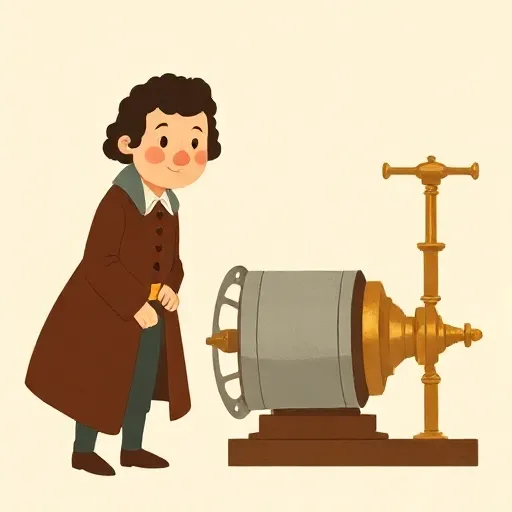
The basic idea goes back to the 1600s. A philosopher named Gottfried Wilhelm Leibniz—a wild-haired genius who also invented calculus and built one of the first mechanical calculators—dreamed of a time when disputes could be settled by saying, “Let us calculate, without further ado, to see who is right.” He imagined a perfect language and a set of rules that would let anyone settle arguments the way you add up numbers. Leibniz even designed a machine that could multiply and divide (called the “stepped reckoner”), and he wanted to extend this kind of mechanical thinking to everything: law, medicine, physics, and philosophy.
The computers Leibniz dreamed of are here now. But using them for philosophy turns out to be much stranger and more interesting than he imagined.
How Beliefs Spread (and Polarize)
Let’s start with a problem you’ve probably noticed: groups of people often end up more divided than they started. Two people with slightly different views talk, and instead of coming together, they drift further apart. This happens in politics, in friend groups, even in families.
Philosophers wonder: is this just people being stubborn and irrational? Or is there something about the way beliefs spread that naturally produces polarization, even when everyone is trying to be rational?
To explore this, philosophers build agent-based models. Here’s how they work:
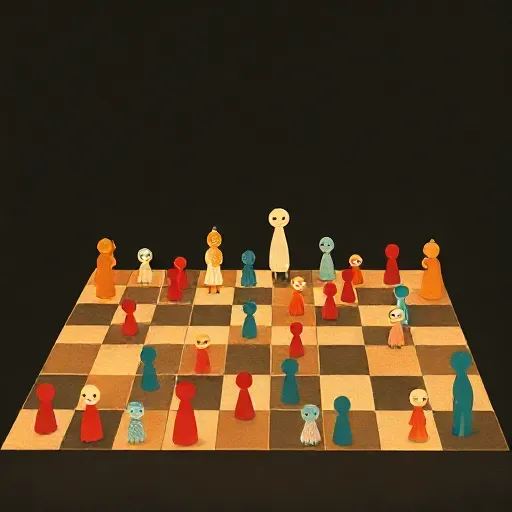
Imagine a simplified world with 100 “agents”—tiny computer people. Each agent has an opinion, represented as a number between 0 and 100. At the start, these opinions are random: some agents are at 10, some at 55, some at 90.
Now, agents update their beliefs by talking to each other. But here’s the key: they only listen to people whose opinions are “close enough” to their own. If the threshold is 15 points, an agent at 50 will listen to anyone between 35 and 65. They ignore everyone else. Then they take the average of that group’s opinions and move toward it.
What happens? It depends entirely on that threshold.
If the threshold is very small (say, 1 point), agents only talk to people who already agree with them almost perfectly. Nobody changes much, and the society stays fragmented into many tiny groups. If the threshold is medium (around 15 points), the agents cluster into two big groups—polarization. If the threshold is large (25 points or more), everyone eventually merges into one big consensus.
This is a model of what philosophers call bounded confidence: we trust and listen only to people who already seem reasonable to us. And the model shows something surprising: polarization can happen even without anyone being mean, stubborn, or irrational. It can just be a mathematical consequence of who talks to whom.
Philosophers are still arguing about what this means for real life. Some think it shows that polarization is inevitable and maybe even rational. Others think the models leave out something crucial—like the fact that in real life, people sometimes actually listen to people they disagree with, or that arguments have content, not just numerical positions.
Should Scientists Talk to Everyone?
Here’s a related question that might surprise you. You might think that science would work best if every scientist had instant access to every other scientist’s results. The internet, open-access journals, shared databases—surely more communication means better science, faster.
Computational philosophy suggests the opposite might be true.
In a series of computer models, philosophers have set up simulated scientific communities and tested different communication networks. In some networks, every scientist talks to every other (like a group chat where everyone sees everything). In others, scientists only talk to their immediate neighbors (like passing notes down a row). In still others, there’s a mix—a “small world” network with some long-distance connections.
The results are striking. The networks that produce the most accurate results are not the fully connected ones. They’re the thin, distributed networks—like a ring where each scientist only talks to the two people next to them. These networks find the best answers more often, even though they take longer to reach agreement.
Why? Because when everyone sees everyone else’s results immediately, the whole community rushes toward the first promising-looking result. They all pile onto the same hill, never noticing that a much taller hill might be hidden somewhere else. But in a sparse network, different groups explore different areas. Some get stuck on low hills, but others climb higher, and eventually the best answer spreads.
This suggests something weird: the communication system of 17th-century science—slow letters passed between individual scholars—might actually be more reliable than today’s instant global connectivity. At least for certain kinds of problems.
But here’s where it gets complicated. The answer depends on what you’re looking for. If you need a result today rather than the best possible result in ten years, maybe a faster, less accurate network is better. And the shape of the “epistemic landscape” matters too: different problems have different patterns of easy and hard answers. What works for one kind of question might fail for another.
Can Computers Be Ethical?
This part gets technical, but here’s what it accomplishes: philosophers have started using automated reasoning programs—theorem provers—to check whether arguments in ethics and metaphysics are logically valid.
A theorem prover is a program that takes a set of premises and tries to deduce a conclusion. If it succeeds, the argument is valid. If it finds a contradiction, the premises can’t all be true. If it finds a counterexample—a situation where the premises are true but the conclusion is false—then the argument fails.
Philosophers have used these tools to analyze some of the most famous arguments in history. They’ve checked versions of the ontological argument for God’s existence (the one that says God must exist because “God” means “the greatest possible being” and a being that exists is greater than one that doesn’t). They found that one version by the logician Kurt Gödel had a hidden inconsistency—and that fixing it forced a strange conclusion called “modal collapse,” where everything that’s true would have to be necessary and could never have been otherwise.
They’ve also used theorem provers to analyze ethical theories. One philosopher, Alan Gewirth, argued that anyone who acts rationally must accept certain basic rights. A team of researchers encoded his argument into a theorem prover and found that it could be formally checked—showing that even complex ethical reasoning can, at least in principle, be turned into something a computer can examine.
Nobody thinks this means computers can replace ethical thinking. But they can help spot mistakes, hidden assumptions, and logical gaps that humans might miss.
How Cooperation Can Emerge
One of the oldest questions in political philosophy is: how does cooperation happen? If everyone is selfish, why don’t we all just cheat and steal? The 17th-century philosopher Thomas Hobbes thought the answer was a powerful ruler who threatens punishment. But computer models suggest something more interesting.
The classic tool here is the Prisoner’s Dilemma, a game where two players each choose to cooperate or defect. If both cooperate, they both get a decent reward. If one defects and the other cooperates, the defector gets a huge reward and the cooperator gets nothing. If both defect, they both get a small punishment. The rational choice, if you only play once, is to defect. But if the game is repeated, cooperation can emerge.
In computer tournaments of the Prisoner’s Dilemma, the winning strategy was often Tit for Tat: cooperate on the first move, then do whatever the other player did on the previous move. This strategy is nice (it never defects first), retaliatory (it punishes defection), forgiving (it returns to cooperation if the other player does), and clear (other players can figure out what it’s doing).
But here’s the surprising part: if you put these strategies on a spatial grid—each agent only plays with its neighbors—Tit for Tat can take over completely, even in a world that starts with mostly selfish defectors. The reason is that clusters of cooperators form, and within those clusters, everyone does well by cooperating with each other. The defectors on the edges of the cluster get the benefits of exploiting cooperators, but they also get punished by other defectors. Over time, the cooperative clusters grow.
Philosophers have also shown that adding a little bit of noise or imperfection—where sometimes you accidentally “mishear” whether the other player cooperated or defected—actually leads to even more cooperation. In a noisy world, the most successful strategy becomes Generous Tit for Tat, which occasionally forgives defection and tries cooperation again. This suggests that perfect information isn’t necessary for cooperation; in fact, a little fuzziness might help.
A Test of Segregation
Perhaps the most striking example of computational philosophy is Thomas Schelling’s model of residential segregation.
If you look at a demographic map of an American city, you see clear patches: mostly White neighborhoods, mostly Black neighborhoods, mostly Latino neighborhoods. The obvious explanation is racism: people don’t want to live next to people of other races.
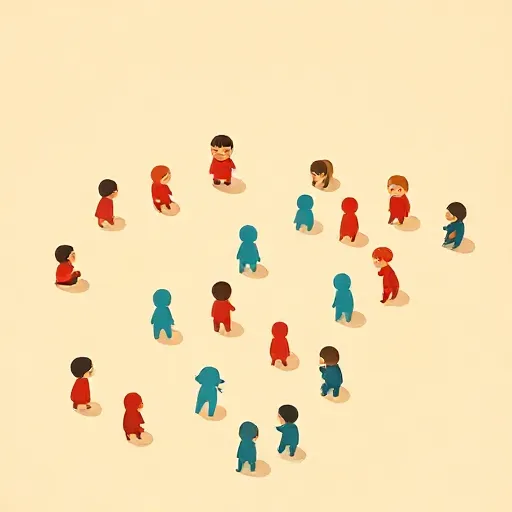
But Schelling built a simple model that suggested something different. He put two types of agents (say, red and green) on a grid. Each agent had a preference: they wanted at least one-third of their neighbors to be the same color as them. That’s a pretty mild preference—it means you’re okay with a neighborhood that’s two-thirds different from you.
Agents who weren’t satisfied moved to a random empty spot. The simulation ran repeatedly, with agents moving, checking their neighbors, and moving again if necessary.
What happened? Even with that mild 33% preference, the grid quickly sorted into starkly segregated patches. Not because anyone was a racist demanding an all-same neighborhood, but because the individual moves—each reasonable on its own—added up to a pattern nobody intended.
Schelling’s model doesn’t prove that racism isn’t a factor in real segregation. But it shows that even if racism were reduced to a fairly mild preference, segregation would still emerge. The structure of the system—the way individual choices combine—creates the outcome, not just individual prejudice.
But Can You Prove Anything with Simulations?
A common criticism of computational philosophy is that you can make a simulation produce whatever result you want. Just tweak the parameters until you get the outcome that supports your argument. This is called being “doomed to succeed.”
But this criticism misunderstands how simulation actually works. Anyone who has tried to build a simulation knows that getting a desired effect is often extremely hard. Models fail in two interesting ways:
Verification failure means the program doesn’t actually do what the modeler thought it did. There might be a bug—a “greater than” that should be “greater than or equal to”—that changes the results entirely. This happened with one famous model of scientific exploration, where the error was only discovered years later when another researcher checked the code.
Validation failure means the model captures the wrong things about reality. It might be too simple, or it might leave out a crucial factor. This is the harder problem: how simple is too simple? All models leave things out—that’s the point. The question is whether what’s left out matters for what you’re trying to understand.
The best response to these criticisms is that they’re being addressed within computational philosophy itself. Researchers share code, test each other’s models, and build on previous work. A model that can’t be replicated or that only works within a tiny range of parameters gets abandoned. A model that shows robust, surprising results across many different assumptions becomes something people take seriously.
Where Next?
The most exciting frontier for computational philosophy is big data. Instead of building simplified models of how beliefs spread, we might analyze actual social media data to see belief dynamics in real time. Instead of modeling hypothetical scientists, we might look at the actual publication patterns of millions of research papers. Instead of guessing about communication structures, we might map real networks of influence.
This would make computational philosophy more empirical, more connected to data science. Some philosophers worry that this changes the nature of philosophy itself—that philosophy is supposed to be abstract and general, not tied to particular facts about this or that dataset.
But philosophy has always adapted to new tools. When logic was formalized, philosophers used it. When probability theory developed, philosophers incorporated it. Computation is just the latest tool—and like the others, it will change what philosophy looks like without changing what it’s after: understanding, as clearly and honestly as possible, how the world works and how we should think about it.
Leibniz dreamed of settling disputes by calculation. We’re not there yet—philosophy still involves plenty of argument, confusion, and disagreement. But computers are helping us see patterns we might otherwise miss, check arguments that are too complex for unaided human minds, and test ideas that used to be just speculation.
The calculation has begun. We don’t know where it will lead.
Key Terms
| Term | What it does in the debate |
|---|---|
| Agent-based model | A computer simulation with many individual “agents” that follow simple rules, used to study how large-scale patterns emerge from individual choices |
| Bounded confidence | The idea that people only listen to others whose opinions are already close to their own, which can explain polarization |
| Epistemic landscape | A way of representing how good different hypotheses or approaches are, used to study how groups explore possibilities |
| Prisoner’s Dilemma | A simple game that shows why rational individuals might fail to cooperate, used to study how cooperation can emerge |
| Theorem prover | A computer program that automatically checks whether a conclusion follows logically from premises |
| Tit for Tat | A strategy that cooperates first and then mirrors the other player’s last move, which turns out to be very successful in repeated games |
Key People
- Gottfried Wilhelm Leibniz (1646–1716): A philosopher and mathematician who dreamed of settling all disputes through calculation and built one of the first mechanical calculators
- Thomas Hobbes (1588–1679): A political philosopher who argued that without a powerful ruler, human life would be a “war of all against all”—exactly the kind of problem computer models later explored
- Thomas Schelling (1921–2016): An economist who used simple models (originally with pennies on a checkerboard) to show how mild preferences can produce extreme segregation
- Brian Skyrms (born 1938): A philosopher who used computer models to study how communication and cooperation can emerge from simple learning rules
Things to Think About
-
If polarization can happen even when everyone is rational, should we try to change the structure of how people talk to each other (for example, by designing social media differently)? Or should we try to make people less rational—more open to listening to strangers?
-
The Schelling segregation model shows that mild individual preferences can produce extreme group outcomes. Can you think of other situations where this might happen—in friendships, in what games people play, in what music people like?
-
If a computer can check whether an ethical argument is logically valid, does that mean ethics can be automated? Or is there something about ethical reasoning that can’t be captured in formal logic?
-
The models suggest that slow, distributed communication can produce better scientific results than fast, complete communication. But they also show a trade-off between accuracy and speed. When would you rather have a quick rough answer, and when would you wait longer for a more accurate one?
Where This Shows Up
- Social media algorithms are built on ideas from opinion dynamics models—they decide what you see based on what they think you’ll engage with, which can create filter bubbles
- Scientific funding agencies argue about whether to fund many small independent teams or a few big collaborative projects—exactly the kind of question the network models address
- Online gaming communities develop norms of cooperation and punishment that look a lot like the strategies from the Prisoner’s Dilemma tournaments
- Urban planning and housing policy has been influenced by Schelling’s segregation model, which showed that even without explicit discrimination, certain housing choices can produce segregated neighborhoods