What Happens When Gravity and Quantum Physics Collide?
A Shrinking Journey to the Edge of Space
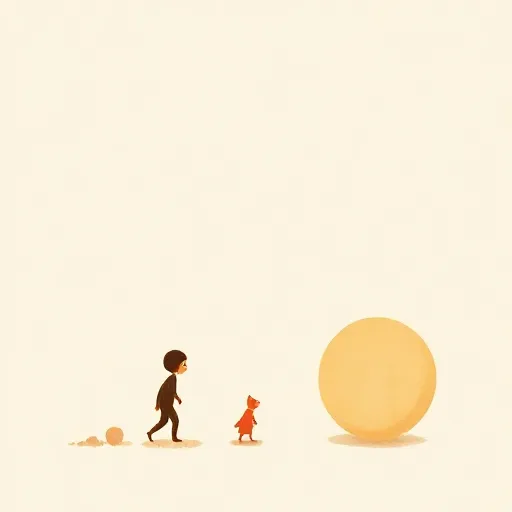
Imagine you could shrink. Smaller than a dust mite, smaller than an atom, hurtling down through the guts of matter. At the tiniest possible size — around a trillionth of a trillionth of a millimetre — space itself would look like churning foam, the fizz on a soda. Physicists call this threshold the Planck scale. It is where the two titans of modern physics, general relativity (the theory of gravity and huge things) and quantum theory (the theory of tiny particles), crash into each other. And they do not get along.
For a century, they have been like two neighbours who refuse to speak the same language. General relativity says the universe is a smooth, definite stage where planets follow precise curves. Quantum theory says everything is made of fuzzy probabilities, and you can’t know exactly where a particle is and how fast it’s moving at the same time. The search for quantum gravity — a single story that combines both — is one of the deepest adventures in human thought. It forces philosophers and physicists to ask: what are space and time really made of?
The Two Giants Refuse to Shake Hands
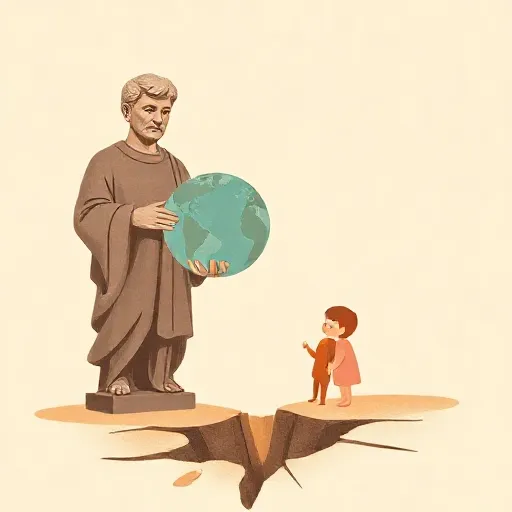
General relativity, finished by Albert Einstein in 1915, describes gravity not as a force but as the bending of spacetime. Mass tells space how to curve, and curve tells matter how to move. The equations use a metric, a set of numbers at every point that gives the distance to neighbouring points. Everything in the theory is classical: every location, every energy has a definite value, like the co-ordinates on a map.
Quantum field theory, the framework behind the forces that hold atoms together, is different. It lives by Heisenberg’s uncertainty principle: the more sharply you pin down a particle’s position, the fuzzier its momentum becomes. Physical quantities don’t have a single value; they smear into a cloud of probabilities. If you treat gravity with that same fuzzy logic, the metric itself would jitter and foam — a picture called spacetime foam. But quantum calculations need a fixed background stage to make sense. Filming a wobbly camera is hard if the camera itself is also wobbling. That is the knot at the heart of quantum gravity.
The philosopher Tian Cao (20th–21st century) calls this a serious tension between the ontologies of general relativity and quantum theory. General relativity needs a smooth neighbourhood around every point; quantum theory demands violent fluctuations. To build a new theory, we may have to smash some piece of the old ones.
Strings and Loops: Two Rival Recipes
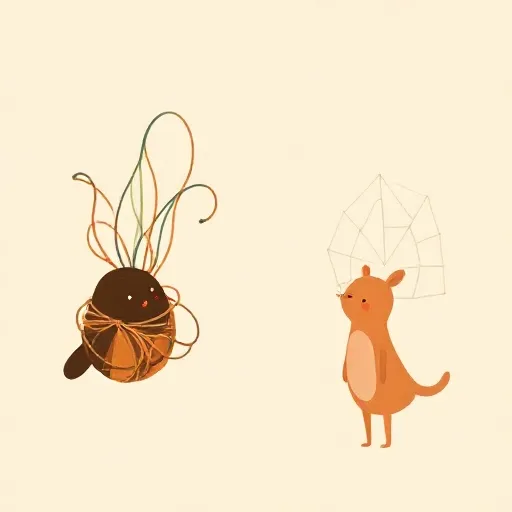
Physicists have chased two main ways to quiet the quarrel. The most famous is string theory. Instead of treating particles as point-like dots, it imagines them as tiny one-dimensional strings vibrating in many ways. One particular vibration behaves like a graviton, a hypothetical particle that would carry the gravitational force. String theory is mathematically elegant and automatically blends gravity with the other forces, but it demands that the universe has nine or ten spatial dimensions — the extra ones must be curled up too tightly to see. A further puzzle is the “landscape”: the theory seems to allow an enormous number of possible universes, about 10⁵⁰⁰ different versions, with no clear recipe to pick the one we live in.
The other big contender is loop quantum gravity, championed by physicists like Carlo Rovelli (1956–) and Lee Smolin (1955–). This approach does not add extra dimensions. Instead, it takes the fabric of spacetime itself and applies quantum rules directly to its geometry. Using a clever set of variables, the mathematics predicts that space is not smooth; area and volume come in the smallest possible chunks, like a digital photograph made of pixels. The idea is beautiful, but it is still struggling to show that an ordinary, continuous world emerges at large scales.
Both camps face a ghost that has haunted the field for decades: in their deepest equations, time seems to vanish.
When the Clock Stops Ticking
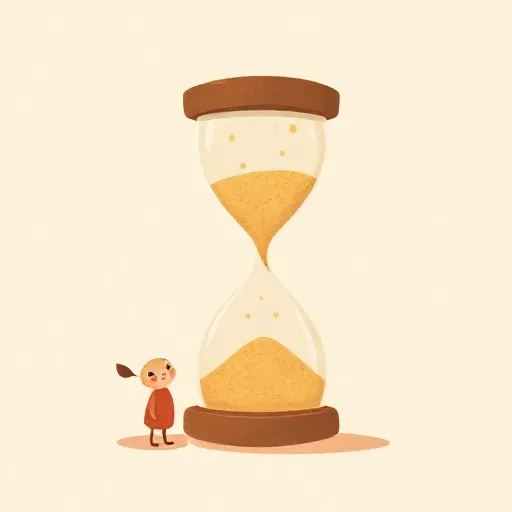
General relativity already treats time not as a universal stopwatch but as part of the woven fabric of space. When you try to quantize the whole geometry, the equation that usually describes change simplifies to something startling: Hψ = 0. At first glance it says that nothing moves, nothing evolves — the universe is just a frozen lump.
This is the problem of time. Physicists and philosophers debate what it means. Perhaps time is not fundamental; it may emerge only when we look at things coarsely, the way the temperature of a room emerges from the average dance of trillions of molecules. The physicist Julian Barbour (1937–) argues that time is an illusion altogether. Others, like Roger Penrose (1931–), suggest that gravity itself might collapse quantum fuzziness into single outcomes, giving a real, one-way flow to events. The problem cuts so deep that it forces us to reconsider what the word “now” even means.
Does Gravity Need to Be Quantum at All?
Not everyone agrees that gravity must be forced into a quantum mould. A quieter idea keeps gravity classical, like a calm ocean, while matter remains quantum, a school of jittery fish. These semiclassical theories couple the gravitational field to the average, fuzzy‑smoothed energy of quantum particles. But attempts to make such hybrids consistent have faced serious obstacles — thought experiments suggest they might allow faster‑than‑light signals or violate the uncertainty principle.
More radically, some researchers have argued that gravity is not a fundamental force at all. Instead, it may be an emergent phenomenon, like ripples on a pond that are really made of countless water molecules. In such views, the solid spacetime you walk through is just a low‑energy habit of deeper, non‑spatial ingredients. The question of whether gravity “must” be quantized remains open, a live philosophical and scientific puzzle.
The Floor Beneath Your Feet
Why does any of this matter to you, right now, sitting in your room? On an ordinary afternoon the floor feels solid, the clock ticks evenly, and tomorrow seems to follow today without a hitch. Quantum gravity hints that this familiar picture is a brilliant trick. The smooth space you trust might be a mosaic of discrete chunks; the passage of time might be a large‑scale illusion, like a film made of still frames that only looks like motion when you play it fast.
The quest to unite gravity and quantum physics is not just about black holes or the first moments of the Big Bang. It is about the skeleton of reality itself — what it is made of, how it changes, and whether cause and choice look the same when you peek behind the curtain. Philosophers and physicists are still arguing, still building toy universes, and still waiting for a glimpse of the Planckian fizz. You get to live in the century when the argument is happening.
Think about it
- If space and time turned out to be made of tiny, indivisible grains, would the world feel more like a video game than a smooth movie? What difference would that make to how you think about moving through it?
- Imagine a region of the universe where nothing ever changes. Can you prove that time passes there, or would time need something to happen before it exists? How could you test your answer?
- If a future theory showed that the whole history of the universe — including your own decisions — is already written into a timeless equation, would that change how you feel about making a hard choice today? Why or why not?