What If Space and Time Are Just Clever Stories We Tell Ourselves?
A Starlight Tug of War
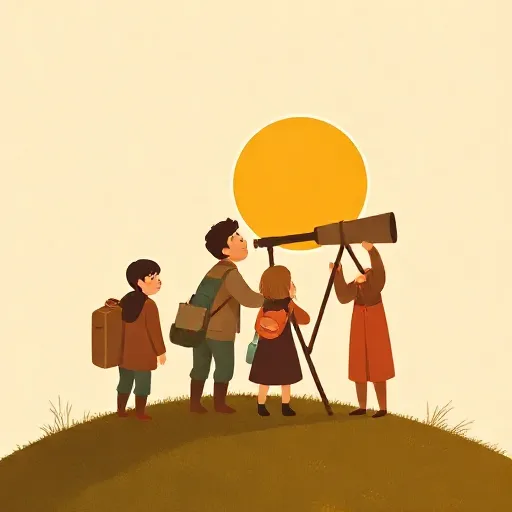
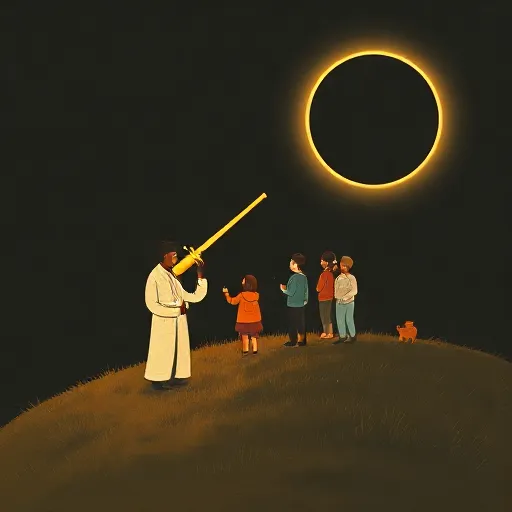
In May 1919, two teams of astronomers sailed to remote corners of the Earth — one to Brazil, the other to an island off West Africa. Their goal: to photograph stars during a total solar eclipse. If light from those stars bent just the right amount while passing the sun, it would confirm Albert Einstein’s wild new theory, general relativity.
The astronomers developed their photographic plates over the summer. When they measured the tiny shifts in starlight, they found a deflection of about 1.75 arcseconds — as small as the angle of a right triangle one inch high and nearly two miles long. But it was exactly what Einstein had predicted. The result made headline news across the world. Isaac Newton’s picture of a fixed, absolute space and time, which had ruled physics for over two centuries, suddenly crumbled.
General relativity replaced absolute space and time with a curved spacetime. You can think of spacetime as a stretchy fabric. A heavy object like the sun makes a dip, and other things move along the curves. Gravity isn’t a force pulling across empty space; it’s the shape of spacetime itself. This was a revolution in physics. But it also set off a fierce philosophical scramble. If space and time are not the fixed, rigid stage Newton imagined, then what on earth — or off it — are they?
Philosophers saw a golden chance to settle old scores and prove their favorite theories right. The 20th‑century British philosopher Bertrand Russell half‑joked: “There has been a tendency, not uncommon in the case of a new scientific theory, for every philosopher to interpret the work of Einstein in accordance with his own metaphysical system… It would be disappointing if so fundamental a change as Einstein has introduced involved no philosophical novelty.” And it did bring novelty — but not in the ways many expected.
Mach’s Dream: No Space Without Things
Long before Einstein, the Austrian physicist Ernst Mach (who wrote in the late 1800s) had a bone to pick with Newton. Newton said there is such a thing as absolute space — an invisible, unchanging container that exists even if nothing else does. That, Mach insisted, was nonsense. Try imagining a completely empty universe, he said. If there were just one rock, could you tell if it was spinning? Mach argued you couldn’t, because spin (or any motion) only makes sense relative to other objects. He dreamed of a physics where all motion and all inertia come from the influence of every mass on everything else. No absolute space: only masses acting on masses.
The young Einstein was deeply inspired by Mach. In building general relativity, he hoped to banish absolute space entirely. He even coined Mach’s principle, the idea that a body’s resistance to acceleration (its inertia) is caused by all the other matter in the universe. If general relativity could make that idea rigorous, spacetime itself would have no existence apart from the stuff in it. As Einstein put it, general covariance — the mathematical rule that the laws of physics stay the same no matter which coordinate labels you slap on spacetime — “takes away from space and time the last remnant of physical objectness.” Think of a video game: you can shift the grid of the map, yet everything that happens in the game stays the same. The grid is just a tool, not a real thing.
This sounded like a victory for positivism, the view that only observable facts and sensations are real, and that theoretical concepts like “space” are just handy shortcuts for talking about them. Some philosophers, like Josef Petzoldt, crowed that relativity “rests, in the end, on the perception of the coincidence of sensations.” Einstein’s own early remarks seemed to back that up.
But the story is trickier. Modern historians have pieced together the “hole argument” from Einstein’s private letters. It showed that if a theory is generally covariant, then bare spacetime points have no identity unless the field that tells you distances and times (the metric field) gives them one. That means empty spacetime isn’t a thing; only the field is real. It wasn’t an endorsement of Mach’s sensationalism, but Einstein’s words were easy to misread. Over time, Einstein grew uneasy with Mach’s philosophy and even called him “un déplorable philosophe” (a deplorable philosopher). The dream of making inertia completely relative also hit obstacles: some solutions to Einstein’s equations allow a universe with no matter at all, which Mach’s principle would forbid. Mach’s principle remains a fascinating and unsettled thread.
Kant Struck by Lightning?

The 18th‑century philosopher Immanuel Kant argued that space and time are forms of synthetic a priori knowledge — they are part of the mind’s machinery, not things in the world. Crucially, Kant believed that physical space must obey Euclidean geometry, because that’s the only kind of space our minds can make sense of in a deep way. When general relativity declared that the real geometry of space is non‑Euclidean (curved), many thinkers waved goodbye to Kant’s theory.
But not everyone. A group of neo‑Kantian philosophers, especially Ernst Cassirer (a philosopher of the early 1900s), insisted that the real heart of Kant’s view was untouched. Kant’s deeper insight, they said, was that space and time are “ideal principles of order” that the mind uses to organize raw sensations. Whether that order is Euclidean or Riemannian (curved) doesn’t matter; both are mathematical frameworks we impose. In fact, Cassirer argued, general covariance made this more obvious: spacetime coordinates are just labels for events, not descriptions of a thing out there. The theory had “de‑anthropomorphized” our concept of the physical object, turning it into a set of relations captured by mathematical invariants. So far from refuting Kant, general relativity “exhibits the most determinate application… of the standpoint of critical idealism.”
Other Kantians tried to save the doctrine by drawing a line between “intuitive” space (still Euclidean) and “physical” space (curved but only a model). But those strategies felt like dodging. The real philosophical action was in the argument that a priori principles need not be unchangeable. Hans Reichenbach, a philosopher working in the 1920s, first developed a “relativized a priori”: every physical theory has some built‑in coordinating principles that are neither pure logic nor raw observation, but they can shift when theories change. Relativity didn’t destroy the a priori; it showed it evolves. This idea would lead to a whole new way of thinking about scientific knowledge.
Choose Your Own Geometry

By the mid‑1920s, Reichenbach pushed this line of thought to a dramatic conclusion: the geometry of spacetime is a matter of convention, not a brute fact. His argument, later called metric conventionalism, goes like this. To measure distances in spacetime, you must pick some physical object as a measuring rod. You decide, by definition, that this rod is rigid. But forces — heat, magnetism, gravity — can warp rods differently. Some forces affect all materials in the same way and can’t be shielded off. Reichenbach called them universal forces. If there are universal forces, your rigid rod might actually be stretching or shrinking without you noticing. So you could always claim that spacetime is flat (Euclidean) by supposing that universal forces are distorting all measurements. Equally, you can say spacetime is curved and that there are no such forces. Both stories fit the observations perfectly.
This means, Reichenbach argued, that whether general relativity describes a curved universe or a flat one with funny forces is entirely up to our free choice of definitions. He thought the curved description without universal forces was “descriptively simpler,” and that’s why we prefer it — but truth has nothing to do with it. He even built a causal theory of time, reducing the whole spacetime edifice to causal chains, to show that geometry is not fundamental.
This view was enormously influential, but it didn’t go unchallenged. The mathematician Hermann Weyl pointed out that physics itself tells us what makes a good measuring instrument: not a naive rigid rod, but the behavior of tiny, freely falling test particles and light rays. The actual metric tensor of general relativity is determined by the dynamical interplay of matter and geometry, not by our arbitrary conventions. Many philosophers today think Reichenbach overstepped. Yet his question — how much of our scientific picture is us, and how much is the world? — remains a live one.
Can Geometry Eat All of Physics?
The success of explaining gravity as curved spacetime tempted many to go further: what if all physical forces could be poured into one giant geometric mold? Einstein, Weyl, Arthur Eddington, and others chased this dream of a geometrical unified field theory. Weyl’s “pure infinitesimal geometry” made length comparisons strictly local, and he identified the extra mathematical structure with the electromagnetic field. Eddington dreamed of a “world geometry” so abstract that even matter and vacuum become just different ways of reading the equations. In both approaches, physics seemed to dissolve into a magnificent mathematical architecture.
Einstein himself grew ever more convinced that “the creative principle resides in mathematics.” He spent decades trying to build a unified theory out of geometry alone, guided by aesthetic principles of simplicity and inevitability. He never succeeded. Yet this pursuit raised a profound possibility: maybe physical reality isn’t made of little hard stuff, but is purely structural — a relational network expressed by mathematical equations, with no “furniture” behind it. That view, today called structural realism, argues that all we can know (and all there is) is the web of relations, not hidden inner natures.
But here again, there’s a divide. Some structural realists are “epistemic”: they say we can only know the structure. Others are “ontic”: the structure is all that exists. And critics note that if we only know structure, we might be missing something crucial — something that makes the difference between a real universe and a mathematical ghost.
What’s Left of Space and Time?

You might think all this belongs to dusty history. But the questions are alive under your feet. The GPS in your phone calculates your position by timing signals from satellites. Because the satellites are higher up where gravity is weaker, their clocks run slightly faster than yours — a direct effect of curved spacetime. Without Einstein’s corrections, the system would drift off by kilometers in a day. So the reality of curved spacetime is baked into every map you use.
But what is that reality? Is spacetime a thing out there, or just a powerful story we tell to organize observations? Physicists still argue about whether spacetime is fundamental or whether it’s a kind of illusion emerging from deeper quantum layers. Philosophers continue to debate the line between convention and fact, between structure and substance. Every time you wonder if the world has a definite shape even when nobody’s looking, you’re stepping into the same conversation that started on that grassy hill in 1919 — and it shows no signs of ending.
Think about it
- If you could make a ruler that always changed length so that every shape looked flat to you, would the universe really be flat, or would you just have a tricky ruler?
- Suppose every single object in the universe vanished. Would space itself still exist? How could you tell?
- Does it matter whether a scientific theory is literally true or just extremely useful, if it predicts eclipses and lands a rover on Mars equally well?