
What If Numbers Are the Secret Recipe of the Universe?
Eurytus and the Pebble Horse

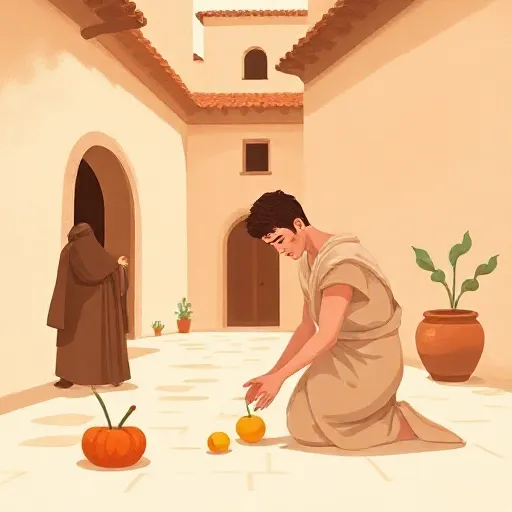
Around 420 BCE in southern Italy, a philosopher named Eurytus (c. 450–440 BCE) was doing something strange. He scattered white pebbles on the ground, arranging them into shapes. Not just any shape — he tried to make the shape of a horse. Then he counted the pebbles. Why? He believed that every kind of thing in the world, whether a man or a horse, was defined by a unique number of points. If he could find that number, he could understand the thing’s true nature.
Eurytus was a student of Philolaus (c. 470–385 BCE), the most important thinker in a group of philosophers we call the Pythagoreans (named after Pythagoras, who started their way of life a century earlier). Philolaus had a big idea: all things are known through number. Eurytus tried to show exactly how that works. By laying out points, he hoped to prove that a horse’s structure could be reduced to a definite number, different from the number for a human or an olive tree. Modern scholars used to laugh at this — a horse isn’t made of pebbles! But Theophrastus, a later philosopher who likely learned about Eurytus from the Pythagorean scientist Archytas, described the project with respect. Eurytus wasn’t saying a horse is literally pebbles; he was trying to show that every complex structure is held together by a mathematical skeleton.
Philolaus: The Ordered Cosmos
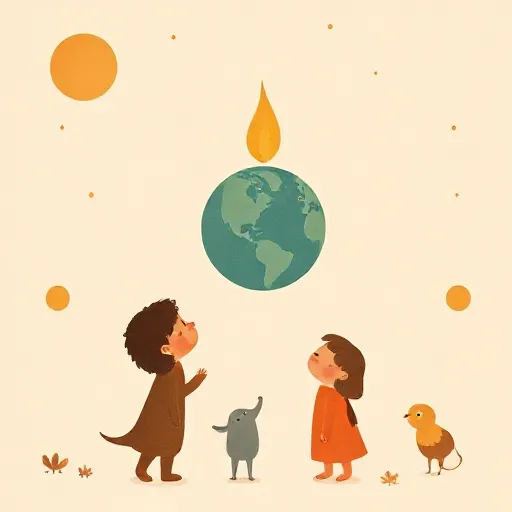
If Eurytus gave us the horse’s number, Philolaus gave us the whole universe’s number. He taught that everything is a blend of two kinds of ingredients: limiters and unlimiteds. Think of a cake. Flour and milk are unlimited stuff — without a recipe they’re just a mess. A recipe gives limits: a cup of flour, three eggs, and so on. For Philolaus, physical things are unlimited stuff (like fire, breath, or whatever matter is) that gets shaped by limiters. The secret that binds them together is harmony — a fitting- together, like the right proportions in music.
But here’s the crucial point: Philolaus never said things are numbers, or that things are literally made of numbers. In one fragment he says, “all things are known through number.” Number is the way we grasp the structure of reality, not the stuff reality is made of.
That didn’t stop him from giving number a starring role in astronomy. He pictured the cosmos with a blazing central fire at its heart — not the sun. Earth and the planets orbited this fire. Since the number ten was considered perfect (the sum of 1+2+3+4), there had to be exactly ten heavenly bodies. Even though we could only see nine — sun, moon, Earth, five planets, and the sphere of the fixed stars — Philolaus introduced an invisible counter-earth on the opposite side of the central fire to reach the perfect ten. We never see it because we’re always turned away from it. This kind of thinking shows the Pythagorean instinct: if the math demands it, reality must adjust.
The Great Number Debate: Numbers or Things?
A generation later, Aristotle (384–322 BCE) described the Pythagoreans very differently. In his Metaphysics, he wrote that they said things are numbers, or are made out of numbers. He even claimed they thought numbers were physical entities — the number one was a physical thing, and from it, the whole cosmos grew. He complained that they were so in love with numerical order that they invented the counter-earth just to get a perfect ten.
This is puzzling. Philolaus’ own words don’t match. So what’s going on? Many scholars think Aristotle was interpreting — he read Philolaus’ claim that “all things are known through number” and concluded that Pythagoreans must mean things are numbers. In another passage, Aristotle himself hesitates, saying the Pythagoreans apply mathematical theories to bodies “as if” the bodies consisted of those numbers. That “as if” shows he was drawing a conclusion, not quoting anyone.
Others argue that Philolaus really did think the number one was both a mathematical unit and the first physical thing. The debate is still open. What’s clear is that the puzzle Aristotle identified — is math just a tool for describing the world, or is the world itself made of math? — has never gone away.
Two Kinds of Pythagoreans: Rule-Followers and Math-Lovers
Even in the fifth century BCE, not all Pythagoreans agreed on what was most important. A split appeared between two groups. The acusmatici — from the Greek word for “things heard” — focused on the oral instructions and taboos handed down by Pythagoras. They lived by a set of rules called symbola, or acusmata: don’t eat beans, don’t step over a balance, don’t stir fire with a knife. They claimed to be the true Pythagoreans.
The mathêmatici — from “learning” or “mathematics” — insisted that the deeper truth lay in studying math and the natural world. They acknowledged that the acusmatici were Pythagoreans of a sort, but argued that the real teaching was meant for those who had time to learn the proofs behind the rules. One of the earliest figures on the mathêmatic side was Hippasus (early 5th century BCE). He is said to have performed a clever experiment: he made four bronze disks of equal diameter but different thicknesses, in the ratios 2:1, 3:2, and 4:3. Striking them produced the musical intervals of an octave, a fifth, and a fourth. This showed that musical harmony followed whole-number ratios — an exciting link between math and the physical world.
Yet the school could be harsh to its own. A later story, reported by Iamblichus, says Hippasus was drowned at sea as punishment for revealing the secret of the dodecahedron — a twelve-sided solid that may have been a cult object for the Pythagoreans. Whether true or not, the tale captures the tension between secret rule-following and public knowledge.
The Number Recipe Still Cooks
Jump forward two thousand years. The German astronomer Johannes Kepler (1571–1630) was obsessed with fitting the orbits of the planets into a pattern of the five regular solids — shapes beloved by the Pythagoreans and Plato. Later, when he discovered that planets move in ellipses rather than circles, he still looked for musical ratios in their speeds. He heard a heavenly harmony — not a sound heard with ears, but a mathematical order perceived by reason. Kepler called for the shade of Pythagoras to help him, joking that maybe Pythagoras’ soul had migrated into his own.
The Pythagorean idea that mathematics is the language of nature didn’t end with Kepler. Today we use equations to describe everything from the arc of a basketball to the birth of a galaxy. Physicists often say the universe seems to be written in mathematics. That’s a deeply Pythagorean thought. Even the split between the acusmatici and the mathêmatici has echoes in modern life: some of us want clear rules for living; others want to chase the hidden patterns behind the rules. The debate about whether math describes reality or is reality keeps humming.
Think about it
- If a horse’s shape depends on a certain number of points, could you ever change the number and still have a horse?
- Is a rainbow more “real” when you describe it with a mathematical formula, or when you just see the colors?
- Why might someone feel safer following a set of rules without asking for reasons — and is that enough for a good life?