Is Morality Something We Discover—or Something We Invent?
A Candy Bar, a Diamond, and a Dollar

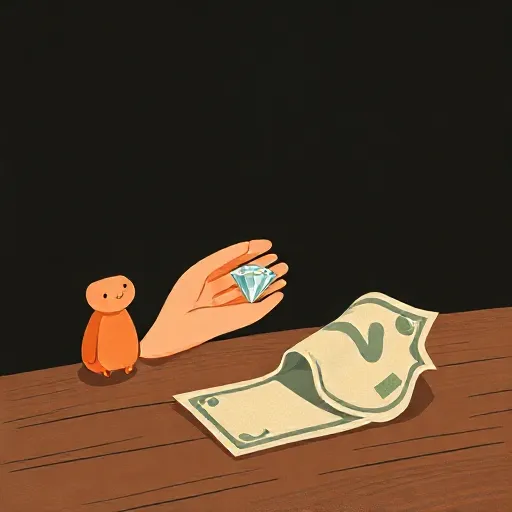
You catch someone sneaking a candy bar into their pocket without paying. Instantly you think, That is wrong. But what makes it wrong? Does the act of stealing contain some invisible property, like the carbon that makes a diamond hard? Or is calling it “wrong” more like saying a dollar is worth a dollar — something that’s true only because we all agree?
Philosophers who think moral wrongness is a real, objective feature of the world, existing independently of human minds, are called moral realists. Those who deny that are moral anti-realists. But anti-realism isn’t one view. It splits into three families, each with a different story about what is going on when we make moral judgments. That story — about whether morality is discovered or invented — touches every argument you’ve ever had about fairness, lying, or helping a friend.
When Words Aren’t Facts: Noncognitivism
The British philosopher A. J. Ayer (1910–1989) offered a startling idea. When someone says “Stealing is wrong,” they are not stating a fact that could be true or false. Instead, they are simply expressing a feeling — the way you might wrinkle your nose and hiss “Eww, stealing!” The sentence looks like a normal claim, but really it’s just a noise of disapproval. This view is noncognitivism: moral judgments don’t aim at truth at all.
Ayer was inspired partly by a puzzle. If “wrongness” were a property of actions, what kind of property would it be? You can’t see it under a microscope or measure it with a ruler. Noncognitivists avoid that puzzle by denying there is any such property. Moral disagreements, they add, are often loud and impossible to settle — which fits the idea that what’s clashing are emotional attitudes, not rival beliefs.
However, noncognitivism faces a big problem known as the Frege-Geach challenge. If moral sentences aren’t even the kind of thing that can be true or false, how can we use them in logical reasoning? For instance: “If stealing is wrong, then asking your brother to steal is wrong.” This if–then structure seems to require that “Stealing is wrong” has a truth value. Noncognitivists have spent decades trying to explain how emotional expressions can behave like statements in these cases. One modern response, called quasi-realism, argues that even though moral talk starts as expression, we can legitimately treat it as if it were about facts — saying things like “It’s true that stealing is wrong” — without committing ourselves to spooky moral properties.
The Big Mistake: Error Theory
Imagine someone who believes unicorns are real. When they say “A unicorn lives in my garden,” they are making a claim that aims at truth. According to most people, though, that claim is false because unicorns don’t exist. Error theory thinks moral talk is like that. We intend to say something true, but the world contains none of the special properties — moral wrongness, goodness, evil — needed to make any moral statement true.
The most famous error theorist, J. L. Mackie (1917–1981), argued that moral judgments commit us to the existence of “objectively prescriptive” facts — facts that would somehow demand us to act in certain ways regardless of our own wants. To Mackie, that demand looked “queer” (in the sense of strange and out of place). Nothing in the natural world suggests that rules of conduct are woven into the fabric of the universe.
Moral error theorists don’t necessarily want us to stop using moral language. Some are fictionalists: they propose we keep saying “Stealing is wrong” the way we might tell a story about unicorns — without believing in any real unicorn-properties. Others think we’d be better off dropping moral talk almost entirely. Either way, error theorists must defend two claims: first, that moral language genuinely commits us to something strange; second, that the world contains no such thing. Critics often challenge the first step, arguing that morality never actually required anything so weird.
Morality Made by Minds: Non-Objectivism

What if moral facts do exist, but they aren’t “out there” like diamonds — they depend on us? Non-objectivism holds this middle ground. The fact that a diamond is made of carbon doesn’t care what anyone thinks; it’s an objective fact. The fact that the same diamond is worth a thousand dollars, however, depends on what people are willing to pay. Non-objectivists say moral facts are more like the price tag than the carbon. They exist, but they’re mind-dependent.
This view easily explains why morality feels important and action-guiding: if moral demands spring from our own desires, emotions, or agreements, of course they matter to us. It also avoids the puzzle of how spooky objective moral rules could exist. But non-objectivists face a dilemma.
On one side, they might try to ground morality in the responses of some ideal judge — a perfectly informed, impartial observer. The trouble is explaining why I should care about what this hypothetical stranger would think. My action of stealing a newspaper might have a dozen dispositional properties — it would be cheered by Vikings, disapproved of by an ideal observer — and simply labeling one “wrong” doesn’t yet give me a reason to care.
On the other side, non-objectivists might tie moral facts to each person’s own attitudes (or those of their idealized self). This makes morality feel directly relevant but introduces relativism: what’s right for me might be wrong for you, with no way to settle the dispute. Many worry that relativism makes genuine moral disagreement and moral progress impossible.
Why This Fight Still Matters to You

You’ve almost certainly been in a moment where you and a friend could not agree about whether something was fair. If morality is objective, you’re both trying to detect the same real fact — like two scientists measuring temperature. This hope keeps many people drawn to realism: the idea that some actions really are wrong, full stop.
But if anti-realism is right, it doesn’t mean anything goes. Non-objectivists still think we can build better moral systems; error theorists can still oppose cruelty with all their care, just without calling it a “fact” about the universe. The debate is about what kind of thing morality is, not whether cruelty is fine. And understanding that debate leaves you better equipped to think clearly the next time you feel the sharp tug of a moral judgment — whether you end up calling it a discovery or a creation.
Think about it
- If a scientist could prove that no one has ever detected a moral property in any action, would it change how you make decisions about right and wrong? Why or why not?
- Imagine two people from very different cultures both insist their moral view is “the truth.” Can they both be right? What would settle the disagreement if there’s no objective referee?
- If moral facts depend on human minds, could a whole society ever be collectively wrong about something like slavery? What would that say about moral progress?