

Is Your Memory a Filing Cabinet or a Storyteller?
The Girl Who Knew Paris but Forgot Why

Lily is completely sure that Paris is the capital of France. She remembers learning it back in third grade. But when a friend asks how she knows, she goes blank. She can’t remember her teacher’s name, the geography lesson, or even the classroom. She just knows it, and that feeling seems strong and reliable.
Philosophers call this kind of support justification — good reasons for believing something. For most of us, a belief with justification is better than a lucky guess. Memory clearly helps supply justification, but cases like Lily’s stir up a big puzzle. If you have forgotten your original reasons, why is your belief still reasonable? The debate that follows splits the philosophical map in two.
Preservationists: The Filing Clerk Model
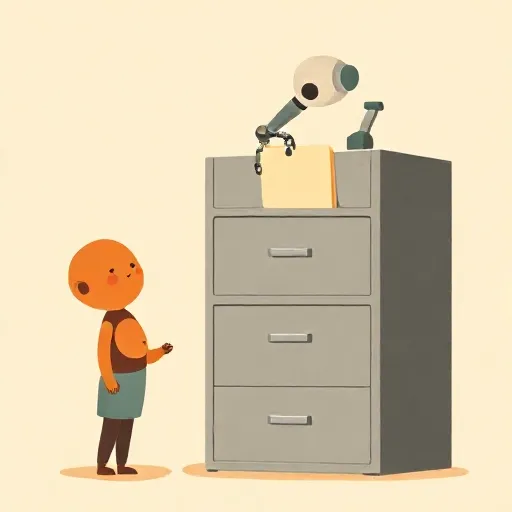
One side, the preservationists, argues that memory is limited — it can only keep justification safe. Memory itself never creates fresh reasons to believe. It just passes along the justification that a belief already had when it first entered your mind. Think of it like a trustworthy librarian who never writes new books, but makes sure the old ones don’t get lost.
The philosopher Alvin Goldman (20th–21st century) built a famous theory called process reliabilism. Very roughly, it says a belief is justified if it comes from a reliable mental process. Memory, Goldman noted, tends to preserve true beliefs rather than manufacture false ones. So if Lily’s original learning was justified, and her memory has reliably kept that belief, the belief is still justified now — even if she has forgotten the geography lesson entirely.
A related view, epistemic conservatism, goes a step further. Matthew McGrath (21st century) and others have argued that simply believing something in the past gives you a weak but real reason to keep believing it, unless you have a specific reason to drop it. On this picture, a stored belief carries its past justification forward like a battery that holds its charge over time.
Generativists: The Artist’s Sketchbook Model

The rival camp, generativists, says memory can actually generate new justification. The act of remembering isn’t always just fetching a file. Sometimes it builds something that wasn’t there before, and that new construction can itself be a good reason to believe.
Think about a time you noticed a detail only later. A philosopher might argue that when a previously unnoticed piece of information suddenly becomes clear in your mind — say, you realize the thief in the movie wore a red scarf, even though you didn’t consciously notice it while watching — memory is giving you a fresh justified belief, not merely replaying an old one.
Kourken Michaelian (21st century) and others point to a key fact from psychology: constructive memory is the norm, not a glitch. Episodic memory, your memory for events, doesn’t work like a video recorder. It actively reassembles bits and pieces of the past, sometimes filling in gaps. Yet that doesn’t automatically make it untrustworthy. A constructed memory can be reliable, and its very vividness can provide a kind of immediate justification, like a strong mental impression that things were a certain way.
Generativists often appeal to seeming recollection — that sense of “I remember it happening like this.” They argue that this feeling alone gives you a basic, prima facie justification to believe, unless you have a reason to doubt it. So in Lily’s case, the simple experience of recollection could be what justifies her belief about Paris, even if the original lesson is long gone. Memory, on this view, isn’t just storing; it’s actively authorizing.
Does the Past Matter, or Just Right Now?

Underneath this fight is an even knottier question: does the history of your belief matter for its justification now? A time-slice theory says only how things are at this very moment matters. Your current mental life — what you’re aware of, what you’re disposed to remember — settles whether your beliefs are justified. A historical theory says the past can directly count, too. How you originally got a belief and what happened to it over time can make a real difference.
Imagine two people, Vic and Ric, who are mentally identical right now. They have all the same beliefs, memories, and feelings. Vic, however, was just created by an evil demon five seconds ago, complete with a full set of fake memories. Ric, on the other hand, has a genuine past that matches his memories. A time-slice theory says their beliefs are equally justified. A historical theory can say, “Not so fast — Ric’s belief has a better history, so his justification is stronger.” This creates a real tension: many philosophers feel pulled toward historical theories because they solve problems like forgotten evidence naturally, yet also find time-slice arguments hard to shake when thinking about Vic and Ric.
The preservationism-generativism debate often lines up here. Many externalist, historically minded views (like reliabilism) are friendly to preservationism. But some generativists are internalists who embrace time-slice views — they think the mind’s current resources can generate fresh justification all on their own.
The World That Began Five Minutes Ago

The philosopher Bertrand Russell (1872–1970) pushed memory skepticism to its limits with a famous thought. He imagined that the entire universe, and you along with it, might have sprung into existence just five minutes ago. You’d have all your current memories — of childhood, of yesterday’s lunch, of learning the capital of France — but none of it ever really happened. The apparent past is completely fake.
If that scenario is possible, can memory ever give you good reason to believe anything about the past? One reply is that memory is conditionally reliable: it tends to get things right when the beliefs it starts with are true. So if real events did feed those beliefs, memory preserves the truth. But to check whether that condition holds, you’d have to step outside your own memory, and it’s not clear you can. The skeptical worry has no knock-down solution, but it forces us to think carefully about what we’re really relying on when we trust our recollections.
Why This Matters: Your Memory on Trial

You might never need to settle Russell’s five-minute puzzle. But the everyday version of the debate shows up constantly. Eyewitnesses in court can be confident and yet mistaken, in part because memory is constructive. Psychologists have found that a witness can hear a misleading question and later “remember” a stop sign that was actually a yield sign. Yet sometimes constructive memory also helps us see patterns we’d otherwise miss, giving us knowledge we wouldn’t have had.
The philosophy behind all this doesn’t give you a simple rulebook. Instead, it hands you two important habits. First, memory isn’t a perfect recording, but it isn’t worthless either — being aware of its constructive nature makes you a more careful thinker. Second, when you find yourself absolutely certain about something from the past, ask: is that certainty coming from the remembering itself, or from the original event? The answer, the arguments above suggest, is neither simple nor obvious. And wrestling with that uncertainty is exactly what makes you think like a philosopher.
Think about it
- If you and your best friend remember the same event differently, and you have no photos or other records, how could you figure out whose memory is more trustworthy?
- Could a memory that you know was partly shaped by your imagination — like a dream you’ve retold many times — still count as genuine knowledge?
- Imagine you discover that all your memories from before this morning were artificially implanted yesterday. Would you still know your own name and life story?